

Spirituality
Feminist
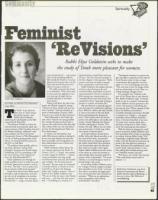
Rabbi Elyse Goldstein seeks to make
the study of Torah more pleasant for women.
Rabbi Elyse Goldstein
ESTHER ALLWEISS TSCHIRHART
Copy Editor
T
he Torah "is my spiritual
diary even if I don't always
like all the entries," said
Rabbi Elyse Goldstein,
explaining her philosophy at the 48th
annual Jewish Book Fair.
The director of Kolel, a Center for
Liberal Jewish Learning (the adult edu-
cation institute of the Canadian Council
for Reform Judaism), addressed a day-
time audience of 250 at the Jewish
Community Center in West Bloomfield
on Nov. 9 before giving another lively
talk to 75 evening book fair patrons at
the JCC in Oak Park.
The audience there quickly sold out
her book, ReVisions: Seeing Torah
Through a Feminist Lens (Jewish Lights
Publishing, $19.95), prompting a call
for more volumes to be rushed over
from the West Bloomfield JCC.
Rabbi Goldstein's aim through her
book and life's work is to make the study
of Torah "pleasant for women as well as
for men." She said: "I love a system that
has not always vitally loved me back."
People have learned their Bible stories
through a male interpretation and cho-
sen one set of metaphors over another,
she asserted, but when "seen through a
feminist lens — using a woman's experi-
ence and sensitivity" — the stories
may reveal something different.
She rereads the Torah to "uncover,
discover and recover what is at the
heart and soul of that piece and
what it trying to teach us."
The rabbi compared the Torah
to an artichoke, "with a heart that
is sweet and even egalitarian, but
you must get through the pur-
poseful male bias in the bitter
outer leaves.
Taking a leaf from the John Gray
books, she elicited a laugh by stating,
"Women are from Genesis and men are
from Leviticus." Girls see morality as a
series of relationships (Genesis), while
boys see it as a series of rules (Leviticus).
That's illustrated in the Torah, she
said, when "Aaron's two sons get killed
by a strange fire because they broke a
rule; no one really knows what they did.
Also, Moses broke one rule and doesn't
get into the Promised Land. Rules win
over relationships."
In Genesis, our foremothers may
strike 20th-century readers as having lit-
tle say over their destiny, she said, but
they successfully used manipulation in
their relationships as one of their only
routes to power.
Rabbi Goldstein talked about the
two creation stories in the Torah. In
Genesis 1:26-27, a "being" was created
in God's image (in Hebrew — adam),
male and female were they made.
God blessed them and said, Be fruitful
and multiply." In the better-known
"rib story," the one most of us learned
in Sunday school, in Genesis 2:18-23,
God takes a rib from the sleeping
Adam and "builds a woman," who we
know as Eve. Rabbi Goldstein said,
"We act as if the rib story is the Torah's
only way — and thus the only correct
way — of looking at a woman as a
spiritual being, created from and part
of man." But the essential message of
the first chapter is the opposite: "Both
woman and man are born as equals
from a genderless and fertile God."
Rabbi Goldstein also applies feminist
revision to laws having to do with
women's bodies, particularly surround-
ing menstruation. For her, a mother of
three young sons, menstruation is a
"monthly Post-It note from God" that
reminds her of her "potential of being a
partner in creation of another life."
She sees blood as a spiritual opportu-
nity, but said we've inherited a loathing
for it. Blood is a taboo, she said, because
it "puts us too close to life and death
forces and perhaps that threatened
men." Each month when she has her
period, the rabbi lights a red candle and
recites a bracha (blessing) that thanks
God for making her a woman. This
bracha, she said, "affirms my own holi-
ness and sanctity in God's eyes within
the context of menstruation."
In Jewish tradition, female blood
defiles while male blood sanctifies, as in
the ritual of brit mila, circumcision.
Feminists need not abandon going to
the mikva (ritual bath) after menstrua-
tion because they reject the idea that
they need to be made "clean" again.
Rather, Rabbi Goldstein sees the waters
of the mikva as a place for women to
acknowledge their sensuality and feel a
positive sense of physicality The water
rebirths us as sexual beings as much as
Jewish beings," she writes.
In her book, Rabbi Goldstein uncov-
ers "vestiges of female imagery and god-
dess symbolism in the Torah," and pon-
ders what it was about the pagan prac-
tices mentioned there that attracted our
ancestors. "What can we appropriate
about the goddess while staying
monotheistic?" she asked.
Theological maturity is a system one
goes through in expansion of the idea of
God. Because today we have a larger
consciousness about gender, we must
apply it to our God language, she said.
"The core issue is how we image (God)
and our relationship to God. How we
change language changes ritual."
For example: the V'ahavta is the
part of the Shema that is said silently.
But, Rabbi Goldstein said, "It doesn't
speak to me as a woman" because she
knows Hebrew and its grammar is for
a man. The prayer is something she
just says by rote. When a group of rab-
bis at the Reform movement's
Canadian biennial convention decided
to rewrite it as V'ahavt — the gram-
matically correct Hebrew feminine
form, it became beautiful to her ears.
"It made every woman there feel a
spiritual connection to God. I had
never felt anything like that before."
With her desire to change the world
person by person, Rabbi Goldstein said
she's sometimes felt as if she was pushing
an iceberg. Having Rabbi Irving "Yitz"
Greenberg, a respected male Orthodox
rabbi, write the forward to her book was
proof to her that she's not pushing it
alone. Because of his endorsement, mak-
ing her book "safe and kosher," it has
been selling like hotcakes among mod-
em Orthodox women, she said.
"ReVision is not trivial," she asserted.
"This could bring women back to
Judaism."
Rabbi Elyse Goldstein's next book,
Feminist Commentaries by Women
Rabbis (Jewish Lights Publishing), is
due out in June. Her Web site is
www.kolel.org
PA
zak
1.;
•