
Spiraling Into
Co ntrol
Fiber artist Ferne Jacobs
and jewelry artist
Andrew Cooperman
share a similar theme
but different approaches
in the creation of their
respective works of art.
SUZANNE CHESSLER
Special to the Jewish News
S
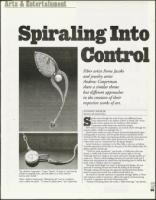
Top: Andrew Cooperman: "Loupe," brooch. `YI loupe is a tool used by
jewelers to magnify items, and tools allow us to access interiors
and see other worlds."
Above: Andrew Cooperman's 'Mainspring #2," one in a neckpiece
series, utilizes the spiral. "It's almost a perfect form," says Cooperman.
pirals move through the work of two very different Jewish
artists represented at the Sybaris Gallery in Royal Oak. Ferne
Jacobs weaves spirals into her basketry, while Andrew
Cooperman molds them into metals for jewelry.
Both look to the past for inspiration, an attitude shown through the
current exhibit, which runs through Dec. 4.
Jacobs' latest works are made of many interconnecting spirals repre-
senting paths or journeys, and the spirals become reminiscent of the
rhythms of life, the larger encompassing rhythms and the more personal
ones. Cooperman's metals often spiral protectively around the stones
within them and set a framework for the deeper designs.
Jacobs' basketry, a trendsetter in the fiber field, is not new to Sybaris.
An earlier generation of her fiber art was part of the first exhibit when the
gallery opened a decade ago.
"I find my work mysterious," says Jacobs, a Californian who uses
thread, a needle and scissors and forms her pieces right in her lap.
"Although there's an image in my mind, each piece changes quietly as I
work on it. There's a silent dialogue between me and the work, and I
believe that the greatest art comes from not knowing how it will be fin-
ished. Each is timeless when it's a mystery."
Although Jacobs began her career in painting and design, she was
attracted to weaving because she loved the feeling of the material.
Through coiling and twining, her approach dramatized three-dimen-
sional concepts and turned into nonfunctional basket art.
An interest in Jewish mysticism is expressed through Sefirot, a 4-foot
wall sculpture made of numerous, ribbon-like spirals interconnecting
10 circles. It represents the levels of knowing God.
"Instead of thinking about the works, I make drawings," says Jacobs,
83
Scanned image of the page. Keyboard directions: use + to zoom in, - to zoom out, arrow keys to pan inside the viewer.
November 19, 1999 - Image 119
- Resource type:
- Text
- Publication:
- The Detroit Jewish News, 1999-11-19
Disclaimer: Computer generated plain text may have errors. Read more about this.