
HOLLYWOOD
from page 75
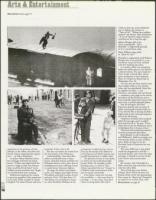
Clockwise from top: Lionel Abelanski
stars as Shlomo the Dreamer in
"Train of Life." "Shlomo has a sublime
madness" says director Radu Mihaileanu.
"To me, he represents tragic innocence,
something we lost a long time ago."
Roberto Benigni, left, in his
Oscar-winning film, "Life is
Beautiful," a tragicomedy partially
set in a concentration camp.
Robin Williams plays Jakob
in "Jakob the Liar"
Beautiful, a tragicomedy with Roberto
sometimes in the presence of Nazi
officials, as the oldest, and often sole,
Jewish weapon targeting their oppres-
sors — as well as themselves. -
As author Henry Bulawko asks in
his anthology of Jewish and Israeli
humor, "If Jews were deprived of the
power to laugh at their own distress,
what would be left of them?" and a
Yiddish proverb proclaims that "laugh-
ter is heard farther than weeping."
Hollywood employed the weapon
to puncture grandiose Nazi pretensions
in the early 1940s, notably in Charlie
Chaplin's The Great Dictator and Ernst
11/19
1999
78
Lubitsch's To Be or Not to Be.
But that was before the world knew
the true depths of the Holocaust.
Understandably, it has taken film-
makers considerable time to inject
humor, absurdity, fantasy and fable into
Holocaust themes, and to show Jews as
something more than suffering victims,
or, rarely, heroic Resistance fighters.
On stage, the taboos were broken
earlier. Los Angeles playwright Shimon
Wincelberg used both mordant humor
and piety in his 1962 play Resort 76
The drama even introduced a charac-
ter, who, like Robin Williams as the
protagonist in Jakob the Liar, tries to
keep up the morale of his fellows by
inventing news of Allied victories, sup-
posedly gleaned from a hidden radio.
The pervasive humor is even darker
in Ghetto, by the Israeli playwright
Joshua Sobol. He includes a mind-
bending scene, in which a Vilna
Ghetto ensemble belts out "Swanee" in
Yiddish for the entertainment of the
jazz-loving SS commander.
It has taken a long time to bring
this sensibility — some may deem it
sacrilege — to the screen. Last year's
Oscar-winning Italian film Life Is
Benigni that is set partially in a con-
centration camp, has been credited
with first breaking the taboo.
In actuality, Jakob was completed
before the Italian picture, but held for
a delayed release. The same holds for
Train of Life, a French film, which
opens exclusively at the Landmark
Main Art Theatre in Royal Oak on
Wednesday, Nov. 24.
The fact that the three movies were
shot roughly within a year of each
other may be coincidental. More like-
ly, together the films — one
American, one Italian and one French
— represent a new stage in the artistic
perception of the Holocaust, just as
some scientific discoveries occur at the
same time in widely separated places.
Not all will agree, but Peter
Kassovitz, director and co-writer of
Jakob, and himself a Jewish child sur-
vivor, sees his film as having reached a
higher level in the evolving interpreta-
tion of the Holocaust.
"Audiences wouldn't have accepted
Jakob 20 years ago, and I wouldn't
have dared touch it," he says. "It has
taken time to see the Holocaust not in
mythological but in human terms."
There are both similarities and dis-
tinctions among the three films.
Both Benigni in Life Is Beautiful
and Williams in Jakob are average men
who become heroes in spite of them-
selves. Both are fated to see the
Promised Land of liberation but not
to reach it.
The main difference is that Jakob
could have happened in real life —
and Jurek Becker, who wrote the origi-
nal book, is himself a survivor of the
Lodz Ghetto and concentration
camps.
By contrast, Life Is Beautiful is a
fable, sensitively and sometimes wittily
told, but still a fable.
Train of Life goes even farther,
telling a tale in which the Jews of a
Russian shtetl outwit the approaching
Nazi troops by "deporting" themselves
en masse on an ancient train, with
HOLLYWOOD on page 81
Scanned image of the page. Keyboard directions: use + to zoom in, - to zoom out, arrow keys to pan inside the viewer.
November 19, 1999 - Image 114
- Resource type:
- Text
- Publication:
- The Detroit Jewish News, 1999-11-19
Disclaimer: Computer generated plain text may have errors. Read more about this.