
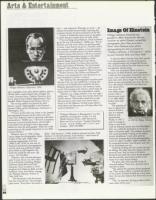

Philippe Halsman, self-portrait, 1950.
hide — and sometimes, fleetingly, to reveal — the
mystery of another human being. Capturing this
revelation became the goal and passion of my life."
A series of revelations comes across in the exhib-
it, which features notables from all walks of life.
"The nice thing about Halsman is that he doesn't
get in the way of his subjects," Mellby says. "But he
did have one little trick, which was getting people
to jump. It got them to let go for a moment, and in
that moment, he could capture a truer personality.
Everyone has a formal persona, but when someone
is asked to jump, that persona is left for an instant."
Among the impromptu jumpers in the exhibit
are Richard Nixon, Audrey Hepburn, Jackie
Gleason, Judge Learned Hand, Lena Home,
Liberace, Grace Kelly, Eva Marie Saint and the
Duke and Duchess of Windsor. The Ford family
"jumped" when Halsman made an official photo-
graph to mark the auto company's 50th anniversary.
Herbert Hoover, Van Cliburn and Edward R.
Murrow were among the few who declined to sus-
pend themselves in air for a moment.
After Halsman first photographed surrealist artist
Salvador Dali, the two established a working rela-
tionship and friendship that would last 30 years.
Halsman planned his photo Dali Atomicus, based
on the Dali painting Leda Atomica, which made all
objects seem as if they were suspended in midair.
"Halsman was a huge celebrity in his own right,"
Mellby says. "There's a great deal written about him
and his sessions. Writers often asked him to take
their pictures so they could write about what it
meant to sit for Halsman. He had a great deal of
social talent, and that was part of living within that
world of celebrities." T1
show spotlights many other Jewish subjects, such as
Woody Allen, Lauren Bacall, Marc Chagall, Sid
Caesar, Groucho Marx, Vladimir Horowitz, Jerry
Lewis, Danny Kaye, Robert Oppenheimer, Tony
Randall, Barbra Streisand and Sammy Davis Jr.
The touring exhibit was planned by Mary
Panzer, curator of photographs at the National
Portrait Gallery of the Smithsonian Institution in
Washington, D.C.
"Viewers of this show can relate to the [people
"Philippe Halsman: A Retrospective" is a free
photographed] because of the talent and tech-
exhibition running Nov. 14-Jan. 9 at the
nique that Halsman used in capturing individual
Toledo
Museum of Art, 2445 Monroe St.
personalities," Mellby says. "He had a scrupulous
Hours
are
10 a.m.-4 p.m. Tuesdays-Saturdays,
precision and interesting details, and he had a
10
a.m.-
10
p.m. Fridays and 11 a.m.-5 p.m.
real [ability] for getting to know the people
Sundays.
(419)
225-8000.
before he took the photographs. What he's really
presenting are the people important to our 20th-
century history. "
Below: "Dali Atomicus" (1948): Halsman planned his photo "Dali
Halsman, born in 1906 in Riga,
Latvia, began his photographic career Atomicus" on the Dali painting "Leda Atomica," which made all
objects seem as if they were suspended in midair.
in Paris in the early 1930s, after
studying engineering. From the
1940s to the 1970s, he was one of
America's preeminent photographers,
and his work was published widely,
particularly in Life magazine. He
holds the record for the most Life
covers, 101 all-tolled.
Halsman, who married photogra-
pher Yvonne Moser, was the author
of several books, including Philippe
Halsman's Jump Book and Dali's
Mustache. Since his death in 1979,
daughter Jane Halsman Bello and her
husband, writer Steve Bello, manage
the Philippe Halsman Archive in
New York City.
This fascination with the human
face has never left me," the photogra-
pher wrote. "Every face I see seems to
Image Of
Philippe Halsman remained ever
grateful to Albert Einstein for the
occasions on which Einstein rescued t
photographer from Nazi persecutors.
Here's what Halsman wrote about
photographing his hero as printed in
"Philippe Halsman: A .Retrospective, ) e
by Jane Halsman Bello and Steve Bello
"I admired Albert Einstein more tha
I ever photographed, not only as the gem
who singlehandedly had changed the foun
tion of modern physics but even more as a ra
and idealistic human being.
"After my miraculous rescue, I went to
Princeton to thank Einstein, and I remembe..
vividly my first impression. Instead of a frail s
entist, I saw a deep-chested man with a res(v4:'
nant voice and a hearty laugh. The long hair,
which in some photographs gave hirn the loo
of an old woman, framed his marve19usface ,
with a kind of leo-
nine mane. He
wore slacks, a gray
sweater with a
fountain pen stuck
in its collar, black
leather shoes and
no socks.
"The question of g
how to capture the u2
I.
essence of such a
man in a portrait
filled me with
apprehension.
Albert Einste
Finally, in 1947, I
in 194
had the courage to
bring on one of my
visits my Halsman camera and a fe
After tea, I asked for permission to .
lights in Einstein's study. The profess
and started peacefully working on his
matical calculations. I took a few'
Ordinarily, Einstein did not like
whom he called "Lictaffen" (li
he cooperated because I was his
all, he had helped save me.
"Suddenly, looking Into my camera,
ed talking. He spoke about his despair
formula E=mc2 and his letter to Preside*,
Roosevelt had made the atomic bom
that his scientific search had resultedii.k r
death of so many human beings.,..‘.
"He grew silent. His eyes had a lo'o
immense sadness. There was a quesp**
reproach in them.
"The spell of this moment almo st
me. Then, with an effort, I released d
of my camera. Einstein looked up, an d'
him, 'So you don't believe that there wil
peace?'
'No,' he answered. 'As long as there wt
man, there will be wars.'