

The BiG Story
housework and mundane chores
(Rosh Chodesh is not a holiday
when one needs to abstain from
going to a professional job).
Instead, women decided to meet
and study, establishing women's
Rosh Chodesh groups throughout
the world.
In general, Rosh Chodesh groups
meet in members' homes and focus
their discussion on women's issues
and Judaism. Some groups opt to
study the lives and teachings of
great Jewish women on a relevant
month; thus, a group might talk
about Queen Esther during Adar,
when Purim falls, or Ruth and
Naomi during the month of Sivan,
when we celebrate Shavuot.
Rosh Chodesh has an unusual
trait on the Jewish calendar: It
can be observed for one day or
two. Here's the reason: Every
lunar month is exactly 29 days,
12 hours, 44 minutes and 3-Y2
seconds long. Of course, measur-
ing those minutes and seconds
can become a little tedious. To
even out the calendar, some
Hebrew months become 29 days
long, while others are 30 days
long. When a month contains 30
days, the last day is regarded as
the first day of Rosh Chodesh,
since it effectively also begins a
new month. At the same time, the
new month also must be honored
with a Rosh Chodesh. On such
occasions, Rosh Chodesh is
observed for two days.
VVhether you're female or male,
Rosh Chodesh is an excellent time
to study- the Jewish matriarchs and
other fascinating women in Jewish
history. Mark your calendars for
these upcoming new-moon cele-
brations:
Rosh Chodesh Tevet: Friday, Dec.
10 (also the last night of Chanuka)
Rosh Chodesh Shevat: Saturday,
Jan. 8
Rosh Chodesh Adar I: Sunday and
Monday, Feb. 6 and 7
Rosh Chodesh Adar II: Wednesday,
March 8
1999
70
Rosh Chodesh Nisan: Thursday,
April 6
Rosh Chodesh lyar: Friday and Sat-
urday, May 5 and 6
Rosh Chodesh Sivan: Sunday, June 4
Rosh Chodesh Tamuz: Monday
and Tuesday, July 3 and 4
Rosh Chodesh Av:-Wednesday,
Aug. 2
(Remember, the Jewish day begins
the evening before the calendar
date.)
If you're interested in learning
more about Jewish women in histo-
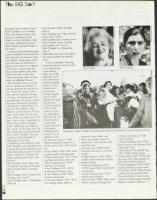
Ruth Ginsburg
Betty Friedan
ry, consider doing
some research
about any of the
following. You'll
find information in
the Encyclopedia
Judaica, on the
Internet and in
various texts.
• Grace Aguilar
(1816-1947):
BritishJewish poet
and historian.
• Hannah Arendt
(1906-1975):
Influential Ameri-
can philosopher,
educator and con-
troversial author,
whose works
include Eichn-iann
in Jerusalem.
Involvement in Rosh Chodesh study groups often leads to participation in women's prayer services.
• Babata (2nd
century C.E.): A
• Cythnia Ozick (born 1928):
impressive chain called Lane
collection of let-
American
author.
Bryant, give larger women the
ters about her, found in 1960,
• Maya Plisetskaya (born 1925):
opportunity to find attractive cloth-
affords tremendous insight into a
Russian
dancer and recipient of the
ing in their size.
Jewish woman's life in the 2nd cen-
1964 Lenin Prize.
• Fannie Hurst (1889-1969):
tury.
• Rachel (born Eliza Rachel Felix,
American short-story writer and
• Edna Ferber (1887-1968: Michi-
1821-1958): French actress.
novelist.
gan-born author and playwright.
Melly Sachs (1891-1970): Ger-
•
• Esther Kreitman (1891-1934):
• Betty Friedan (born 1921): Lead-
man poet and 1966 recipient of
Yiddish novelist and sister of Isaac
ing American feminist and writer.
the
Nobel Prize for Literature.
Bashevis Singer.
• Ruth Ginsburg (born 1933):
• Alice Seligsberg (1873-1940):
• Wanda Landowska (1877-
Supreme Court justice.
Leading
American social worker.
1959): Famed Polish harpsichordist
• Lea Goldberg (1911-1970):
• Lino Stern (1878-1968): Russian
and educator.
Israeli poet and literary critic.
scientist
who received the Stalin
• Alicia Markova (born 1910):
• Lilian Hellman (1906-1984):
Prize and Order of Merit; former
English prima ballerina.
American playwright.
head of the Physiological Scientific
• Sarah Millin (1889-1968): South
• Lena Himmelstein (1881-1951):
Research Institute in Moscow. LI
African novelist and biographer.
Her clothing shops, today an