

Community
Spirituality
Prayers
0
-C
C.
Ilealing
New service
is geared
toward physical
and spiritual
good health.
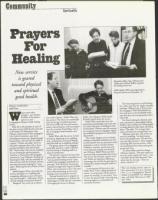
Menachem Weiss, Faye Ullmann and
Debbie and Michael Balkin sing from
the healing service text.
Rabbi Stephen Weiss isaccompanied on
the guitar by his son Menachem, 10.
SHELLI DORFMAN
StaffWriter
INT
e give each other
strength," says Marlene
Krohner of the partici-
pants in a new
Congregation Shaarey Zedek healing
service.
With 30 to 40 attendees at each of
the three services held . thus far come 30
to 40 reasons for being there. Faye
Ullman, chairwoman of the synagogue's
Life Cycles Committee, says some
attending the service are "going through
bereavement, with the loss of a child or
a parent." Others, she adds, "are ill or
caring for someone who is ill, or have
personal problems with their family
life." Some come "who are not troubled,
but are looking for spiritual growth,
closeness to God and to the synagogue
community," says Ullmann. Krohner of
Farmington Hills, who has attended all
three services with her husband, Martin,
says they have been looking for "inner
peace" following the loss of three of their
parents.
Rabbi Stephen Weiss, who leads the
service, describes it as "uplifting and
energizing, offering a source of inspira-
tion and strength — following a theme
of both healing and spiritual renewal."
Designed "very much as an alterna-
tive mode of prayer," Rabbi Weiss says
the service is "for those not comfortable
with the liturgy of traditional prayer."
The service offers all new and contem-
porary musical prayers, with accompani-
ment by musician Frank Ellias, who is
also a synagogue board member and
educator.
Rabbi Weiss calls the service "a kind
of journey, beginning on an uplifting
note, working into innermost feelings
and then back up to uplifting ending."
The group meets in the synagogue
social hall, seated in a circle. Ullmann
sees the setting as "lending itself to a
sense of community."
The idea for a series of services came
about after what Ullman remembers as a
"very successful healing service" spon-
sored by the synagogue sisterhood two
years ago. The Life Cycles Committee
members brought their request to Rabbi
Weiss, who turned out to have for years
been collecting healing services from
healing centers around the country."
Having founded such a program at
his former congregation in Atlanta, the
rabbi began to work with the committee
in bringing the service to Shaarey
Zedek. His colleague, Rabbi Joseph
Krakoff, helped shape the service.
Rabbi Weiss remembers how the
committee painstakingly read every arti-
cle, prayer and essay on healing he had
accumulated. Ullmann says the commit-
tee contacted various synagogues regard-
ing established programs as well as heal-
ing societies.
The mostly English service includes
readings and guided meditation as well
as silent prayers that are personal to each
participant, such as "one for women
wishing to conceive, one for loss and
one for general strength and renewal,"
says Ullmann. Rabbi Weiss says these
moments help to personalize the service.
The service also includes a prayer to be
said "before an operation, following a
miscarriage, for a child, for grieving, for
healing from shame and guilt and for a
caretaker.
A moving part of the service, says
Rabbi Weiss, is the "calling forward of
names," in reciting the Mi-She-beyrach
(prayer for healing.) At one point, "arm
in arm, the group stands in one big hug,
showing support in a beautiful and
emotional moment."
The hour-long service is still looking
for a place and time for regular monthly
meetings. Offered twice at B'nai Israel,
the synagogue's West Bloomfield loca-
tion, and once at the Southfield build-
ing, both day and evening sessions have
been held.
For those looking for physical, spiri-
tual, emotional or relationship healing,
Krohner says, it helps just "being togeth-
er, being there for each other, not being
alone." She adds, "I'm stronger than )1
some, and some are stronger than me.
Ullmann notes that with all the rea-
sons for attending, "we don't always
know why people come. We don't dis-
cuss why they are here." Some stopped
attending after just one service, while
new participants have been joining the
group each time.
As relationships and lives change,
Ullmann explains, We don't expect to
have the same people each time — not
everybody always feels the need." But
when they do, she says, "They are
always welcome." ri
The next healing service, open to
the community, is 4 p.m. Sunday,
Nov. 21, at Congregation Shaarey
Zedek in Southfield. For informa-
tion, call Kelly Woerner at (248)
357-5544.
KAAftaa%.aWKOVUM*V:KOkMAW-Wt' SSA