

Remnant Or Renaissance?
Ten years after the Berlin Wall fill, European Jewry is redefining itself.
RUTH E. GRUBER
Jewish Telegraphic Agency
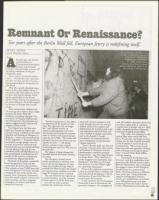
An unidentified Berliner tries
in vain to demolish a segment
of the Berlin Wall with a
sledgehamme); November
1 1 , 1989, at Bcrnauei-
Strasse, where East German ,
police pulled down segments of
the wallfb r a new passage.
Rome
A
decade ago, the Jewish
communities in
Communist-dominated
Eastern and Central
Europe were generally written off
as dying remnants or the pre-
Holocaust past.
Forty years of communist restric-
tions — and decades more than that
in what was then the Soviet Union —
had compounded the devastation of
the Shoah.
Most who openly identified them-
selves as Jews were elderly. Man); if
not most, other Jews chose to conceal
or deny their Jewish identity. Many
others, particularly in the former
Soviet Union, faced active persecution.
To many observers, the Jewish chapter
in this part of Europe was virtually
closed.
Then communism collapsed and
10 years ago this week its most visible
symbol, the Berlin Wall, fell.
Suddenly, everything changed. The
institution of religious freedom and
the disintegration of communist-era
taboos triggered social, cultural and
religious Jewish revival.
Exact figures have not been corn-
piled, but throughout Eastern and
Central Europe, in Poland, in the Czech
Republic and Slovakia, in Hungary, in
Bulgaria — even in th6 countries of the
former Yugoslavia — thousands of Jews,
particularly younger people, have dis-
covered, recovered or reclaimed long-
buried Jewish roots and openly declared
a Jewish identity. This may be via a
superficial public self-identification as a
Jew, participation in study groups and
secular Jewish activities, or immersion
in traditional, religious Jewish life.
Hundreds of thousands, meanwhile,
have immigrated to Israel and else-
where from the former Soviet Union.
This includes at least 70,000 Jews who
have immigrated to Germany, radically
changing the face of the Jewish com-
munity, there. Hundreds of thousands
have also stayed in Russia, Ukraine and
other countries, and have reopened
synagogues and schools and rebuilt
communal structures.
"Jewish communities in the region
are throwing off the mantle of 'rem-
nant' like a garment that no longer
fits," says Edward Serotta, an
American photographer and writer
who has documented Jewish commu-
nities in Eastern and Central Europe
since the mid-1980s. "We've been call-
ing them last Jews, but they're not act-
ing like last Jews — with kinder-
gartens, summer camps, schools,
youth programs and even Web sites on
the Internet."
The impact of these changes has
extended beyond the former commu-
nist states.
The emergence of newly active
Jewish communities in the East, com-
bined with the development of a new
vision of a pluralistic Europe freed of
artificial East-West frontiers, has created
new opportunities, conditions and chal-
lenges for European Jewry in general.
The new freedoms have opened up
a world of choices. And the outcome
of these choices is still far from clear.
It is still too early to predict
whether the momentum of what
many call a Jewish renaissance will
carry through into the 21st century
Indeed, much of the support and
infrastructure for Jewish revival in for-
mer communist states has been, and
still is, funded by foreign institutions
such as the Ronald S. Lauder
Foundation, the American Jewish
Joint Distribution Committee and
Chabad Lubavitch.
"Jews in Europe today are, first and
foremost, voluntary Jews, their contin-
ued presence in _European societies
demonstrates a conscious personal
commitment," says Paris-based histori-
an Diana Pinto. "They could just as
easily disappear into anonymity, stop
being Jews. And they are, of course,
free to do so; it is one of their rights
in a pluralistic democracy."
Pinto, in fact, espouses an optimistic
vision of a Jewish future in Europe, one
that links Jewish development with the
development of post-Cold War civil
society across the continent.
In this construct, the new European
framework is seen as the basis for the
potential emergence of a strengthened
and self-confident European Jewry that
can take its place both as a positive,
creative force in Europe and as a "third
pillar" alongside the Jews of America
and Israel in global Jewish affairs.
This vision was celebrated at the
end of May, when nearly 600 Jews
from 39 countries converged on Nice,
France, for the first General Assembly
of the European Council of Jewish
Communities. "We are here to cele-
brate the pride and optimism of being
Jews in Europe and being European
Jews," Council Chair Ruth Zilkha
told the meeting.
Looming in the background,
however, were dire predictions from
pessimists like British Jewish scholar
Bernard Wasserstein, who articulated
his negative vision of the European
Jewish future in a controversial
book, Vanishing Diaspora, published
three years ago. Citing drastically
negative demographic statistics,
thanks to a combination of assimila-
tion, falling birth rates and mass
emigration from the former Soviet
Union, Wasserstein pooh-poohs the
11/12
1999
19