

▪
Oslo Atmospherics
Summit set the tone for the toughest talks yet.
DOUGLAS DAVIS
Jewish Telegraphic Agency
London
U
Norway's placid setting, the task of negotiating the
really tough issues back home in the pressure cooker
of Middle East politics would be far more difficult.
No one was underestimating the enormity of the
task ahead, the consequences of failure — or the
very real benefits that success will bring.
For the Israelis, a final settlement with the
Palestinians will still leave unfinished business in
Syria and Lebanon, but it will remove the major
obstacle to normalizing relations with much of the
Arab world and help secure the legitimacy that has
eluded the Jewish state in the region.
For the Palestinians, a deal would mean not just a
nlike previous efforts at Middle East
summitry, this week's Clinton-Barak-
Arafat meeting in Oslo did not aim at
achieving any dramatic breakthroughs.
Instead, the three leaders had the more modest
goal of creating a positive atmosphere as Israel and
the Palestinian Authority embark on their most dif-
ficult negotiations to date — the final-status talks.
Given these goals, President Bill Clinton had lit-
tle difficulty in hailing his
meeting with Israeli Prime
Minister Ehud Barak and
Palestinian Authority
Chairman Yasser Arafat. "We
have just completed a very
good meeting. I feel we have
revitalized the peace process,"
Clinton said after Tuesday's
meeting, which took place
amid commemorations in the
Norwegian capital of the
fourth anniversary of the
assassination of Israeli Prime
Minister Yitzhak Rabin.
Clinton offered no details
about the hour-long meeting,
which was intended to lay the
groundwork for the final-sta-
tus talks. Those discussions
— which will tackle such
seemingly intractable issues as
the future of Jerusalem,
Jewish settlements,
Palestinian refugees and final
borders — are slated to begin
next week in the West Bank
town of Ramallah.
Barak and Arafat have
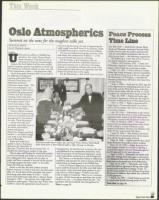
Palestinian leader Yasser Arafat, left, and Israeli Prime Minister Ehud Barak
agreed to reach a final peace
shake hands prior to their bilateral talks in Oslo, Norway, on Monday
agreement by September of
next year. They have also set an interim Feb. 15
homeland but, for the first time in history, the very
deadline for achieving an outline of that pact.
real likelihood of an independent Palestinian state,
Clinton also said Tuesday he would hold another
with the promise of international diplomatic recog-
summit with Barak and Arafat to work on the out-
nition and aid for reconstruction and development.
line, adding that they "agreed with me that we
For Clinton, it is his last best chance to redeem his
might well have a summit at the end of this process
presidency and associate his name in history with the
if enough progress has been made" in the weeks
achievement of a lasting peace in the Middle East.
before the February deadline.
A hint of Clinton's eagerness to score this achieve-
Earlier in the day, the three leaders invoked
ment could be detected at the Oslo town hall before
Rabin's memory in a bid to kick-start the final-status
the summit, when he joined other speakers in pay-
talks. Yet, for all three of the principals who assem-
ing tribute to Rabin's legacy. "If Rabin were here
bled along with other leaders in Oslo — where
with us today he would say, 'There is not a moment
secret Israeli-Palestinian talks led to a historic break-
to spare. All this honoring me and these nice words,
through in 1993 — the summit was a high-stakes
they're very nice — but please finish the job,'" the
diplomatic poker game. They knew that if they were
president told the hundreds who had gathered to
unable to create the appropriate mood music in
OSLO on page 28
Peace Process
Tune Line
New York (DTA) — Israeli Prime Minister Ehud
Barak and Palestinian Authority Chairman Yasser
Arafat vowed in Oslo this week to press forward
with the most difficult and delicate talks the two
sides have yet faced — the final-status negotiations.
The following is a time line of key events in
the Israeli-Palestinian peace process:
• Winter 1992-Summer 1993 — Israeli and
Palestinian negotiators hold a series of secret meet-
ings in Oslo to draw up a road map to peace.
• Sept. 13, 1993 — Prime Minister Yitzhak
Rabin and Arafat exchange a historic handshake
on the White House lawn as the two sides sign
the Declaration of Principles, a timetable for
launching Palestinian self-rule in the Gaza Strip
= and West 'Bank.
• May 4, 1994 — Israel and the PLO sign the
Cairo Agreement for establishing self-rule in the
Gaza Strip and the West Bank town of Jericho.
Jericho comes under self-rule on May 13. Israel
3 completes its withdrawal from Gaza on May 18.
• Sept. 28, 1995 — Rabin and Arafat sign
the Interim Agreement, which sets the stage for
an Israeli withdrawal from six West Bank towns.
• Nov. 4, 1995 — Rabin is assassinated by
Yigal Amir, a 25-year-old Jewish law student,
after a Tel Aviv peace rally. Shimon Peres steps
in as prime minister.
• Jan. 20, 1996 — Palestinians in the territo-
ries vote for the first time to elect an 88-member
legislative body. Arafat is elected leader of the
Palestinian Council with 90 percent of the vote.
• Feb. 25-March 4, 1996 — The peace
process faces its most serious threat when Israel
is left reeling by a series of Hamas suicide
attacks in Jerusalem, Tel Aviv and Ashkelon that
claim 59 lives and wound 220 others.
• April 24, 1996 — The Palestine National
Council votes to amend portions of the charter
that call for the destruction of Israel.
• May 29, 1996 — Israelis narrowly elect Likud
leader Binyamin Netanyahu as prime minister.
• June 22-23, 1996 — Egypt hosts the first
A rab
League summit in six years to develop a
fo nt against the new Netanyahu govern-
,
oath to the peace process.
1996 Netanyahu and Arafat hold
‘ 'eeting. Both sides agree to discussions
„
from most of Hebron, the last West
430ati$nvin. to be turned over to the Palestinians.
15, 1997 — Netanyahud
an Arafat
c during a late-night
bron Agreement
at the Erez Crossing. On Jan. 17 ,
"WA•W,
rt :q•.
ps redeploy in the predawn hours from
of Hebron, days earlier than called for
gement.
18, 1997 — Israel breaks ground for
erslal Jewish housing project at Har
At;7,%
n page 28
s
itkAAQ"t, ,
1,1 5
1999
Dettoit Jewfsh News
25'