

Cover Story: Prelude To The Holocaust
Time To Remember
Neo-Nazi in ltrator to help commemorate Kristallnacht in campus forum.
SHIRT REVITAL BILIK
Special to the Jewish News
T
he subject of the original
cable television movie The
Infiltrator will speak
Monday, Nov. 8, at a
Kristallnacht commemoration in Ann
Arbor.
A speaker at the annual student-
planned Holocaust Conference held
last March at University of Michigan,
author Yaron Svoray will again detail
his attempts to expose the Neo-Nazi
movement from within its ranks.
Svoray, an Israeli, spent nearly a year
undercover as a member of the move-
Shiri Revital Bilik of Commerce is a
sophomore in the Residential College
program at the University of Michigan.
She is a political science major.
ment. In often life-threatening, always
frightening situations, Svoray succeed-
ed and went on to capture his experi-
ences in print and film. Svoray's book,
In Hitler's Shadow, has been translated
into 23 languages and was produced
as a HBO movie.
Despite the danger and his back-
ground
round as the son of a Holocaust sur-
vivor, Svoray, 46, continues heading
an effort to expose the movement and
its connections to the U.S.
The 61st anniversary of
Kristallnacht commemorates the coor-
dinated attack incited by the Nazis
against Jewish businesses, synagogues
and homes on Nov. 9-10, 1938. The
pogrom was named "The Night of
Broken Glass" because of the vast
destruction: 267 synagogues
destroyed, 7,500 businesses vandalized
and, worse, 91 Jews killed all across
Germany, according to Saul
Friedlander's 1997 book, Nazi
Germany and the Jews.
Svoray's book and lecture based on
it chronicle his yearlong advances in
the hierarchy of the German move-
ment and the efforts that followed.
The book exposes "the real Neo-Nazi
movement from down in the trench-
es," he said. It allows readers and lis-
teners to "learn a most valuable lesson
in responsibility and taking a stand
when the time is right."
Svoray said his recollections are
"often humorous, as I recall several of
my bigger mistakes and near misses."
Senior Celia Alcoff of Pittsburgh,
chair of the conference last March,
helped bring Svoray back to the U-M
campus. It is a rare opportunity that
we get to interact with an actual hero
— and Yaron Svoray has truly proven
himself as one through his courageous
actions," she said.
"Each year, we try to bring diverse
programming to campus in order to
promote a broader awareness of the
Holocaust and its lessons," said sopho-
more Josh Samek of Miami, co-chair
of the upcoming 21st U-M Holocaust
conference with Shira Revital Bilik.
Each year's Holocaust program
advances understanding of the
Holocaust and its repercussions, but
the forum has become more challeng-
ing, according to Zvi Gitelman, direc-
tor of Judaic studies and a political
science professor at U-M. "I feel a ten-
sion between the need to know about,
remember and think about the
Holocaust," said Gitelman, himself a
past conference speaker.
The professor described the need as
perhaps greater as we get farther away
"
A Different Kind Of Survivor
A restored remnant of Kristallnacht is on display,
just in time to commemorate the 61st anniversary.
SAM ENGLAND
Staff Writer
n Dearborn's Henry Ford Museum stands
an 18th-century European desk, a recent
donation. Stately and ornate, the wooden
piece doesn't show its 200-plus years — or
the scars of certain terrors it's witnessed.
"This desk looks perfect, doesn't it?" reads the
accompanying label. "It was once in pieces, bro-
ken by Hitler's troops in Dusseldorf, Germany,
during Kristallnacht (`The Night of Broken
Glass') on Nov. 9-10, 1938."
The same could be said for the life of Ruth
Adler Schnee, who was 15 when the Gestapo
stormed into her home, and those of millions of
other German Jews, during Kristallnacht. Schnee
donated the desk recently, and the museum
moved swiftly to display it in time to commemo-
rate the night.
For Schnee, Kristallnacht marked a turning
point for her and her family, who had been bear-
ing persecution from the Nazi government for
several years leading up to that cataclysmic event.
Sitting with her husband, Ed, in their elabo-
rately decorated Southfield home, Schnee recalled
11/5
1999
7 n
no+rnit_lavuich_Novac
a happy childhood in Dusseldorf, then spoke of
the radical change as Adolf Hitler took power in
Germany. "I have many memories. Actually, I
have some wonderful memories. Our lives in
Germany were wonderful until 1936, when the
Nuremberg laws were established."
Kristallnacht came two years later. We were
not in the house when our house was destroyed.
Neighbors warned us that they (the Gestapo) were
on the way," she said of the event.
"We just walked the streets all day. Because there
was no place — we couldn't come to our friends'
house or we would be discovered. At night, we
came back to our house and it was a total — all my
mother's dishes were in a big heap."
Little by little, memories returned to Schnee, as
she recounted a kind neighbor who risked severe
punishment by bringing tea and cookies to the
distraught family.
Despite that kindness, the Adlers' lives were
bleak and they soon fled their Dusseldorf home.
They escaped Germany with the desk — after
being forced to pay for its restoration so it would
provide no obvious evidence of Kristallnacht —
and emigrated to the United States, settling in the
Detroit area.
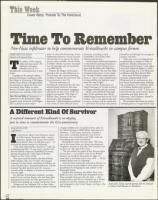
Ruth Adler Schnee and the family desk she donated
to Henry Ford Museum in Dearborn.