

Defusing Rabin
Next week's annual memorial ceremony promises
to be a lot different than the first three.
LARRY DERFNER
Israel Correspondent
Tel Aviv
T
wo years ago at Tel Aviv's
Rabin Square, the mood of
the crowd was expressed by
these huge posters: a photo
of Yitzhak Rabin had the caption,
"We won't forget," next to a photo of
Binyamin Netanyahu in a Mussolini-
like pose and with the caption, "And
we won't forgive."
Natan Sharansky, one of the more
right-wing members of the cabinet at
the time, was booed loudly during his
speech.
And one year ago, ministers Yitzhak
Mordechai and David Levy steered
clear of politics in their speeches,
emphasizing the slain prime minister's
background as a great military man.
They were warmly applauded.
This year Shalom Chaver, the
group that puts together this year's
Saturday, November 6 memorial rally,
is considering inviting Likud leader
Ariel Sharon, said rally producer Hemi
Sal. "Some people in Shalom Chaver
are saying this would be the fair thing
to do because Ehud Barak spoke at the
rally last year when he was opposition
leader," he said.
That Sharon, a leader of the anti-
Oslo demonstrations who described
the Rabin government as being "worse
than kapos," should be a candidate to
speak at the memorial rally shows how
the annual event has changed since his
assassination.
And not everybody's happy about
that.
"There's too much symmetry, too
much sentimentality. The official atti-
tude taken is that everybody — Left,
Right, religious and secular — bears
equal responsibility for the assassina-
tion, and that's just not true," said Dr.
Haggai Hurvitz, a Tel Aviv University
historian taking part in a university
symposium on the lessons of Rabin's
murder.
One thing different than in the past
three years is that Netanyahu is not
prime minister. He is blamed heavily
10/29
1999
NO1A/C
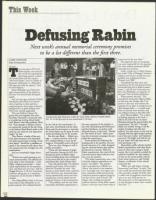
Israeli youths light memorial candles for Israeli Prime Minister Yitzhak Rabin,
Oct. 21, at the spot were he was assassinated in Tel Aviv.
by the Left for the assassination. In
past years, Ehud Barak and the Labor
Party used the anniversary to excoriate
the Likud leader and his party for their
words and deeds prior to the murder.
But this year Barak — Rabin's pro-
tege — is prime minister. And so far
he is saying nothing to muss up his
image as "everybody's prime minister."
There are other changes as well in
public atmosphere.
"There isn't that element of anger
and frustration [among the Left] over
having lost power to Rabin's oppo-
nents, including those who contributed
to the mood that led to the murder,"
said Mossy Raz, head of Peace Now
That's all political talk. The Hebrew
calendar anniversary of the murder -
observed Thursday last week - has
become a more somber than a political
event. But here, too, memorial obser-
vances sponsored by towns and cities
already seem to have edited out the
political character of the assassination.
"The problem with the way Israel
remembers the Rabin assassination is
the exact opposite of the problem it
has with remembering the Holocaust,"
said Ina Friedman, co-author, with
Michael Karpin, of the book, "Murder
In The Name of God," which exam-
ines the incitement campaign that pre-
ceded the assassination.
"Israel teaches the Holocaust by
looking only at the specifics, the anti-
Jewish character of it, while disregard-
ing the universal lessons that need to
be learned by everyone. With the
Rabin assassination, they teach all the
universal lessons about tolerance, but
they miss the specifics.
"The Rabin assassination was a case
of Jewish religious nationalism run
amok," she added. "The popular
right-wing depiction of Rabin as a
`traitor' was central to the assassina-
tion. And right now, once again, you
have nationalist rabbis pronouncing
[religious] sanctions against giving up
any part of the Land of Israel. The
danger with avoiding the specific
political character of the Rabin assassi-
nation is that you won't know what to
watch out for the next time."
This approach that no one group
was more responsible for the assassina-
tion than another permeates official
remembrance activities.
Under a huge tent in Rabin Square,
last week's "Day of Dialogue" between
religious and secular carried the even-
handed, non-judgmental theme,
"Friend, Let's Talk."
"Everybody has their own soul-
searching to do for the destructiveness
and hatred that led to Rabin's assassi-
nation," said Tel Aviv University stu-
dent Liat Hollander, an organizer of
last year's Tent of Study and Prayer.
When pressed, she said, "The
atmosphere among the religious Right
at that time was virulent. But if we
present it this way, we'll achieve the
opposite of our goal. It would do more
than alienate them — it would cause
them to become more extreme, and
less willing to listen to the other side."
Prof. Hurvitz differs. "I'm in favor
of looking squarely at the truth. I
believe the Left was by no means.
blameless during the period before the
assassination," he said. "I thought
Rabin was terribly wrong to say the
settlers ['could go spin like pro-
pellers], but this cannot in any way be
equated with the right-wing's constant
use of the term 'traitor' and ludenrat'
and such. The Right and Left do not
by any means have the same sort of
soul-searching to do."
Meanwhile, public schools marked
Rabin's assassination with class discus-
sions of what went wrong in Israeli
society. But even teachers avoided the
political minefield. Yet, the teachers -
at least in the secular public schools,
know what's going on, said Yitzhak
Shapira, coordinator of the schools'
memorial day.
"When you talk about crossing
democracy's red lines," he said, "you
can't avoid the conclusion that those
who introduce images of death, like
a coffin and a hangman's noose [pre-
sent at an anti-Oslo protest in
Ra'anana prior to the assassination],
or use the term 'traitor' have crossed
that line." ❑