
page 112
BIG Calendar
For November .. page 117
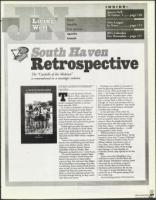
etrospecti e
The "Catskills of the Midwest"
is remembered in a nostalgic volume.
A TIME RIMEMBER
A history of
OW
jtwish Cinnutunity in South tlurcn
li3
Bea Kraus
ESTHER ALLWEISS TSCHIRHART
Copy Editor
T
he open farmland of South
Haven, Mich., adjacent to the
white sandy beaches of Lake
Michigan, drew a number of
Jewish immigrant families in the late
teens and early 1920s.
In A Time to Remember: A History of
the Jewish Community in South Haven
(Priscilla Press, $30), Jewish Book Fair
speaker Bea Kraus, who has a summer
home in South Haven, writes about the
small farmer-entrepreneurs that ran a
string of Jewish resorts favored by genera-
tions of Midwest vacationers.
Middle-aged and older Detroiters who
came with their families to South Haven
should enjoy reading about the resorts (as
many as 63 of them, Kraus says) in this
illustrated and fact-filled volume, complete
with index.
"Some of the earliest settlers [in South
Haven] who established good sized farm
resorts were Nathan Gassin, Morris
Fidelman, Abraham Reznik, Morris
Androfsky, Solomon Zlatkin, Max
Weinstein and Jacob Levin," writes Kraus.
The Jewish hospitality tradition began
with guests coming to South Haven area
farms in the summer to enjoy healthy
country living. Not only were they delight-
ed by the pleasant surroundings, but there
was delicious, home-cooked Jewish food to
savor as well. As time went by, the families
realized that financial success was more
likely to come from pleasing summer visi-
tors than through farming, so they turned
their farms into resorts.
Buildings were added or expanded to
meet the growing demand for accommo-
dations in the 1920s up through the war
years — the heyday of the Jewish resorts
in South Haven. In earlier times, when
people didn't typically travel far on vaca-
tion, word got back to folks in Detroit,
Chicago, St. Louis and elsewhere that in
the "Catskills of the Midwest" they would
find clean air, natural beauty and kosher
or kosher-style cooking.
In the early days of the resort era,
horses and wagons were the primary way
to travel. Chicago vacationers often came
over on steamers. Resort owners would
come to where the people disembarked
and boast about why they ought to stay
with them. Buses — horse-drawn wagons
with leather-padded benches — would
bring people to their hotels.
Fidelman's Resort was one of the
prominent places in South Haven. Family
owned for more than 75 years, Fidelman's
("Where Vacation Dreams Come True"),
offered celebrity entertainers, such as
Artie Shaw, Arte Johnson and Glenn
Miller's Orchestra. Most of the acreage
now belongs to Camp Agudah, an
Orthodox Jewish camp opened in the late
1980s.
Kraus writes that Mendelson was a
well-known name in South Haven for
eight decades. Mendelson's Atlantic Hotel
was noted for its attention to guests'
needs. Martha Raye and Dave Rose's
Orchestra performed there. By the late
'70s, when it closed, Mendelson's had
rooms for up to 250 guests paying $165
for a week's stay.
An interesting section of the book has
,
10/29
1999
Detroit Jewish News 107
)VVEI: 1.2V,
tolikt
Scanned image of the page. Keyboard directions: use + to zoom in, - to zoom out, arrow keys to pan inside the viewer.
October 29, 1999 - Image 107
- Resource type:
- Text
- Publication:
- The Detroit Jewish News, 1999-10-29
Disclaimer: Computer generated plain text may have errors. Read more about this.