

Arts & Entertainment
Behind Closed Doors
Photo by Iry Antler
A TV documentary provides the first in-depth look at the Friars Club,
showbiz's most exclusive haven for entertainers.
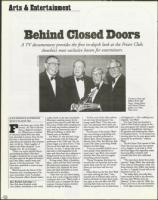
Clockwise, from top:
Milton Berle, Bob
Hope, George Burns
and Danny Thomas
gather at a Friars
Club event.
ALICE BURDICK SCHWEIGER
Special to the Jewish News
r
or the better part of the 20th
century; the Friars Club has
been a refuge for entertain-
ers. What's gone on behind
its notorious closed doors has often
been shrouded in secrecy. Now, for the
first time, a documentary has been
made about the exclusive show business
club. Let Me In, I Hear Laughter: A
Salute to the Friars premieres 7 p.m.
Tuesday, Oct. 26, on Cinemax.
"There is so much colorful history
surrounding the Friars Club that I
thought it would be fun to look inside
and meet some of the great old-timers,"
says Dean Ward, creator, writer and
director of the documentary. "The
Friars have embodied so much of pop-
ular culture."
Ward chronicles the history of the
illustrious club, including some of its
most memorable events: Comedian
Harry Einstein's (Albert Brooks' father)
Alice Burdick Schweiger is a
New-York-based freelance writer.
Curt Schleier contributed to this article.
10/22
1999
sudden death on the dais immediately
following a standing ovation for his
speech at the roast of Lucille Ball and
Desi Arnaz; Phyllis Diller sneaking into
an all-male stag luncheon dressed as a
man; and the controversial roast of
Whoopi Goldberg, to which Ted
Danson came in blackface.
For Ward, 29, who has had a long-
time fascination with the Friars and
performers of the 1940s and '50s, the
project began as a labor of love. "I was
just one of those kids who was born
too late," he says. "I adored old movies
and used to read biographies of the
stars, and often there was a reference to
being honored by the Friars Club. I
always wanted to know more about it."
To forge ahead, Ward, a Brookline,
Mass., native and New York University
film department graduate, contacted
the Friars Club, explained his inten-
tions and asked permission to access
the club and its members.
"They were very nice about letting
me in, but it took a long time before I
could gain their trust," Ward recalls. It
took four years to complete the docu-
mentary. Cinemax became involved
halfway through the filming.
"At first, some of the older perform-
ers were wary of me because I was
young, recalls Ward. "Once they real-
ized I was passionate about them and
their history, they were very helpful and
supportive."
The best part of the project, Ward
says, was meeting and spending time
with such venerable performers as
Milton Berle, Henny Youngman, Jan
Murray, Steve Allen, Red Buttons, Jack
Carter, Sid Caesar, Larry King, Buddy
Hackett and Alan King.
"It was an incredible thrill for me to
meet people I have admired for so
many years," says Ward, who traveled
between New York and Los Angeles,
researching archival material.
"Henny Youngman died about six
months after our interview, but he was
pretty sharp until the end. He would
shout out one-liners and was very
funny."
Milton Berle was the first Friar Ward
met upon entering the club. "I was
escorted over to Milton's table, and he
told me all kinds of stories about smok-
ing cigars in the oval office with JFK,
meeting Babe Ruth and much more.
Milton was good for two or three hours
.
of background — he's a walking ency-
clopedia," says Ward.
The Friars Club was founded in
1904 in New York by a group of the-
ater press agents who wanted to guard
against men fraudulently claiming to
be reporters and obtaining free tickets
to Broadway shows. "It was formed as a
meeting place for the press agents and a
sanctuary for performers," explains
Ward.
The first Friars Club opened in New
York City, and years later one opened
in Los Angeles. As far back as 1910,
the Friars began their legendary roasts,
honoring fellow members with
comedic jabs from their celebrated
peers.
"The roasts have always been pretty
raunchy," laughs Ward, who notes that
Friar roasts are still popular today. The
latest honoree, Jerry Stiller, was roasted
on Oct. 1; Comedy Central will air the
festivities on Oct. 27.
"[In earlier days], the really dirty
roasts would be held in the afternoon,
for men only. Women were not
allowed." In fact, until the 1980s, the
Friars Club was an all-male institution.
Civil rights attorney and feminist