

COMMUNITY VIEWS
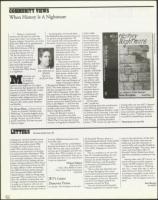
When History Is A Nightmare
As young Jews, we learned about
the Holocaust from the generations of
our parents and grandparents. We
were exposed early and consistently to
the stories of survivors; those stories
taught us certain lessons
about good and evil, ene-
mies and friends, identity
and preservation. Our
memories have been a bur-
den, but they also are a key
to our humanity.
The presence of this his-
tory in our lives is certainly
part of what drove me to
gather Bosnians' testimonies
DR. ST EVAN M. and to immerse myself in
their stories, which is the
WE INE
basis for my new book,
Spec ial to
. . . There is a connection
between my life and my work that
comes alive when I am sitting with a
Bosnian refugee. Sometimes, my mind
drifts and I feel as if my grandmother
Kate — once an immigrant
child full of dreams of life in
a strange, new country — is
sitting and talking with me.
"Do not ever forget who you
are," she said to me one of
the last times we were togeth-
er. I was 23, a medical stu-
dent and could not really
know what she meant.
— Excerpt from When History
is a Nightmare
y journey into
1VIE the world of
the Balkans
engaged this
question and taught me a lot about
the memories that shaped my life and
that of my family. That's why it never
surprises me to encounter Jews
engaged in work with Bosnians, Koso-
vars and other refugee survivors. The
important connections to my experi-
ence as a Jew center upon memories
and families.
Dr. Stevan Weine, co-director of the
"Project on Genocide, Psychiatry and
Witnessing," is associate professor of psy-
chiatry at the University of Illinois at
Chicago. He grew up in the Detroit
Jewish community. His book was pub-
lished in August.
LETTIIIIS
$25). This book explores a history
that has outraged the world — the so-
called "ethnic cleansing" of the Mus-
lim population in Bosnia-Herzegovina
by Serbia and Bosnian Serbs. It is an
impassioned investigation of how col-
lective memory has shaped history and
lives in the Balkans — and how the
mishandling of traumatic memories
actually made ethnic cleansing in the
former Yugoslavia possible.
From the Bosnians' stories, I
learned how prevalent were their
memories of crime and suffering from
World War II, but also that the gov-
ernment of Yugoslavia's Marshal Tito
Wheft
/5:
WatSas,,.
turning calms seas into hell'). I learned
how they were manipulating memo-
ries of Serbian suffering so as to pro-
mote and lead a genocidal movement.
Raskovic writes, "Nothing is more
successful at establishing a national
NIGHTMARE ON PAGE 38
LETTERS FROM PAGE 35
keeping our city from needed revenue
streams that can flow from our courts
via 1-696 state police tickets? Why
wouldn't we want to lower our tax
rates? Why would anyone want to
make our city unattractive to develop-
ers and particularly redevelopers? Why
would we turn down a chance to give
our municipal employees, who provide
our essential services, healthy and ade-
quate working conditions? What future
is there in continuing to force our pub-
lic safety officers to drive to Farming-
ton Hills for firearms practice because
the Occupational Safety and Health
Administration closed our firing range
years ago? Why would anyone want to
force our residents to shove their way
through chained and shackled prisoners
in order to do business with our city
clerk? Why would we want to postpone
needed construction and repair work so
10/15
1999
When History is a Night-
mare: Lives and Memories of
Ethnic Cleansing in Bosnia-
Herzegovina (Rutgers University Press;
the Jew ish News
(1892-1980)
pushed memories
of ethnic atrocities
out of public and
institutional life. It
was the dark side
of Yugoslavia and
people didn't focus
on it. Bosnians
practiced
merhamet, which
means forgiveness
and charity in
Bosnian, and cher-
ished the experi-
ence of living
together with Serbs
and Croats. Bosn-
ian Muslims did
not acquire what
one of them calls
"Jewish suspicious-
ness." They did
not learn from
memories how to
recognize ethnic
nationalism and
how to defend
themselves.
On the other
side, I could not
stop thinking about the contributions
two infamous psychiatrists, Jovan
Raskovic and Radovan Karadzic, made
to Serbian ethnic cleansing. I met with
and interviewed many of their former
colleagues and friends, and studied
their writings, including Karadzic's
poetry ("This moment my right hand /is
ish Ensemble Theatre, there is a
as to pay inflated construction costs
heartrending description of the painful
down the road?
adjustment that was endured by the
Our community has a tremendous
newcomer in a totally strange place
financial investment in the city of Oak
•
with neither language nor means for
Park. We live, play, enjoy municipal
support.
services, go to synagogue and raise our
This is a revelation as we view the
children here. Why wouldn't we want
fear,
the misunderstanding, the slow
our
investment?
Vote
yes
on
to protect
achievement of communication
the bond issue Nov. 2; our city's future
between the Jewish foreigner and the
is just too important.
Michael Seligson WASP-Americans, and the gradual
involvement and adjustment of the
Mayor pro tem
Jew
and his family.
Chair, Blue Ribbon Citizen's
This is a play that should be seen
Civic Center Study Commission
Oak Park by all ages throughout the various
communities beyond the Jewish popu-
lation, to understand and appreciate
the integration of the new Americans •
JET's Latest
and how they helped establish the
expansion toward the West.
Deserves
The role of the Jewish Ensemble
In the play The Immigrant at the Jew-
Theatre emphasizes its cultural impor-
Praise
tance to the community. In the same
tradition (of) Israel, social services,
health care and other functions, it
must be fully and annually funded by
a substantial budget. The vision, dedi-
cation and tremendous effort of
(founder) Evelyn Orbach have devel-
oped this remarkable, professional the-
ater.
Among other areas JET serves, its
award-winning outreach program
reaches 20,000 students each year.
I first saw this play in Washing-
ton, D.C., many years ago. It was a
solid sell-out for three months; it
was almost impossible to get tickets.
To finally have JET present it is a
fulfillment. The Immigrant must be
seen!
Ann Barnett
Southfield