

F
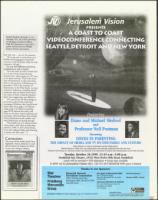
Jerusalem Vision
PRESENTS
Rashid Khali& will speak 11 a:m.
Monday, Oct. 18, in the University
of Michigan-Dearborn's Elliott
Hall. His appearance is part of its
public lecture series on Middle
Eastern history and culture.
feel that way ... are on the extreme.
"If you go out to universities and
Hillels and synagogues around the
country, you'll find they really do only
represent a fringe."
Do you find differences between
speaking here and in Israel?
"It's a lot easier to talk in Israel than
it is in the United States because
Israelis know what's going on. If I were
to sit down and say, This is the situa-
tion of Palestinians in the Gaza Strip.
This is the situation of Palestinians in
Jerusalem. This is the situation of
Palestinians in the West Bank,' to most
American audiences, including liberal
audiences who are Peace Now-orient-
ed, many of them would be shocked,
feel I was exaggerating, get defensive.
"If I were to say the same things to
an Israeli audience that reads [the
newspaper] Ha'aretz, they Would know
that's taken from page 1 of Ha'aretz
today, page 3 of Ha'aretz yesterday,
page 20 of Haaretz last week, and
those are the facts. Israeli audiences are
just better informed about the realities
of the Palestinian-Israeli conflict and
what Palestinians are going through.
"The Israelis are in a school system
where they're told what actually hap-
pened in 1948. In the United States,
we're still reading Exodus and listening
to myths and fairy tales." Fl
Correction
The cover of last week's Jewish News
ii
displayed a hamsa, believed to ward
off evil spirits, by Israeli artist Ruth
Coriat, now living in Atlanta.
A COAST TO COAST
VI DEOCON F E RENC. F. CONNECTING
SEATTLE,DETROIT AN MEW YORK
Featuring
Diane and Michael Medved
and
Professor Neil Postman
Discussing
ISSUES IN PARENTING:
THE IMPACT OF MEDIA AND TV ON OUR FAMILY AND CULTURE
Diane Medved is a clinical psychologist and best-selling author.
Michael Medved is a film critic, best selling author and nationally syndicated radio talk show host.
Professor Neil Postman is a well-known author and chairman of the Department of Culture and Communications at New York University.
Tuesday, October 26,1999, 11:45 a.m.-1:00 p.m.
Southfield Star Theatre, 25333 West Twelve Mile Road, Southfield
Lunch will be provided • $20 Admission • Group rates available
To RSVP call the Jerusalem Vision office: 248-352-4870 REGISTER NOW space is limited
.
•
s tovrIponsors-
.Thak.
mana e or
Sta
Investment
Corporation
Theatres
30833 Northwestern Hwy._
Hills, MI 48334-2581
Friedberg Farmington
248-626-3120
Mercantile
ow* :Group
misionsomm:
The Bank of Btoomfie d Hills
IloWard Rosenberg
505 N. Woodward Avenue,
Suite1300, Bloomfield Hills, MI 48304
Dynamic Muffler & Brake"
248-644-2301
American Educational Institute
401 South Old Woodward, Suite 333
Birmingham, MI 48009
248-433-0606
Jerusalem Vision 100 Galleria Officentre Suite 422 Southfield, MI 48034
Jerusalem Vision.-
• Is being developed with seed funding from the Max M. Fisher
Foundation of the Jewish Federation of Metropolitan Detroit
10/15
1999