

ever For
HARRY KIRS BAUM
Staff Writer
T
here is no easy way to talk
about the Holocaust, nor
should there be," said presi-
dential candidate Bill
Bradley. "No words can describe the
evil, but we will have to speak about it
because, by speaking about it, we will
remember, and only by remembering
can we learn about it."
Bradley, a Democrat, spoke to
about 1,300 guests at the Holocaust
Memorial Center's 15th anniversary
dinner held Oct. 10 at the Marriott
Hotel in Detroit's Renaissance Center.
During a night filled with tales of war
and survival from evil, Bradley's
keynote speech to supporters of the
West Bloomfield center was sincere
but lacked punch.
A U.S. senator from New Jersey for
16 years, Bradley said his former con-
stituents who were survivors taught
him that "the human heart is capable
of such malignancies as the Holocaust,
but it is also so large and strong that it
can overwhelm such evil."
Speaking of silence and hate in
America, he cited the Jewish
Community Center shootings in subur-
ban Los Angeles, the dragging death of
African-American James Byrd in Texas
Harry Kirsbaum can be reached at
(248) 354-6060, ext. 244, or by e-mail
at hkirsbaum@thejewishnews.com
10/15
1999
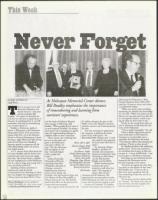
At Holocaust Memorial Center dinner,
Bill Bradley emphasizes the importance
of remembering and learning from
survivors' experiences.
$1 million donation he gave to the
and the death of Matthew Shepard,
HMC in his wife Mignon's memory,
who was gay, in Wyoming. Said
told the crowd it was a bittersweet day
Bradley: "When people do evil, each of
for him.
us must respond forcefully" by taking a
"Just this morning we gathered at
more active role in speaking out against
the cemetery to dedicate the head-
hate. He urged teaching tolerance to
stone of my wife's grave," the
children earlier in their curriculum.
Bloomfield Hills resident said. "I wish
"Hate crimes and vocalizing hate
she could be here physical-
are not in the same cate-
gory as the Holocaust,
Above, left to right: ly, but I know she's here in
spirit."
and never will be," he
Honoree Eugene Kraft
Dr. Ernestine Schlant
said. "But the Holocaust
says HaMotzi.
Bradley, a professor of
did not appear in one
Sol Allweiss, Rabbi German and comparative
day. Genocide begins
Charles
Rosenzveig of the literature at Montclair State
with a single hate
Holocaust
Memorial University in New Jersey,
crime."
Center, Franciszka was the link between
Earlier, Franciszka
Olszewska, Zyga Allweiss Bradley and the HMC.
Olszewska of Detroit,
and
Wladyslawa Rzeznik
Before introducing her
attending with sister
during
the Righteousness husband, she took a
Wladyslawa Rzeznik of
Award presentation.
moment to talk about her
Chicago, received a
Bill Bradley book, The Language of
Righteousness Award in
Silence: West German
honor of her family, the
Literature and the Holocaust. She
Dudziks, who hid brothers Zygie and
explained that the tremendous burden
Sol Allweiss of West Bloomfield, in
of the Holocaust not only is on the sur-
Poland during the war. The families
vivors, but the German people as well.
found each other on the Internet last
A native of Germany, Dr. Bradley
winter and were reunited.
said her book about the avoidance of
Also, Eugene Kraft, honored for the
addressing the Holocaust in West
German literature from 1949-1990
took her 10 years to write, and covers
a complicated subject.
"When you avoid, you're avoiding
something you already have knowledge
of," she said. "When you point out the
silence, you can also point out that this
is a very specific silence, words cover-
ing up what we don't want to say."
Yet she let the crowd know that no
one in Germany would deny the exis-
tence of the Holocaust.
"This is totally impossible," she said.
There is debate raging from govern-
ment levels down to the citizens in
Germany on an honorable way to
remember the Holocaust, she stated.
"The literature reflects the attempts and
confusion. There's no clear answer."
Dr. Bradley alluded to the redeeming
quality of art. "If you can resurrect in
art something that is gone, at least you
can give it — not a real life back — but
you can give it a life back in memory."
Summing up, her husband said the
lessons of the Holocaust can be
learned by going to the source.
"Survivors are aging, but only they
can teach us the horrors of that time,"
Bill Bradley said. "They are all, in
their own ways, prophets; they all
have something I hope the rest of us
will never see.
"If you are a survivor, please teach
us," he said. "For those of us who are
not survivors, we must commit our-
selves to learn from you." 7