

Shaping An Identity
Era-tsed Aral
Rosh lidayin, Israel
he old half of this town of about 32,000 people is primarily
Orthodox, habitually right-wing and representing a key
stronghold of the powerful Shas (Sephardi Religious Party).
Printed signs of the numerous little yeshivot operating out of
apartments dot the streets.
On a recent afternoon, four men on a corner are dressed in
black kippot, white shirts and black pants. The group's senior
member, 42-year-old Ya'acov Admoni, heads the local branch of
Shas' religious schools. The other three are yeshiva students. All
voted for Binyamin Netanyahu in the prime ministerial election.
"Whomever Rabbi Ovadia Yosef [Shas' spiritual leader] tells us
to vote for, we vote for," said Admoni.
They clearly have reservations about Ehud Barak, especially
since he forced the publicly funded Shas school system finances
open to inspection. They also are displeased that Barak allowed
the national electric utility to transport giant turbines on Shabbat.
But their attitude is striking for its lack of heat. "It's not like
with, for instance, Shularnith Aloni," said Tsuriel Ashwal, 29. He is
referring to the former leader of Israel's secular left, who Shas forced
out as education minister during the [Yitzhak] Rabin government
"Barak seems to be going in the right direction," added
Ya'acov Yisrael, 35. The others aren't ready for that much enthu-
siasm, but agree that they like Barak's now-famous pledge to be
"prime minister of everyone."
Shas is relatively dovish on the
peace process, so the men go along
with recent peace-process moves.
Shas, however, also is dedicated to
helping the poor, and this group
criticizes Barak for forsaking cam-
paign promises to take up that
cause. "Patients are still lying in
hospital corridors because there are
no beds for them," said Uziel
Admoni, 22, Ya'acov's nephew.
Working in Barak's favor is the
Strong sense that he should be spared
from the badmouthing that's integral to Israeli public life.
"Just once," said Yisrael, "let somebody carry out a policy
without everybody yelling at him and trying to destroy it."
Teal' rem
Rosh Hakyin, Israel
peaking in his optometry business located in a shopping center
on this town's secular Yuppie side, Slav Hasdan shows surpris-
ing sympathy for the man Ehud Barak defeated. "Bibi
[Netanyahu] never had a chance to succeed. The media and the
Left started kicking him as soon as he got in," he said
Hasdan, 28, immigrated from Belarus with his family in 1990.
This owner of three optometrist shops is a member of the hard-
working, secular, Russian-Israeli middle-class. But he is not part of
the massive Russian electoral switch from Netanyahu to Barak.
Like most Russians, he is viscerally opposed to religious restric-
tions on Israeli life. "I'm glad that Barak didn't stop the turbines
on Shabbat," he said, referring to the newest battle in the secular-
religious culture war.
Surprisingly, he gives Barak high marks for his pledge to extri-
cate Israeli soldiers from south Lebanon by the middle of next
year. "I fought in Lebanon, and I saw soldiers get killed there. It's a
hopeless situation."
But he doesn't like Barak's moves with the Palestinians and Syrians.
S
10/15
1999
Kafr Kassem, Israel
his Israeli Arab town is in the news. Education
Minister Yossi Sarid is urging teachers to teach
about the massacre here on the eve of the 1956 war
with Egypt. A curfew had been imposed on Israel's
Arabs, but some peasants and children here didn't
know about it They were walking home from the
fields when a unit of Israeli border policemen captured
43 of them, lined them up and shot them to death.
"Your tragedy is our shame," Sarid told the people
of this town. The Israeli Right accused him and the
Left of "self-flagellation."
Nearly all of Kafr Kassern's roughly 10,000 residents,
like the rest of Israel's 1 million Arab citizens, voted for
Barak "Barak wants peace in the Middle East, Netanyahu
didn't," said a man of about 70, wearing an Arab head-
dress and keeping his name to himself "But to make
peace you have to give the Palestinians land, a capital in
Jerusalem -- you have to also let them have something."
He supports the ex-Communist, Arab-doininated
Hadash party. He does not care for the Islamic
Movement, which is supplanting Hadash as the lead-
ing Israeli Arab political force. Since a number of
Islamic Movement supporters recently set off car
T
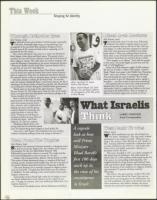
Above: Issa Yosef 35, Israeli
Arab in Kafr Kassem.
Below: Tsuriel Ashwal, 29, Uziel
Admoni, 22, and Yaacov Admoni,
42, all supporters of the Shas party
in Rosh Hatayin.
'4.•"*."
‘N4,
"
A capsule
look at how
well Prime
Minister
Ehud Barak's
first 100 days
stack up in
the view o f his.
Mgq
' . • A
N
MTTa-g3
Elkana, Israel
est Bank settlements are typi ally divided into
two types: "ideological," mea ling small, isolated
settlements in the midst of a solidi - Palestinian area,
deep in the interior of the West Ba ik; and "quality of
life," meaning relatively comfortabi settlements close
to other settlements, the 1967-set I raeli border (the
Green Line), and within commutin ; distance to
Jerusalem and/or Tel Aviv.
This town, founded in 1977, is a classic example of
the second type of settlement. Ten miles across the
Green Line, its 3,500 residents work mainly in the Tel
Aviv area or in surrounding industrial parks. The
neighborhoods have large homes, gold-colored stone
walls and thickly tufted, brightly colored landscaping.
Some 90 percent of the residents are religious Zionists;
approximately 95 percent of them voted for
Netanyahu.
Pini Zimra, who grew up here, and his wife, Orit,
raised on the other side of the Green Line, are not
afraid of the area being given to the Palestinians. It's
too well established, too close to the Green Line and
other settlements, they believe. Besides, the prime
minister has promised to preserve Israeli sovereignty
w