

fled, but considered the beginning of
Jewish literature. Birmingham
Temple's Torah is found on a shelf in
the library.
"We believe the power to deal with
the problems of our life does not
come from some divine or supernatur-
al source, but from within us," Rabbi
Wine has said. "Once you use theistic
vocabulary, then you have to sit
around apologizing, redefining, always
explaining."
Ironically, these ideas come from a
man who grew up in a Conservative
Jewish home in Detroit, and was
ordained a Reform rabbi in 1956. He
thought his humanistic ideals would
be able to exist in the Reform move-
ment.
He was wrong.
"The Reform movement was
attached to liturgical formats, prayers
and davening that were not consistent
to my convictions," he said. "It's not
my job to change the movement or to
deceive, so it was clear that I had to go
out and organize something on my
own.
In 1963, he left as rabbi of Temple
Beth El in Windsor to organize
Birmingham Temple, which moved to
its current location in Farmington
Hills in 1971.
A Time magazine article in 1965
about the fledgling movement created
much interest. The phone began to
ring, and Rabbi Wine hit the road. He
would deliver a public lecture or lead
a service, and people who liked it
would stay and organize.
Rabbi Wine is a powerful, persua-
sive speaker. When he talks, people
listen. At a vigorous 71, he still lec-
much connected to Rabbi Wine.
She began in the rabbinic program
at the International Institute for
Secular Humanistic Judaism in 1992,
the same year the program got off the
ground. Last weekend, she was
awarded a doctorate in interdiscipli-
nary arts and sciences, with
a concentration in rabbinic
studies, from the Union
Institute in Cincinnati,
which is an accredited, inde-
pendent university formerly
known as the University
Without Walls.
Rabbi Kolton said the
role of rabbi brings together
all the things she loves —
relating to people, singing,
writing, a passion for
Humanism, Hebrew. In
tures about four times a week, speak-
ing at Birmingham Temple, Unitarian
churches, libraries and for private
groups. His voice is that of a lawyer
during final arguments; his vocabulary
is that of a graduate school professor.
He won't be caught off guard by a
question.
One of the first to affiliate with
Rabbi Wine's movement was Rabbi
Daniel Friedman, a Humanistic rabbi
at Congregation Beth Or in Chicago.
Over the course of three years,
Rabbi Friedman described to his con-
gregation the changes he planned to
make. For example, he announced
from the start that the Union Prayer
Book eventually would be abandoned.
After a year or two, he began to sub-
stitute different readings and medita-
tions.
"During the third High Holy Day
season, we replaced the prayer book
with a humanistic liturgy," he said.
That really caused a commotion." A
six-month crisis followed.
The next spring, in 1969, during
the annual meeting, members took a
vote in favor of the new philosophy.
Rather than losing his congregation,
Friedman had successfully converted
them to Humanistic Judaism.
Only six families dropped out, he
said, and now his congregation is 250
families strong.
Other organizing action took place
in those early years. In 1969, the
Society for Humanistic Judaism was
created in three communities: Detroit,
Chicago and Westwood, Conn. Also
that year, communal leader Harold
Gales founded the Congress of Secular
Jewish Organizations. Together, the
tam y congtega on a rim
Temple.
"I love this community, their
integrity, capacity for friendship,
warmth," she said. "The ternple is
made up of loving, intelligent people
who are here at
the Birmingham
Temple because
their conviction
takes them here.
"To work
here is to work
at home, doing
the things you
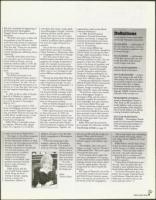
Rabbi
Tamara Kolton
organizations made up the North
American Federation.
In 1986, the International
Federation of Secular Humanistic
Judaism was formed. It merged the
existing Secular Judaism movement
with the Humanistic Judaism move-
ment in 10 countries.
A more recent affiliate was
Congregation Kol Chaim, founded in
Atlanta nearly six years ago by Dave
Savage, leader and president. It has a
loose affiliation with Secular
Humanist Judaism, he said. The con-
gregation of less than 100 people
meets at the homes of members, and
Savage says his job is "like herding
cats" because "most of the people
consider themselves whole human
beings not lacking anything by not
attending a congregation. So they are
much more willing to drop out."
Cutting and pasting from material
offered by Rabbi Wine's International
Institute of Secular Humanistic
Judaism, Savage is creating his own
siddur of poetry, music and readings.
The Institute, with its two centers,
one at Birmingham Temple in
Farmington Hills, and the other in
Jerusalem, supplies the movement
with anthologies and other literature
to draw from, Rabbi Wine said.
"Every community creates its own
celebration format," he said. "What
any community decides to use at any
given moment is up to that commu-
nity. They don't have to use the same
things in the same order every year.
We all change."
Rabbi Wine said the movement
serves people who otherwise wouldn't
THE FUTURE Is Now on page 10
Koltons ra pper
teens.
"My daughter, Julie, looks up to
Tamara so much," said Lori Schechter
of Bloomfield Hills. "She's such a good
role model for those girls."
At the temple school, which this
year has an enrollment of 78 young
people, Rabbi Kolton teaches Hebrew
language, Jewish music and an ethics
course for eighth-graders. She also
inaugurated the once-a-month Tot
Services.
Bill Trapp of Plymouth, one of the
five-member temple executive board,
said Rabbi Kolton's dynamic person-
ality is among the top reasons he and
his family joined the congregation.
SECULAR JUDAISM — a move-
ment that started at the end of the
19th century The idea is that Jews
are primarily a nation and a nation-
al culture rather than a religion.
Humanism includes the develop-
rnent and promotion of a national
language, Yiddish. Zionism was ini-
tially part of the concept. too.
HUMANISTIC JUDAISM
—
started at Birmingham Temple in
1963. Built on the foundation of
secular Judaism, with a strong per-
sonal philosophy of life taking the
idea of secular Judaism and adding
a strong humanistic philosophy.
SECULAR HUMANISTIC
Birmingham Temple
created the International Federation
of Secular Humanistic Judaism in
1986, combining the two afore-
mentioned forms of Judaism.
JUDAISM
—
at the
will be based on its abil to em race
pluralism. "There are Mar* roads to
the truth," she said, "and we must
understand this as a community."
Rabbi Kolton personally considers
herself an agnostic.
"I don't know if God exists or not,"
she said. "But I do believe that the
strength to solve problems has to be
found within myself and those I love.
"As Secular Humanistic Jews, we
believe the message of Jewish history
is self-reliance. Especially after the
Holocaust, we need to rely on our-
selves and each other." ❑
10/1
1999
Detroit Jewish News
7