
The Scene
'
•
vz.
•.:V••••••;•,..•••• , , , k,
• •
'.,• •••••••
g Detroiters see Israel through the eyes of t e natives..
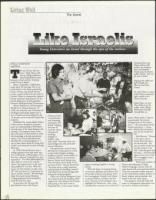
Clockwise from top:
Otzma alumni Jill
Lulkin, her husband
Sam and daughter
Emily enjoy an Otzma
sukka reunion. The cou-
ple met in Israel.
SHELLI DORFMAN
Staff Writer
T
he rest of your life can
0
wait," Mark Myers tells
_c
young college graduates
about spending the year
between school and the working
world living in Israel.
Myers, originally a Californian,
made aliya 20 years ago. He is cur-
rently back in the States promoting
Project Otzma, the Jewish Service
Corps, as part of his two-year stint in
Detroit. Myers is community shaliach
(Israeli emissary) and director of the
Jewish Federation of Metropolitan
Detroit's Michigan/Israel Connection.
Allison Rabinovitz of Huntington
Woods is an Otzma alumnus. In
1998, she took her new University of
Michigan psychology degree and a
love of Israel and participated in the
10-month, service-oriented leadership
program.
Established for young adults, Project
Otzma aims to develop in its partici-
pants an understanding of the history
and relevance of the Israel-diaspora rela-
tionship. The program's hope is that
they will return to their homes to share
this knowledge as Jewish community
leaders. The 23-year-old Rabinovitz
described the national program as "a
way to learn about Israel, by living with
Israelis" and seeing the country through
their eyes.
In 1998, Samuel Harwin was a
college graduate who had spent one
year working for a Washington, D.C.,
law firm, and was "looking for a new
experience." The West Bloomfield res-
ident did not want to be one for
whom "the opportunity to do some-
thing different" was lost. With the
luxury of "the freedom to take time
off" and the desire to "experience liv-
ing in another society," the Michigan
State University James Madison
College graduate found himself in
Israel for the first time.
A year later, the 24-year-old
described his time with Project
Enjoying the sukka are
Je Aronoffl Sam
Harwin and Steve
Grand.
Dr. John Marx, co-chair
of the Oztma committee,
right, speaks to the
Otzma veterans.
Eylah Myers, 6, and
Tracy Roth sit in the
sukka, while Allison
Rabinovitz and Jeff
Aronoff look on.
Otzma as both
a contribution
and a learning
experience. He
found "helping
the state of
Israel by volun-
teering and
teaching
English to
Israelis" valu-
able, while "learning where you
stand religiously and politically"
was an education.
He experienced a taste of army
life with two weeks spent on a base
in the Golan Heights, building
bunkers to protect Israeli soldiers in
Lebanon. Harwin sees American
Jews as "pretty much shying away
from the army, but in Israel, we see
an army of Jews." He also found that
the army serves a really important
social purpose for building a society,"
with those from diverse backgrounds
living and working together.
Each city's Otzma delegation lived
for a time in their Partnership 2000
region city. This allowed the Detroit-
area group to live and work in
Nazareth Illit, in the central Galilee
letters. Myers calls it "almost
unanimously the central,
strongest part of the experi-
ence — the nitty-gritty of the
Israeli experience — being
with a family, functioning as
part of the Israeli soci-
ety
region, teaching English to young
Israelis.
With the hope of creating lasting
connections between participants and
the people of Israel, each group mem-
ber was assigned a family with whom
to spend Shabbat, holidays and free
time. This part of the program was a
highlight for Rabinovitz, with a rela-
tionship that continues via e-mail and
Said Harwin, "Otzma
is not just a trip to
Israel. We lived there,
we all had jobs." He
says a tourist would not
see the country as he
did, "with the good and
the bad — the beautiful
place to live, even with
all its struggles, issues
and tensions."
With each member of
Oztma participating in Ulpan
Hebrew language courses, they all
came home with conversational skills.
They also attended weekly seminars
on the Arab-Israel conflict, politics in
Israel, religion and secularism, the
Israeli army and other topics.
The program involved work and
study in immigration absorption cen-
ters and in schools and human
Scanned image of the page. Keyboard directions: use + to zoom in, - to zoom out, arrow keys to pan inside the viewer.
October 01, 1999 - Image 104
- Resource type:
- Text
- Publication:
- The Detroit Jewish News, 1999-10-01
Disclaimer: Computer generated plain text may have errors. Read more about this.