

Ce eBraTe
The seventh day of Sukkot (starting
Thursday night, Sept. 30, or Tishrei
21) is HoShana Raba, which is both
a festival and day of judgment. It is a
day that truly shows us God's mercy
— and patience. For according to
tradition, this is really our last chance:
on Rosh HaShana, God makes his
decision regarding our futures; He
sort of sealed it on Yom Kippur, but
we have until HoShana Raba before
He REALLY makes up His mind.
The synagogue services on
HoShana Raba include the custom
of worshippers holding an etrog
and lulav and making seven circuits
around the sanctuary, during which
time special prayers, called
Hashanas, are said.
And how does it all end?
This last day of Sukkot is Shemini
Atzeret. Known as "the festival of
conclusion," it is mentioned in the
Tanach (Leviticus 23:36, Deuterono-
my 16:8, and Isaiah 1:13) as "a
holy convocation."
Shemini Atzeret (Tishrei 22) has
the distinction of being both part of
Sukkot and a separate holiday.
Observant families do not drive,
work, write or draw on Shemini
Atzeret (and follow all other rules
associated with any major Jewish
observance). But interestingly
enough, there are no real rituals for
Shemini Atzeret: no matza, no danc-
ing, no structures to build, no tasty
dishes to prepare, no costumes.
The one exception comes during
davening, when congregations
recite Hallel and Yizkor, and say a
prayer for rain called Tefillat
Geshem. (This is rainfall season in
Israel, and we wish for farmers all
that they will need.)
Reciting Tefillat Geshem is an
ancient practice, which began in
talmudic times. Then, a priest would
fill a golden pitcher with water.
When he returned from filling the
pitcher, he was greeted by a crowd
that would watch as the priest
poured the water and wine into a
container on the Temple altar.
amto ffari efid
CON
AT I:ON :SHAAREY ZEDEK REM HAY:
Shelli Dorfman
Staff Writer
C
ongregation Shaarey
Zedek in Southfield has
been host to many
anniversary parties in its 138
years — with friends and family
paying tribute to a multitude of
couples and organizations.
But on Aug. 27, nearly 400
guests were honored at the 50th
anniversary celebration of Beth
Hayeled Nursery School, where
most have been touched person-
ally.
Former and current students
joined together, and each
signed a guest list, divided in
sections by year of attendance,
from the 1950s to the 1990s.
Barbara Morse signed the top
of the list. As the youngest mem-
ber of the first Beth Hayeled
class, Morse said the school
was part of the synagogue her
mother always made certain she
thought of as home. Her
Shaarey Zedek memories,
including her consecration, high
school graduation, wedding
and the brit of her grandson, all
begin with her days as a 21 /2-
year-old nursery school student.
She said her "vivid, vivid memo-
ries of the A-frame upstairs sec-
tion of the old Chicago Boule-
vard building is where my mind
goes when I think of Beth
Hayeled."
Morse's daughters were also
students there, with her eldest
daughter, Jennifer Morse Mattler,
attending as the first child of a
member of the first class and Jen-
nifer's son Morgan, 19 months,
a Beth Hayeled parent-toddler
student, being the first grand-
child. With that in mind, Rena
Weintraub, director of Beth
Hayeled, invited four genera-
tions of the family to lead the
Kiddush at the Friday-night Shab-
bat anniversary celebration.
Morse said, "It meant so much
to be asked to participate in the
synagogue that has always
been in my life.
Sharing the honor with Morse
were her mother, Vivian Berry;
her daughter and son-in-law,
Barbara and Stephan Morse;
her granddaughters, Rachel
Morse, 27, and Jennifer Morse
Mattler, 31, along with Jennifer's
husband, Robert Mattler and
their son, Morgan.
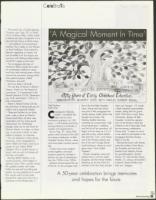
A 50-year celebration brines memories
and hopes for the future.
9/24
1999
Detroit Jewish News
71