

Mazel Toy!
41.
5 Pieces Of Silver
Buying back a first-born son is an ancient, joyous custom.
•
r.
•
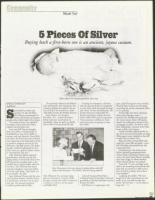
Elliot Meyers lies on great grandmas
silver tray.
6
SHELLI DORFMAN
Staff Writer
S
urrounded by smiles and
curiosity, 31-day-old Elliot
Max Meyers was presented to
family and friends on his great-
grandmother Adela Engel's silver platter.
The mode of entry was typical of
the pidyan haben ceremony, which
redeems the first-born son.
Susie and Jeff Meyers brought
their new baby to Young Israel of .
Southfield on Aug: 26 to fulfil an
ancient and rare mitzvah. Since bibli-
cal times, the first-born sons of Israel
were expected to be dedicated to God
to perform religious service for the
Kohanim, the high priests. The baby,
though, could be redeemed for five
silver coins at a pidyan haben, literal-
ly "buying back the son.
Toby Schlussel, Elliot's maternal
grandmother, said this was the first
pidyan haben in the family. Son-in-law
Jeff Meyers has an older sister, so he
couldn't have a pidyan haben when he
was born. Mrs. Schlussel has sisters,
and three daughters were born before
son Irvin came along. "Boys don't run
in our family," she said.
Susie Schlussel Meyers said the mitz-
vah of pidyan haben is halachic (based
in Jewish law), and there was no ques-
tion that "the unusual ceremony"
would be performed for Elliot.
The ceremony relates to the biblical
story of Hannah, who was barren, but
vowed to dedicate her child to the ser-
vice of God if she could have a baby
That baby became the Prophet Samuel.
Susie Meyers, now living in
Riverdale, N.Y., wanted the pidyan
haben ceremony to take place in
Southfield, where she grew up. Rabbi
Steven Weil of Young Israel of Oak
During the ceremony, a Kohain
asks the parents if they are prepared
to raise their child in Jewish heritage
and values. If not, the Kohanim, the
Jewish educators responsible for
Jewish continuity, would raise the
child. Rabbi Weil said this question
forces parents to define to them-
selves how they are going to raise
this child."
"
Susie Meyers gazes at her son during the pidyan haben while Jeff
Meyers reads the prayers. The Kohain, Edward Traurig, looks on.
Park officiated. The ceremony takers
place on the 30th or 31st day of life,
the age at which "the child is Viable and
we know he will live and be raised,"
said Rabbi Weil.
.
Edward Traurig of Oak Park, a
childhood friend of the baby's maternal
grandfather, Herschel Schlussel, was the
Kohain for Elliot..
Jeff Meyers, in agreeing to the
pact, paid Traurig five silver dollars.
Traurig then recited two blessings,
returning the newly redeemed infant
to his parents.
Technically, the short ceremony
takes place during a meal —
between the HaMotzi blessing and
the main course. Some 140 guests
shared the celebratory dinner at the
synagogue at tables covered in royal
blue tablecloths, centered with white
bears in blue satin kippot.
Family members placed jewelry on
the silver tray around the baby, to make
Elliot appear more valuable so that Jeff
would want to redeem him.
Blue and white netting filled with
sugar for a sweet life and garlic, a sym-
bol of fertility and productivity, also
surrounded him.
Participating in the simcha were
Elliot's paternal grandparents from
Miami, Betty and Joseph Meyers, and
many who knew Susie Meyers' grandfa-
ther, Isaac Engel, in whose memory
Elliot (Moshe Eliezer) was named.
Susie said, "It was a privilege to be
able to do something in the Jewish-reli-
gion that not everyone is able to be a
part of, and it is always nice to have
extra simchas."
Laughing, she added, "We were
happy to be able to purchase our son
back, so we were able to take him
home. We love him — so we want to
keep him." L J
9/17
1999