

No Illusions
Palestinians and Israelis say
final-status talks will be tough.
NAOMI SEGAL
Jewish Telegraphic Agency
Jerusalem
S
ix years after signing the first Oslo
accord at the White House, Israel
and the Palestinians have launched
final-status negotiations aimed at
ending their decades-long conflict.
But alongside hopeful declarations by
Israeli Foreign Minister David Levy and
Palestinian Authority official Abu Mazen at
a festive ceremony at the Erez Crossing to
the Gaza Strip on Sept. 13, both sides
made clear they are aware of the difficulties
that lie ahead.
"We are now entering the final phase to
reach a final arrangement between Israel
and the Palestinian which will hopefully
end years of suffering and conflict," Levy
said. "But no one is under any illusion.
It is no secret each side is coming to
the table with its own principles and posi-
tions," Levy said, "in which differences will
at times seem insurmountable."
Abu Mazen, who is Palestinian
Authority Chairman Yasser Arafat's deputy,
declared that Israel and the Palestinians
have reached the moment of truth and that
the Palestinians look with "hope and opti-
mism" toward a "historic reconciliation
between the two sides."
He stressed that the process must be
based on the principle of land for peace
and the establishment "of an independent
Palestinian state with Jerusalem as its capi-
tal." Abu Mazen said the Palestinians
would uphold their commitment to fight
terrorism.
"We have wasted much time in the
peace process," he said. "For that reason we
have decided to launch final-status talks in
an intensive fashion. If the Sharm el-Sheik
agreement is implemented, it will restore
Palestinian faith in the peace process."
In the agreement signed at the Egyptian
resort of Sharm el-Sheik earlier this month,
Israel and the Palestinians set an ambitious
one-year deadline to conclude a final-status
accord by Sept. 13, 2000 — and to resolve
the thorniest issues that the sides have until
now put off dealing with in interim agree-
ments These include borders, refugees,
Jerusalem, Jewish settlements, water, securi-
ty arrangements and the Palestinian entity.
Even before Israeli and Palestinian nego-
tiating teams get to work, observers sug-
gested that the sides have set an impossible
timetable to resolve the contentious issues
facing them.
In Jerusalem, Prime Minister Ehud
Barak's office issued a statement reiterating
Israel's position going into the final-status
negotiations: no return to the pre-1967
borders, Jerusalem will remain the united
capital of Israel, large blocs of Jewish settle-
ments will be preserved, and there will be
no foreign army west of the Jordan River.
Earlier Monday, Israel formally trans-
ferred to Palestinian civilian control 7 per-
cent of West Bank land, as stipulated in the
Sharm el-Sheik agreement. This was the
first of three further withdrawals called for
in the accord. P1
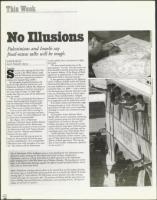
Top: A Palestinian Police draftsman views a map detailing the new Palestinian areas
marked in yellow showing the West Bank land which has been transferred to
Palestinian control as a result of the Sharm el-Sheik agreement at the Palestinian
police headquarters in the West Bank city of Hebron Monday. The handing over of the
maps to the Palestinians Monday signifies the official transfer of administrative rule in
these areas to Palestinian hands.
Right: Palestinian security prisoners about to be released lean out of windows flashing
the victory sign as Israeli border police guard the bus as it reaches the Nahal Oz border
crossing Sept. 9. Israel released 199 Palestinian security prisoners that clay, carrying
out the first stage of a new peace deal. The prisoners had been held for anti-Israel acts,
such as killing suspected Palestinian collaborators and wounding Israelis. All signed a
pledge not to revert to violence.
9/17
1999
N
911
Darnit IpwishNews