

THE ART OF THE SHOFAR from page R1
,
•
•
S..\\%,\
‘..%\'• \%. ".. k;kk ‘SVS.\•11.M.'SVn
the beginning of a new cycle, a clean
slate, with which to begin anew.
Other motives for the blowing of
the shofar have included the heralding
of the beginning of each Jubilee year.
According to Leviticus, every 50th year
the land was to be returned to the
original owners or their descendants,
all Israelites sold into slavery for debt
were to be freed and the land was to
lie fallow.
The shofar also has been employed
as a call to public assembly, to signal a
sacrifice and for military reasons, such
as the marshalling of troops to battle or
to intimidate the enemy. Another clas-
sical reason for the blasting of the sho-
far has been to keep away evil spirits.
In Israel today, the shofar still is
blown regularly before the Sabbath
begins and before public announce-
ments and national events. Since
ancient times, however, the shofar never
has been used as a musical instrument.
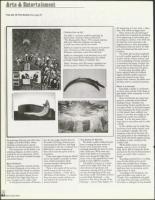
Clockwise from top left:
The shofar is a common symbol in paintings by
Jewish artists. Pictured is Harry Lieberman's
The Blessing of the Moon," 1977, private collection.
Folk artist Lieberman celebrates the ushering
in of the new moon and the new month.
Shofrot are created in much the same way as in ancient
times. Pictured is a 19th-century shofar, probably
Ethiopian, made from a ram's horn and coral.
Shofrot are commonplace in the decorative arts as well.
This mosaic mural by Ben Shahn graces the vestibule
of Temple Ohabai Shalom in Nashville, Tenn.
Shofar, Germany, mid-19th century; mahagony case
by Marcus Jonas, United States, late 19th century.
WA...M.. •
\
the paintings of Jewish artists like Marc
Chagall, and of Ben Shahn, whose
paintings currently grace a special
exhibit at the Detroit Institute of Arts.
The importance of the shofar as an
enduring religious, as well as artistic,
symbol lies in an explanation of how
and why it has been sounded through-
out Jewish history.
ROSH HASHANA
There is a particular moment during
the Rosh Hashanah service when con-
gregants hold their breath in anticipa-
tion; that split second of eerie silence
is broken just before Musaf, the sec-
ond half of the High Holy Day ser-
vice. A single word is called: tekia.
At that precise moment, all become
9/10
1999
R4 Detroit Jewish News
alert for the single, familiar blast of
the shofar. The long, sonorous tone
emanating from the horn, held high
and pointed to the sky, is ethereal. It is
followed by a joyous sequence of
blows that rouse the spirits of all in
attendance.
Three times again during the Musaf
service the shofar is sounded. At these
times, God's sovereignty, God's
covenant and the coming of the
Messiah are affirmed.
Then at the zenith of the service,
which comes at the very end, a
marathon of blares — from 10 to
100 blows of the shofar — is heard.
Even the most secular of Jews can-
not help but be stirred by these
ancient sounds.
THE SHOFAR IN HISTORY
The shofar, usually a hollowed ram's
horn, is among the most ancient of
known wind instruments. It has
remained essentially the same for more
than 5,000 years. While some may
think of the shofar as an instrument
blown only during the High Holy
Days, it has in fact regularly been trum-
peted on many different occasions.
The shofar, of course, is a major
motif of the High Holy Days and
their themes of repentance and
atonement, during which we honor
not just the beginning of the year,
but of the world. The shofar is blown
on both Rosh Hashanah — also
known as Yom Terua, the day of the
blowing — and on Yom Kippur. It's
WHAT IS A SHOFAR?
Essentially, a shofar is a hollowed-
out horn of an animal of the sheep or
goat family. Most commonly, it is the
horn of a ram.
Most contend that the ram's horn
serves as a reminder of the biblical
binding of Isaac. Abraham was
instructed by God to sacrifice his son
as a sign of faith. As the final moment
of the preparation for Isaac's sacrifice
to God neared, Isaac suddenly was
spared. A ram that was caught in the
underbrush nearby was sacrificed
instead. It is for this reason that a
ram's horn is most often used to make
a shofar.
In fact, shofrot may be made from
the horns of any kosher animal, such
as an antelope or gazelle. The only
exception is the use of the horn of a
cow, going back to the wanderings in
Sinai when the Jewish people turning
to idolatry in their worship of the
Golden Calf.
While shofrot come in varying
lengths, most are 10 to 12 inches
long. Some, like the Yemenite shofar
pictured on the Arts & Entertainment
cover, can reach 3 feet or more in
length.
According to Jewish law, it is oblig-
atory for the shofar to be curved
rather than straight like a trumpet.
The curved horn symbolizes the hum-
bled heart bent in contrition and in
subservience to God.
According to the Scriptures, two
types of shofrot were used in the
Temple. One, embellished with gold,
was made from the long, curved horn
of an ibex, a wild goat. It was sounded