

The sho ar
the most dominant
symbol of the
High Holidays —
and a work o art
in its own right.
ANNABEL COHEN
Special to the Jewish News
S
... HEAR THE SOUND OF THE SHOFAR (from the blessing for Rosh Hashanah).
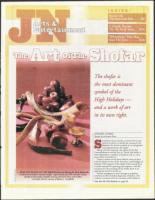
A collection of shofro• Yemenite shofar (top) courtesy of writer Annabel Cohen;
double twisted shofar (middle) courteof Daniel Stein of Franklin;
red shofar (ont) courtesy of-Spitzer's, Southfield
ounded at Sinai, Jericho, in times of war and
said to be blown to herald the coming of the
Messiah, few Jewish symbols are as recognized
and inspirational as the shofar.
Along with the menorah, the tablets of the Ten
Commandments and the Star of David, the shofar is
often depicted as a emblem of Judaism and is a corn-
mon theme in Jewish art. ,
There's a reason artists from biblical times on have
used the shofar as one of the dominant visual badges of
Judaism. The integrity of the shape of the curved horn
is easily conveyed in painting and sculpture. And the
occasions for the sounding of the shofar deem it an
appropriate motif in Jewish art.
Ancient synagogue art and carvings on primitive
tombstones often included depictions of shofrot. The
tradition continues with the inclusion of the shofar in
THE ART OF THE SHOFAR on page R4