

Tortured Ruling
Israel's High Court clamps down on long-used techniques
to extract information from suspected terrorists.
•
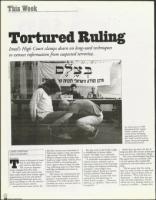
An Israeli actor in 1998
demonstrated the "regular
shabeh" method, one of
several torture techniques
reportedly used by the Shin
Bet, Israel's internal security
agency, during interrogations
of Palestinian prisoners.
LARRY DERFNER
Israel Correspondent
Jerusalem
T
orture is the story in Israel
that no one likes and no
one wants to talk about.
The country's Supreme
Court changed that this week.
For many years, the country has
been under attack from human rights
organizations at home and abroad
for torturing Palestinian terror sus-
pects and doing so with the sanction
of the nation's justice system.
Israel's domestic secret service, the
9/10
1999
36 Detroit Jewish News
Shin Bet, tortures up to hundreds of
Palestinian suspects a year, say human
rights groups. Security officials do
things to suspects such as shake their
heads and upper bodies violently, force
them to kneel in excruciating posi-
tions, deprive them of sleep, tie stink-
ing, suffocating sacks over their heads,
and blare intolerably loud music at
them for hours.
The reason: the ticking bomb the-
ory. It says that "moderate physical
pressure" is permissible to extract a
confession if it's believed that what's
revealed can stop a terrorist attack or
aid national security.
But this week, Israel finally sought
to rehabilitate its human rights
record. The High Court of Justice
ruled unanimously to outlaw torture.
"A reasonable interrogation is one
without torture, without cruel or
inhumane treatment of the interroga-
tion subject and without humiliating
treatment," wrote High Court
President Aharon Barak (no relation
to Prime Minister Ehud Barak).
"This conclusion accords with inter-
national law and agreements to
which Israel is a party ... These pro-
hibitions are 'absolute.' There are no
`exceptions' ..."
Barak then ran down the list of
infamous Shin Bet torture techniques
and, one by one, ruled them illegal.
The court acknowledged that Shin
Bet agents have an extremely diffi-
cult job against often implacable
opponents, and that failure can be
fatal.
We are aware that this ruling
does not make it easier to cope with
this reality," Justice Barak wrote in
the decision. "This is the fate of a
democracy — which does not con-
sider all means legitimate, and for
which not every method used by its
enemies is available ... Despite this,