

Getting Closer
Barak hopes for final peace deal on all but Jerusalem by February.
DAVID LANDAU
Jewish Telegraphic Agency
Jerusalem
t sounds like a tall order, but
Israeli Prime Minister Ehud
Barak seriously intends to have
the essential elements of the
Israeli-Palestinian dispute wrapped up
by February.
With the practicalities of imple-
menting the Wye accord squared away
- - a deal on when and how to imple-
ment the agreement was due to be
signed at a ceremony Thursday in
Egypt in the presence of U.S.
Secretary of State Madeleine Albright
— Israel and the Palestinians will be
ready to embark on the final-status
negotiations.
Israel and the Palestinian Authority
held intensive negotiations this week
in an effort to reach agreement for
implementing Wye, which was signed
last October.
In dramatic on-again, off-again
negotiations Wednesday, both sides
said they hoped to reach agreement by
the following day, when Egyptian
President Hosni Mubarak hoped to
host the signing ceremony during
Albright's visit to the region.
The agreement was expected to
include a timetable for the second and
third Israeli withdrawals from portions
of the West Bank that were spelled out
in the Wye accord. Former Prime
Minister Benjamin Netanyahu carried
out the first of those withdrawals last
November before suspending the
agreement, citing Palestinian non-
compliance.
The main sticking point in
Wednesday's talks was the issue of
prisoner releases. The Palestinian
Authority called for the release of
some 400 Palestinians held in Israeli
jails — after originally demanding 650
— while Israel offered freedom for
some 350 detainees.
But it was expected that these
remaining differences would be
worked out in time for Thursday's cer-
emony.
With this hurdle behind them, the
two sides will turn next to the final-
status talks, which will tackle some of
the thorniest problems confronting
them, including the status of
II:
9/3
Jerusalem, final borders, Palestinian
sovereignty and the return of
Palestinian refugees.
A formal opening ceremony for the
talks was held two years ago, but no
progress has been made since then, as
the two sides became bogged down in
disputes regarding the interim accords.
By February, according to Barak's
timetable, Israel and the Palestinian
Authority will reach a framework agree-
ment that will lay down the guidelines
for a solution of all the key problems
between them, except that of the status
and future of Jerusalem. Subsequent
intensive negotiations will result in a
full- fledged accord by the year's end.
The February document, as Barak
envisages it, will be no less historic
than the original 1993 Oslo accord, in
which Israel and the PLO exchanged
recognition and embarked on the
interim peace process.
The February document will pre-
sumably include:
• acceptance by Israel of Palestinian
independence;
• acceptance by the Palestinian
Authority that the "right of return" of
Palestinian refugees does not pertain
to territory within the State of Israel;
• an international mechanism to
resolve the refugee issue;
• agreement regarding the presence
of Jewish settlements in territory
beyond Israel's 1967 borders. The pre-
cise borders of the new Palestinian
state will be the subject of the subse-
quent negotiations, but their outline
will emerge in broad brush strokes
from the February document.
Barak is operating under the
premise that leaving issues unresolved
beyond the timetable he envisages will
only invite future strife.
Conceivably, the treaty envisaged
for the end of next year could be con-
cluded and signed with only the issue
of Jerusalem left unresolved.
The prisoner issue has generated
intense feelings on both sides. Israelis
fear that many of the prisoners will
quickly and unrepentantly resume
their terrorist ways.
Ahmad Soub-Laban, who sat in
Israeli jails for five years, is a case in
point.
He was 23 when he killed a neigh-
bor he suspected of having collaborat-
ed with the Israelis, and had thrown
gasoline bombs at Israeli policemen.
Even now, he doesn't regret a thing.
"It was all in the service of our peo-
ple," said Soub-Laban, now chairman of
the Jerusalem chapter of the Prisoners
Club. The nationwide organization has
as its primary goal helping the families
of Palestinian security prisoners.
The cabinet of Israel Prime
Minister Ehud Barak recently con-
firmed the principle that had guided
the previous Netanyahu government
— not to release prisoners "with blood
on their hands."
Justice Minister Yossi Beilin sided
with the Palestinian view that once
Israel negotiated with leaders of for-
mer terrorist organizations, it should
no longer rule out amnesty for their
emissaries.
"We have no moral right to do so,"
Beilin said.
But Beilin's voice was a lone one.
"There is no intention to release
prisoners with blood on their hands
who have murdered Israelis," said
Haim Ramon, the cabinet member in
the Prime Minister's Office responsible
for Jerusalem affairs.
The cabinet also reaffirmed the
policy that only members of organi-
zations that had stopped supporting
terrorism — and only those who
were arrested before the signing of
the 1993 Oslo accord — would be
considered for amnesty.
❑
For the latest on the peace talks,
please visit www.detroitjewish-
news.com
Written
From
Memory
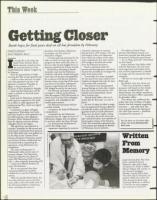
Joseph Amirian from New York,
center, assisited by his son
Raymond, right, adds a final
inscription to a Torah, as Rabbi
Marvin Tokayer, left, watches, in
the Oswiecim Synagogue
•Monday. A group of Jews from
New York came to Oswiecim, the
southern Polish town where the
Nazis- located the death camp
Auschwitz-Birkenau, to dedicate
a Torah for the only synagogue
that remained in Oswiecim.