

kvk ‘‘
tvs,\m t.k\qid
\k
""k`Nt.> \ .s t.'T --.
Vu\\•
\
::
20 11 i
Festival Headliners
The Montreux Detroit Jazz Festival was named for a small resort town in the Swiss
Alps that has hosted one of the world's great jazz festivals since 1966. The Detroit
incarnation of the festival began in 1980. In 1999, the festival celebrates its 20th
anniversary with over 750 musicians in 126 free performances on five stages during the
five-day Labor Day weekend (Sept. 2-6). For updated festival information, call the
hotline at (313) 570-PLAY or visit the official Web site at www.montreuxdetroit.com .
Here are some highlights:
• Dave Brubeck, one of the jazz world's best-known pianists, bandleaders and composers, will perform
at 8 p.m. Monday, Sept. 6, on the Ford/Air Touch Cellular Stage.
• Yusef Lateef & Eternal Wind bring elements of "world music" into their playing. Former Detroiter
Lateef marks his first hometown performance in two decades at 9:45 p.m. Monday, Sept. 6, on the
Ford/Air Touch Cellular Stage.
• Bob James discovered jazz while majoring in composition at the University of Michigan in the late
1950s. The three-time Grammy winner and his quartet, along with Alexander Zonjic, will perform at
6:45 p.m. Friday, Sept. 3, on the Ford/Air Touch Cellular Stage.
• Kenny Garrett Quartet, led by the former Detroit saxophonist who played with Duke Ellington and
Miles Davis, will perform at 8 p.m. Saturday, Sept. 4, on the Ford/Air Touch Cellular Stage.
• Roomful of Blues, known as the ultimate blues road warriors, will bring their trademark horn-powered
blend of classic and jump blues to the Ford/Air Touch Cellular Stage at 9:45 p.m. Saturday, Sept. 4.
I consume a lot of cultural product.
My voraciousness about culture has
something to do with my Jewish
roots. It's the study of life through cul-
ture," Mandel says.
The way I see people expressing
themselves through the arts — express-
ing their feelings — I connect that with
my interest in Judaism. And I like Jewish
culture for this reason, whether it's
Philip Roth or Kafka or Woody Allen."
What about the presence of
Jewish culture in jazz? Although Al
Jolson in The Jazz Singer — or even
Neil Diamond — may come to
mind when we think about jazz, the
genre does not seem characteristical-
ly Jewish. But Mandel's Future Jazz
assures us there is an intersection
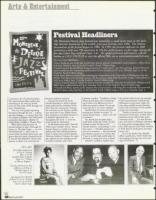
Left to right:
Geri Allen performs at
2:45 p.m. Sunday,
Sept. 5, on the
Ford/AirTouch Cellular
Stage in a "T-ibute
to Marcus Belgrave."
The Joey DeFrancesco Trio
performs at 3:30 p.m.
Monday, Sept. 6, on
the D TE Stage.
Jazz legend Dave Brubeck
per forms at 8 p. m. Monday,
Sept. 6, on the Ford/Air
Touch Cellular Stage.
8/27
1999
92-66tiaaVskg-NRi?'-1
between Judaism and jazz.
Toward the end of the book,
Mandel describes in detail a special
seder performed by members of the
New York jazz community. Among
the musicians at the Passover celebra-
tion were John Zorn, Shelly Hirsch,
Roy Nathanson and Mark Dresser. It
is Mandel's approach here — as
throughout the book — to let the
artists speak for themselves.
In the brief section titled, "And the
Walls Came Tumblin' Down," the per-
formers discuss in candid and corn-
pelling ways their individual relation-
ships to music and to Jewish identity.
Musician Anthony Coleman, for exam-
ple, explores his own ambiguous rela-
tionship to Judaism and to jazz.
Coleman wonders, "Is Judaism a thing?
What's Jewish about me? I started try-
ing to look at my affections to see if
there's any reason to them. Or was my
music just me in my room, isolated?"
Mandel does not insist upon forced
conclusions. Rather, he writes, "In
radical Jewish music ... there is no end
in answers."
Yet, Jewish jazz occupies only a
small niche of the jazz world. "It's fas-
cinated me that it's there at all,"
Mandel exclaims. And perhaps it is for
that reason — Mandel's genuine sur-
prise at its existence — that the Jewish
jazz element stands out in Future Jazz
"I gave it a fairly high profile place in
the book. It comes sort of as a climax."
Mandel is careful to explain that
this special niche is just one example
of the many-faceted, multicultural
influences on jazz music today. He
cites other parallel musical develop-
ments that contribute to the contem-
porary jazz movement.
"Similar to Jewish music having an
interaction [with jazz], so does Asian
American music and so does Latin
American music. ... I've seen Russian
jazz, and music in Finland, and music
in some pretty strange places where
they didn't get jazz until fairly recently.
I think they've [each] given jazz back
quite a lot."
True to his book's title, Mandel
offers a prediction, "And I think that
that's going to be the way we're mov-
ing in the future." I 1