

Growth And ambivalence
New Reform day schools are opening around the country,
but the movement at large is indi Brent to the young institutions.
'ULIE WIENER
C.+
:10
Newish Telegraphic Agency
,'
ew York
n many ways, Rodeph Sholom
School looks like any other elite
Manhattan private school.
Walls are covered with color-
ful student art and the small courtyard
playground is meticulously main-
tained. Dressed-for-success, cellphone-
,ring parents clamor into the kinder-
garten classroom for a special program
where their children show what they
learned about dinosaurs.
But alongside the pictures of
nature and New York hang crayoned
illustrations of Bible stories and
Jewish family trees.
At the "dinosaur breakfast," kinder-
gartners don't just show off the fossil
41icas they have created, but proudly
present miniature handmade "Torah"
scrolls in which there is a page about
each Jewish holiday.
Rodeph Sholom — which enrolls
530 students in nursery school through
sixth grade — is part of a small, but
slowly growing network of Reform day
schools, which are increasingly being
‘;cgarded as training grounds for the
movement's future leadership.
Seen as an antidote to the Jewish
community's assimilation woes, day
schools — which offer secular and
Judaic studies under one roof — are
proliferating throughout North
America. But while day schools have
' long been accepted in the Orthodox
,and Conservative communities,
Reform Judaism has had a more
ambivalent relationship to them.
When a small group introduced the
idea of Reform day schools in the
1960s, opponents argued that day
schools were "inimical" to Reform
Judaism.
Michael Zeldin, in a 1997 article
for a Reform Jewish publication, quot-
,d an opponent of the schools: "As a
modernist movement committed to
democratic principles and integration
into the life of the community,
Reform Judaism could not support a
system of schools that separated Jewish
children from their non-Jewish neigh-
bors." Zeldin is a professor at the
U
--
/
/
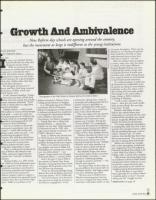
Third-graders at the Solel School in Arizona look at the Scroll of Esther.
Reform movement's Hebrew Union
College-Jewish Institute of Religion.
At a 1969 gathering of the Reform
movement's Union of American
Hebrew Congregations, leaders sound-
ly defeated a proposal that would have
encouraged the experimental develop-
ment of Reform day schools.
Nonetheless, two Reform synagogues
— Temple Beth Am in Miami and
Rodeph Sholom — opened day
schools one year later. Others gradual-
ly followed suit and in 1985, with
eight schools already in operation, the
UAHC softened its stance.
Today, 22 Reform day schools exist
in North America. But despite the
changes, Reform day schools still face
problems finding broad-based support.
While a new school is opening in
Los Angeles, and ones in Dallas and
Philadelphia are entering their second
year, two other schools — Los
Angeles' Temple Isaiah and Chicago's
Rosenwald School — recently closed.
And in the past 15 years, Reform
day schools in Detroit, New Jersey,
Brooklyn and Long Island have closed,
not gotten off the ground or have bro-
ken off from the movement.
"There are still mixed feelings among
Reform Jews and the Reform movement
about day schools," HUC's Zeldin said.
"One of the lessons we've learned is
that you have to begin by drawing on
the Reform congregations" in the
community; "giving them a sense of
ownership and making people feel the
school's success is dependent on
them," said Rabbi Eric Yoffie, presi-
dent of the UAHC and a vocal cham-
pion of day school education.
That may explain why the majority
of Reform day schools, unlike most
Orthodox and Conservative ones,
operate out of temples. Having the
"security blanket" of a congregation
ensures that the school has a solid base
of institutional, financial and rabbinic
support, said Irwin Shlachter, head-
master of New York's Rodeph Sholom.
Shlachter describes his school as one
that aims to "compete effectively with
the best private schools, but do the
learning through Jewish eyes." Rodeph
Sholom's critics often describe it as
more of a fancy school with Jewish
students than a Jewish day school.
But Michelle Singer, who directs
the school's Judaic studies curriculum,
said the Judaic curriculum — once
limited to "celebrating holidays
through art projects and food" — has
become quite rigorous.
"In terms of what we do in class, it's
not that different from Conservative or
Orthodox schools," said Singer, a grad-
uate of an Orthodox day school.
"We learn texts in Hebrew, have
Shacharit (morning prayer) services
and try to integrate the social studies
curriculum with Judaic studies, so that
it's woven throughout. We're very tra-
ditional in our teaching and practice
here at school so the kids can then
make educated choices about how
they want to observe," she said.
How the children observe Judaism
at home, rather than what they learn
in school, is the major difference
between Rodeph Sholom and more
traditional day schools, Singer said,
noting that the level of Jewish com-
mitment varies widely among the par-
ents, many of whom are intermarried
or have limited Jewish education.
"It's a delicate balance to make sure
all the parents are comfortable. A lot
of parents are asking for more Hebrew
and Judaic studies, but others worry
about losing time for secular studies."
The changes in the school reflect a
larger change in Reform Judaism,
according to Shlachter.
"I used to call it Judaism in the
closet — don't give too much, be like
other private schools. But now they
want more," he said.
Shlachter and leaders of other
Reform day schools believe their
schools play an outreach role that more
traditional day schools do not, mostly
because marginally affiliated Jewish
families find them less threatening.
"If a couple makes the commitment
to sending their child here, then I don't
question their practices at home, unless
they do something like wear a cross to
school," Shlachter said. "I'd rather
embrace these families than know they
feel excommunicated. This is our one
last shot at keeping these kids Jewish."
Reform day schools vary consider-
ably in their atmosphere, outlook and
size, ranging from the 750 students at
Toronto's Leo Baeck Day School to 44
at Beth Hillel Day School in Valley
Village, Calif, a suburb of Los Angeles.
Leslie Litman, the former Judaic stud :-
ies coordinator at Boston's Rashi School,
said questions of how observant, or even
how Jewish, a school should be often
surface, particularly at new schools wor-
ried about scaring off potential parents.
"Do all kids have to wear kipot?
How rigorously do we enforce whatev-
er kashrut policy we have?" she,said,
adding that the "struggle between
AMBIVALENCE
on page 18
8/2
19'
Detroit Jewish News
1k