

public school - again feeling like an
outsider because of his poverty.
He also confronts his own feelings
of racism, like his resentment in col-
lege when he was passed over for a
scholarship — after he was told he
was ranked first — in favor of a black,
part American-Indian woman.
His personal anecdotes are presented
in brief chapters, alternating with other
vignettes — other people's stories,
quotes from W.E.B. DuBois, Langston
Hughes, Toni Morrison and others —
and his reporting and reflecting on
racial themes in everyday life, like street
encounters and hair and '`whiteness."
He writes: "White people, while
vigilantly aware of the presence of
blackness, are most often oblivious to
the psychological and political weight
of their own color. Black people can-
not help but evaluate the status of
their blackness in relation to the
racism they experience every day."
He describes himself as "a very
unoptimistic person about , the future
of race relations," adding, "racism isn't
going to go away easily." He feels •
strongly that most Americans don't
know how to talk about race, and that
what passes for public discourse is
often "received ideas that are repeated
over and over again to people who
don't want to be convinced."
Since the book has been pub-
lished, he has turned down many of
the usual publicity opportunities,
like appearing on talk radio, because
he thinks they encourage "sound
bites and anger" rather than authen-
tic, subtle dialogue. "My real moti-
vation is to produce a situation that
will allow people a degree of comfort
to think about themselves," he says.
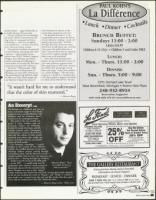
"It wasn't hard for me to understand
that the color of skin mattered."
BRUNCH BUFFET:
Sundays 11:00 - 2:00
Adults $16.95
Children 6-12 $1/yr. • Children 5 and Under FREE
LUNCH:
Mon. - Thurs. 11:00 2.00
DINNER:
Sun. - Thurs. 5:00 - 9:00
7295 Orchard Lake Road
West Bloomfield, Michigan • Robins Nest Plaza
248-932-8934
Reservations Suggested
— Maurice Berger
VISIT OUR WEB SITE AT: www.ladifference.com
An Excerpt
All through my childhood and into my
teens, I remained caught in racial limbo,
trapped between my identification with
blackness and the awareness that I
would never be anything but white. .
The pull of the two worlds was
great: a racist mother and an
antiracist father; an Orthodox
Jewish life inside the home and life
outside infused with Christianity
and blackness; teachers who believed
that only the culture of white people
mattered and others who taught me
about civil rights and the accomplish-
ments of black people.
On Saturday mornings, I would
awaken to the sounds of two different
worlds: the muffled baritone of my father
chanting Hebrew prayers coming through
my bedroom door, and the Motown records —
Aretha Franklin, Marvin Gaye, the Supremes, the
Jackson Five — blaring through my windows.
Aretha I secretly loved. In the fifth grade
Maurice Berger: "Once
— it was 1967 — I would sneak into the
in a while we have to
auditorium after school to watch a group of
,,
look at ourselves.
black girls rehearse for the monthly talent
show. I looked on in awe as they "played"
Aretha, bobbing their heads back and forth, waving their hands elegantly
in the air, lip-synching the words to "Respect" and "Think." I wanted to
play Aretha, too. I wanted to be hip and cool like Aretha, like these girls. I
never told my mother how I felt, but I think she knew.
— Maurice Berge; from "White Lies"
Raw
Juice Bar
Open 7 Days
Lunch and Dinner
Mideastern and American Dining
Now Serving Wines, Beer and Spirits
LATHRUP VILLAGE
27060 Evergreen
at 1-696 & 11 Mile Rd.
in Lathrup Landing
(248) 559-9099
WEST BLOOMFIELD
6123 Haggerty
North of Maple
Bloomfield Avenue Shoppes
(248) 668-1800
r
5%
FF
Buy One Entree
Get Second Entree
Equal or Greater Value
25% OFF
• Dine in only • With Coupon
• 1 Coupon per Couple
• Not Valid With Other Offers
JN
• Expires 12-31-99
CATERING FOR ALL OCCASIONS
THE GALLERY RESTAURANT .4111)
Enjoy gracious dining amid a beautiful
atmosphere of casual elegance
A
P>
4i
i
BREAKFAST LUNCH DINNER
OPEN 7 DAYS: MON.- SAT. 7 a.m.- 9:30 p.m. SUN. 8 a.m.- 9 p.m.
West Bloomfield Plaza • 6638 Telegraph Road and Maple • 248-851-0313
- "11411111.111
8/20
1999
Detroit Jewish News
89