

Rejectionist Dilemma
Palestinian hard-liners suddenly find it easier to shake Arafat's hand.
GIL SEDAN
Jewish Telegraphic Agency
Jerusalem
sraeli hard-liners opposed to
trading land for peace with the
Palestinians are not the only ones
who suffered a major setback as a
result of Israel's recent elections.
Palestinian radical groups based
in Damascus also fear they may
become sidelined if the hopes for
peace that accompanied Israeli
Prime Minister Ehud Barak's elec-
tion begin to materialize.
The groups, collectively known as
rejectionists, because of their staunch
opposition to the Oslo process and their
long-standing call for the annihilation
of Israel, are not only focusing on a pos-
sible Israeli-Palestinian peace treaty
If there is progress on the Israeli-
Syrian negotiating front, they may
also find that Syrian President Hafez
Assad will expel them from their
bases in Damascus.
Given such sobering scenarios, it is
not surprising that the groups are sud-
I
denly willing to meet with Palestinian
Authority Chairman Yasser Arafat, the
man they have long accused of selling
out Palestinian aspirations by embark-
ing on the Oslo process.
Last week Arafat met in Cairo
with representatives of one of those
groups, the Popular Front for the
Liberation of Palestine. The talks
focused on ways to bring the groups
back into the mainstream Palestinian
Liberation Organization.
Arafat hopes to forge a unified
Palestinian front in advance of final-
status talks with Israel, which attempt
to achieve a permanent agreement
between the two sides.
The leader of the Popular Front,
long-time Arafat rival George
b Habash,
did not participate in the meeting, but
he is expected to meet soon with
Arafat — as is the leader of the
Democratic Front for the Liberation
of Palestine, Nayef Hawatmeh.
By meeting with Arafat, the groups
are hoping for "genuine participation
in the decision-making" processes of
the Palestinian leadership, Hawatmeh's
deputy, Keis Abdul Karim, said over
the weekend.
With this goal in mind, a spokesman
for the Popular Front, Maher Al-Taher,
said Monday that his group is calling
for new elections for the PLO's top
political bodies: the Executive
Committee and the Central Council.
While they are
now considering a
return to the
PLO, the rejec-
tionists are still
having trouble
reconciling with
Arafat's policies.
During a meeting
Monday in
Damascus, repre-
sentatives of the
groups said they
still would main-
tain distance from
the self-rule gov-
ernment if Arafat
continues to abide
by his peace agree-
ments with Israel.
But, given their ongoing contacts
with Arafat, such pronouncements
soon may become a rarity.
In an indication that the rejection-
ists may close ranks soon with Arafat,
two of the groups recently became
involved in Palestinian social projects.
DILEMMA on page 24
Stumbling At The Start
Critics say Barak ignores advisers, which leads to diplomatic blunders.
DAVID LANDAU
Jewish Telegraphic Agency
Jerusalem
B
y the time U.S. Secretary
of State Madeleine
Albright arrives in the
region early next month
for her peacemaking trip, the state
of Israeli-Palestinian relations per-
haps may have improved.
But even if there is an end to the
current round of daily disagree-
ments regarding the land-for-securi-
ty Wye Agreement, a growing num-
ber of people are less than impressed
with Prime Minister Ehud Barak's
initial essays at diplomacy.
Discomfort has spread in govern-
ment circles over the gap that has
opened up between the new prime
minister's high intellectual attain-
ments and what they view as his sig-
8/13
1999
22 Detroit Jewish News
nificantly less impressive interper-
sonal achievements.
As a result, while the huge fund of
sympathy for Barak and his policies is
far from exhausted, it has been dis-
cernibly depleted.
Summing up the assessment of the
premier, one minister called Barak's
recent dealings with the Palestinians
"the mistake of a political neophyte."
Observers point to what they
describe as a major blunder Barak
made during his whirlwind round of
meetings with world and regional
leaders during his first weeks in office
— going public with his plans to pro-
pose a revision of the Wye accord.
Pointing out that the agreement
was negotiated by an Israeli govern-
ment fundamentally reluctant to
proceed with the Oslo peace process,
Barak warned that the Israeli with-
drawal from an additional 13 per-
cent of the West
Bank under Wye
would leave sev-
eral Jewish settle-
ments isolated
E\
within territory
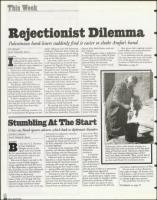
Mohammed Laham washes bunches of grapes in a
controlled by the
bucket of _precious water at his home in the West Bank
Palestinian
village of Tsurif last month. Palestinians angrily blame
Authority.
Israel for water shortages plaguing dozens of their
It would be
towns and villages this summer. Water, and the lack of
far better, Barak
it, has become a growing source of political tension —
suggested, to post-
one that could threaten the revived peace process.
pone implementa-
tion of portions of
the accord until
meticulous implementation of Wye.
after the start of talks on a permanent
On one score, at least, Barak has
Israeli-Palestinian agreement.
been right on target. He foresaw, and
While some of the arguments
still foresees, a rash of terror incidents
were considered quite cogent, once
as Palestinian radicals attempt to sour
Barak had made his thoughts public,
an already fragile peace process.
Palestinian Authority Chairman
His prediction was borne out
Yasser Arafat was quick to reject
them and to demand the full and
STUMBLING on page 25