

The
In Jewish Education
fildith
Way.,
We
Learn
Time To Study
Our community
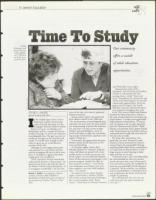
Friedrnan a nel
Sonya Miyerov
study together
at a „ 'Wailers
in Torah" pro-
gram in June.
ers a wealth
of adult education
opportinities.
STUART J. SNIDER
Special to the Jewish News
I
n the Middle Ages (when I was in
elementary school), the principal
mode of Jewish education was the
synagogue afternoon Hebrew school.
From 4 to 6 p.m. on Mondays and
Wednesdays and for a couple of hours on
Sunday mornings, we were to be trained as
knowledgeable Jews. The goal was that we
would get through our bar mitzvahs and,
maybe, we would retain enough so that,
when we grew up, we would become
members of the shul.
Although to some degree those goals
were achieved (we were all bar mitzvah,
and the synagogues all seem to have mem-
bers), in retrospect it appears that those
simple goals were insufficient.
Thirty years later, the bar mitzvah has
unfortunately become a "theme party," the
theme having little to do with any title in
the Hebrew school's course description. As
to synagogue membership, I am sure that
Stuart J. Snider is an attorney, a board
member of Yeshiva Beth Yehudah in
Southfield and Oak Park and a member of
the presidium of Machon LTorah in Oak
Park.
most of the kids with whom I graduated
belong somewhere.
But do today's adults, who graduated
from Hebrew school in the 1960s and
'70s, see themselves as knowledgeable Jews
educated with more than the most superfi-
cial understanding of Jewish life, literature,
law, and lore? Can they convey to their
children and grandchildren a sense of
Jewish self-esteem to fight the overwhelm-
ing scourge of assimilation, ignorance and
apathy? I think not.
Fortunately, the opportunities for post-
Hebrew school Jewish education in this
town are flourishing.
On Tuesday nights, Yeshiva Beth
Yehudah sponsors its "partners" program,
where individuals are paired.with a com-
patible teacher to study, one-on-one, any
Jewish subject. An unusually full represen-
tation of the community participates in the
partners program. Indeed, the odds are
that someone you know — your lawyer,
your landscaper, your banker, your next-
doOr neighbor, even your child's pediatri-
cian — is a partner.
For those of you for whom Tuesday
night is inconvenient, Machon L'Torah,
the Jewish Learning Network of Michigan,
has a similar program titled "Torah
Teams," which meets on Monday (women)
and Wednesday (men) nights.
Organizations such as Ohr
Somayach, Aish HaTorah and Machon
L'Torah as well sponsor day and
evening classes, weeldy "lunch and
learns" throughout the community and
will be more than happy to set up indi-
vidual study opportunities. Area syna-
gogues and the Agency For Jewish
Education sponsor adult Jewish educa-
tion programs throughout the week.
In the 19th century, Rabbi Israel Salanter
founded the Musar Movement (Musar is
the study of ethical behavior and proper per-
sonal conduct). A student once approached
Rabbi Salanter and asked him, "If one has
only 10 minutes a day to study, should he
learn the Talmud or study Musar?" Rabbi
Salanter answered that such a person should
study Musar because he would then come to
understand that he really had more than 10
minutes a day to study
For those who, nonetheless, have
absolutely "no time" during the week,
Machon L'Torah maintains an extensive
cassette library for automobile listening,
including Rabbi Berel Wein's extraordinary
117-tape series on Jewish history I chal-
lenge anyone to start listening to these
tapes and then try to stop.
The bottom line is that notwithstanding
the well-intended but short-on-content
Jewish education that many (if not most)
of us received as youths, the availability of
painless, yet meaningful Jewish education
is plentiful. We do ourselves, our children
and our grandchildren a tremendous favor,
and we guarantee the future of the Jewish
people, by partaking.
You will find that the time you set
aside to be the best spent minutes of
your day. 17i
1999
Detroit Jewish News
73