

v
W ay
We
Learn
Education Is Universal
Adults must grow spiritually and educationa4
RABBI AVROHOM FISHMAN
Special to the Jewish News
"We must ahvays remember thai the
true accomplishments of a school and its
teachers are measured before G-(1 and in
the eyes of any thoughtful observer by
what they have been able to do for less
gified students.''
in developing and using cognitive
strategies; others may have written or
oral language difficulties. On the
other hand, there are students who are
gifted and talented who need the extra
time and lessons to help motivate
them.
This diversity requires a greater
community awareness of the respon-
sibility to provide specialized pro-
grams where needed. The Agency for
Jewish Education's Opening the
Doors program as well as the
Michigan Chapter of P'TACH are
two of the community resources we
currently employ in our effort to
deliver the education and attention
every child deserves. The success of
field, we recognize that Jewish edu-
cation should not end with elemen-
tary, or even high school. Adults also
have an obligation to grow spiritual-
ly and educationally. Parents of day
school children have an even greater
responsibility to be involved in their
own growth so they can foster and
develop the education of their chil-
R
abbi Samson Raphael
Hirsch's statement
about the importance
of providing a Jewish
education to all is as relevant
today as it was when it was writ-
ten more than 125 years ago.
What starred at Yeshiva Beth
Yehudah 85 years ago as a novel,
almost unique, notion has
matured into a well-respected
convention: Every Jewish child is
entitled to a Jewish education and
each must be treated as an indi-
vidual with particular needs.
As our pedagogical experience
has grown, we have come to
adopt a model of inclusion.
We have worked hard
to successfully inte-
grate all children
into a diverse
classroom set-
ting. Still, there
are many dif-
ferent types of
students in
each class.
The majori-
ty of students
flourish within
the current
framework and
utilize their learn-
ing skills to the
benefit of the entire
group. Others may
require some assistance to
maintain their studies at the
class level.
Some students may have difficulty
paving attention; some may be lagging
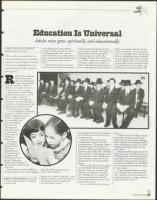
Top: The 1999 . -radztating class of
Yeshiva Beth Yelmdah.
Rabbi Avrohom Fishman is the dean
Ye'shiva Beth Yehudah in Southfield
and Oak Park.
Above circle: Yocheved Garfinkel, 7, and
Shoshana Krohnei; 8, both of Oak Park,
checked the graduation program for
their big brothers' 11 a in CS .
0
these programs needs to be duplicat-
ed to enhance the array of services
we can provide.
There is another avenue for
reaching these students that has
shown promise. "Grouping" similar-
ly skilled students for just 20-25
minutes a day can provide the extra
attention each child needs. Working
with a reacher in small groups of no
more than four or five children at a
time can play a major role in the
development of the child and the
group.
We have learned a lot about educa-
tion since Rabbi Hirsch opened his
schools in Germanya century ago.
What has not changed is our goal.
Our challenge now is to apply our
experience to help assure that all
Jewish children receive the care and
attention they need.
As \.ve examine the future of our
dren.
Children need to see their own par-
ents make a priority out of Torah
study and to make time for learning.
This is the key to developing children
who will continue to grow ever more
dedicated to Judaism and their par-
ents' values.
One successful component of this
effort has been the Yeshiva's Partners
in Torah project. By including many
more adults in this wonderful prac-
tice of learning and growing togeth-
er with their children, we will build
the strong foundation for the future
of our people.
In our wonderful Detroit commu-
nity, education has truly become the
No. I priority. Let us all continue to
work together for a stronger and more
educated Jewish future. LI
8/6
199
Detroit Jewish News 62