
At The Movies
Commander In Chief
On the 25th anniversary of the resignation of Richard M. Nixon,
a Syrian Jew portrays the beleaguered 37th president in "Dick.'
JN: You had a small role in Oliver
Stone's Nixon as Bebe Rebozo, but
you've said that you didn't look at the
work of other actors who've por-
trayed Nixon. Is that so your perfor-
mance wouldn't be tainted?
DH: I wouldn't use the word tainted. I
just wasn't interested. I didn't feel the
necessity, because I lived then, and
observed Nixon. Why would you want
to observe an actor? Everything is so
embedded in everybody's memory. [As
for viewing footage], there were just
two specific televised speeches, those
that I had to re-create in the film.
SERENA DONADONI
Special to the Jewish. News
A
t this point in his long and
prolific acting career, Dan
Hedaya has reached critical
mass. His television roles
(particularly as Carla's shifty ex-hus-
band Nick on Cheers and its spinoff,
The Tortellis) and extensive stage work
aside, Hedaya has become a ubiqui-
tous presence in American movies.
The hirsute Hedaya, 59, easily
embodies extremes. His characters
range
to sleazy,
: often
b
z-, from dignified
falling into a slippery place in between:
Bette Midler's philandering spouse in
First Wives Club; Alicia Silverstone's car-
ing but distant lawyer father in Clueless;
a demanding, take-no-prisoners Angel
Gabriel in A Life Less Ordinary; and one
of his best, the jealous husband who
hires a hitman in the Coen brothers'
stunning debut, Blood Simple.
Now comes a marvelous bit of cast-
ing — Hedaya as Richard M. Nixon in
the satirical comedy Dick (Rated PG-
13), which re-imagines the Watergate
scandal through the eyes of two none-
too-bright teenage girls (Kirsten Dunst
and Michelle Williams) who stumble
upon White House secrets and facilitate
the president's downfall by becoming
Carl Bernstein and Bob Woodward's
infamous informant, Deep Throat.
For someone who works as much
as he does (he's currently filming The
Crew with Burt Reynolds and Richard
Dreyfuss), Hedaya is surprised both
by his success and career longevity'.
Born in Brooklyn of Syrian Jewish
descent, Hedaya didn't discover acting
until he attended Tufts University in
Massachusetts, where he spent four
years basically floundering academical-
ly. Disgusted with the hazing of Frater-
nity life, he became drawn instead to
on-campus theatrical productions.
"I just kept doing plays," he
explains, "but I didn't think I was
going to be an actor. I didn't know
what I was going to do."
Graduating with a degree in litera-
ture, Hedava began reaching junior
high school English and mathematics.
A friend encouraged him to take acting
classes and it was - then that my inter-
JN: Dick is quite funny; but your
Nixon isn't a buffoon. What was your
approach?
DH: I'm not a comic. There s not any
great need for another caricature or paro-
dy. You can be aware of something being
funny without playing it as comedy. The
scenes with Nixon after the trouble start-
ed, they could come out of a drama.
When he was in the office with the dog
listening to the tapes, the man was in
anguish. It's funny that Pat's snoring in
the background and he's drinking, and
he goes crazy and begs her to stop snor-
ing. It's funny, but it could be life.
'
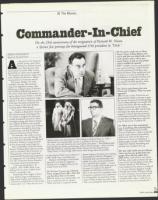
Clockwise from top: Paranoid prez: Dan Hedaya as Richard Nixon in "Dick."
"His actions were reprehensible, not just as a politician but as a person. ...
IM a Jew, so his anti-Semitism was a particular (sore poind." Saul Rubinek plays
National Security Adviser and Secretary of State Henry Kissinger. Arlene Lorenzo
(Michelle Williams) and Betsy Jobs (Kirsten Dunst) take the assumed name
"Deep Throat" as they divulge information which brings down the president.
est got piqued. There was no dream, in
other words, that I was following."
Hedaya's refreshingly workmanlike
approach to acting was apparent
recently in Los Angeles when he dis-
cussed Nixon and Dick.
JN: It's been 25 years since Richard
Nixon resigned from office. How did
you feel about him at the time?
DH: His actions were reprehensible, not
just as a politician but as a person.
When you look at, in general, all the
abuses of power, the hubris, the cunning,
these people [involved in Watergate] —
they'd lost their sense of humility com-
pletely. I'm a Jew, so his anti-Semitism
was a particular [sore point] — I wasn't
aware of it actually, until I heard some of
the tapes. As a person; he's kind of
pathetic and all of that. It's funny how
after, in the years of his restoration, when
he became a statesman and a spokesman
for foreign policy, he acquired a certain -
respect. When he died, it was like a joke.
They were praising him like he was pure.
JN: What was it that intimidated
you, if anything, about playing him?
DH: I had apprehensions initially
because of the voice. I had a wonderful
speech coach, Howard Samuelsohn,
and he met with me for about two
hours in my house in Manhattan. I
had laryngitis actually, which I think
might have helped. Something just
clicked, and I couldn't shut up.
JN: You really nailed not just Nixon's
voice, but his very quirky body Ian- .
guage. How did you tackle that?
DH: When I was a kid, I was a base-
ball fan, and I used to imitate the pos-
tures of my favorite players at bat, like
Mickey Mantle or Ted Williams. I
never looked in the mirror or analyzed
it. It's just whatever happens visually
through your mind. Without making
it into a mockery, if VOU tried to posi-
tion your arms like Nixon did, you
would be able to do it, really, if you
closed your eyes and remembered.
,
8/6
1999
Detroit Jewish News
103
Scanned image of the page. Keyboard directions: use + to zoom in, - to zoom out, arrow keys to pan inside the viewer.
August 06, 1999 - Image 103
- Resource type:
- Text
- Publication:
- The Detroit Jewish News, 1999-08-06
Disclaimer: Computer generated plain text may have errors. Read more about this.