

CENTURY OF EXCELLENCE
from page 74
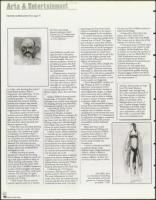
Jim Dine used etching,
drypoint and electric tools
to create his 1979 self-portrait,
"The Hand Painted Portrait
on Thin Fabriano."
is, in fact, only drawing that counts,"
noted famed sculptor Alberto
Giacometti, who added that, "if one
could master drawing, all the rest
would be possible." It is hardly sur-
prising that this century's leading
painters and sculptors also created
extraordinary prints and drawings,
whether studies for larger works or
integral pieces in their own right.
The eclectic nature of such an all-
inclusive overview defies easy catego-
rization. Nor can the following high-
lights do justice to the sweep of this
first-rate show, which demands and
deserves repeated visits.
• Paul Klee once described drawing
as taking a line for a walk. The Swiss-
born artist, who studied and taught
in-Germany, was forced to leave
because of his staunch anti-Nazi fer-
vor. Veil Dance is a clandestine attack
on the Nazi movement, which Klee
detested. The veil covers up and
impedes the joyous movement of the
dancer, whose eyes are blindfolded
and hands are tied.
• When painting on canvas
became too arduous for the ailing
Henri Matisse, he began to create col-
lages with paper cutouts or what he
called "drawing with scissors." Two
stencil prints from the artist's 1947
book Jazz elicit a childlike exuberance
in their colorful squiggles and shapes.
Matisse's spare use of line could speak
volumes. His Still Life, of a giant
pumpkin, a jug and other objects, is
sensual and inviting.
• Pablo Picasso was not only the
century's greatest artist but a consum-
7/30
1999
76 Detroit Jewish News
mate draftsman as well, creat-
ing more than 2,500 prints,
including lithographs, linoleum
cuts and intaglio. His intro-
spective young boy, Portrait of
an Adolescent, graces this show.
The Israel Museum owns 900
Picasso prints, donated by just
two individuals.
• Representative American
artists in the exhibit include
John Marin, considered the
American master of watercol-
or in the 20th century. Marin
uses light to stunning effect
to evoke the rain-filled clouds
of an encroaching storm in New
Mexico, Region about Taos and Santa
Fe.
• Jackson Pollock's drawings mimic
his paintings. A Rorschach inkblot
technique in an untitled work simulates
the dripping, pouring and airbrushing
techniques he applied to his canvases.
• Like Pollock, Philip Guston
(born Phillip Goldstein) was
impressed by Mexican muralists,
including Diego Rivera, and began his
career as a muralist. In his ink draw-
ing Lower Level, rain falls on a sea of
floating heads, some half-submerged
and sinking. The cartoon-like work
echoes the artist's despair and anxiety
over ill health and negative reviews.
• Milton Avery's sublime watercol-
or Umbrellas by Sea emphasizes the
importance of color in the artist's
everyday subject matter. In this peace-
ful tableau, beach, water and sky are
punctuated by two tilted umbrellas,
which flatten the surface from three
dimensions to two. The calm of the
sea, serenity and peacefulness repli-
cate the artist's joy in life.
• A black human figure is superim-
posed on an abstract background of
explosive color in an untitled work by
leading abstract expressionist Willem
de Kooning, who was born in
Holland and settled in New York City.
• Following the 1917 Russian
Revolution, leading artist El Lissitzy
sparked a Jewish cultural renaissance.
The artist's illustrations to Chad
Gadya (One-Kid), the traditional song
sung towards the close of the seder, is
considered his best work. The draw-
ings change the focus from Jewish
traditions embedded in the song to
beliefs propagated by the revolution.
In another illustration, titled Boat
Ticket, two intersecting triangles form
a skewed Star of David. The upper
part includes an ocean liner and the
American flag, symbolizing the dream
and destination of Jewish immigrants
at the turn of the century. Burial let-
ters superimposed on a dark hand
symbolically connote the burial of the
old ways and religious Jewish tradi-
tions and the embracing of the new
religion of communism.
• Like Lissitzky, Marc Chagall also
endorsed the promise of the revolu-
tion. Chagall's whimsical watercolor
Promenade, in which the artist holds
the hand of his wife who is suspended
in mid-air, suggests the idyllic early
days following the revolution, as well
as the couple's own happiness.
• Erwin Blumenfeld's complex col-
lage Marquis de Sade is a stinging
indictment of bourgeois society,
including Jewish society. Among its
many fragmented images, a newspa-
per ad announces that a nobleman
with money and no debts is looking
to marry a woman of means; widows
or Jewesses might also apply.
Collage, the juxtaposition of oppo-
sitional forms representing reality and
the subconscious, is a prominent
medium seen in Dadaism, an anti-
establishment art movement that arose
during World War I. It is characterized
by expressions of outrage at conditions
of the world, along with cynicism
and rebellion toward traditional
art forms.
Major gifts from noted
Surrealist poet and lifelong col-
lector Arturo Schwarz of Milan
and New York collector I. M.
Cohen have made The Israel
Museum an international center
for the study of Dada and
Surrealist art.
• Artistic revolution was linked
to political change. Laszlo
Moholy-Nagy's collage Bankruptcy
Vultures, created in Berlin in
1922-23, focuses on Germany's
rampant inflation. As there was
no money to buy paint or canvas,
Leon Bakst, born
Lev Samoilovich Rosenberg,
used watercolor, pencil and
gouache in "Costume Design
for Judith," 1922.
the artist uses the worthless currency to
make his assemblage.
• Using urban debris from city
streets, anti-Nazi activist Kurt
Schwitters' collages following World
War I create new art forms out of the
remains of a former culture.
• Three generations of Israeli artists
are represented in the exhibit as well,
including Moshe Kupferman. Born
in Galicia, he was the only member of
his family to survive World War II. In
1948, Kupferman came to Israel,
where he helped found Kibbutz
Lohamei HaGetaot (Commemoration
of Jewish Resistance to the
Holocaust); he still resides there.
Rendered in ghostly black and gray
hues, Kupferman's gridlike drawing
Untitled suggests barbed wire fences
and the striped pajamas of concentra-
tion camp inmates. fl
"Modern Masterworks on Paper
from The Israel Museum,
Jerusalem" runs through Aug.
29 at The Cleveland Museum of
Art. The museum is located in
University Circle, 11150 East
Blvd., in Cleveland, Ohio.
Museum hours are 10 a.m.-5
p.m. Tuesday through Sunday,
Wednesday and.Friday nights
until 9. Admission is free. For
more information, call (216)
421-7350, or access the Web
site at www.clemusart.com .
. -
,sts.imm
: