

A show of 20th century masterworks from The Israel Museum makes
its only U.S. appearance at The Cleveland Museum of Art.
I,
n Israeli artist Moshe Gershuni's
drawing Untitled (Cyclamen),
,, the bulbous spring flower rises
like a billowing white parachute
from a scarlet surface, symbolizing life
and renewal over blood and death.
Both title and subject matter relate to
a 1948 poem by Israeli poet Haim
Guri called "Bab-El-wad," so named
for a strip of road leading to
Jerusalem, where many lost their lives
in the struggle for independence.
.
Fran Heller is a freelance writer
based in Cleveland.
The work is one of 114 drawings,
watercolors and prints from the Israel
Museum in Jerusalem on exhibit at
The Cleveland Museum of Art — its
only American venue — through Aug.
29. Untitled (Cyclamen) also is a fitting
paradigm for the birth of a nation,
and the creation of its 34-year-old art
museum, whose extraordinary collec-
tion, mostly donated, includes 55,000
works on paper.
The genesis of The Israel Museum
in 1965, an outgrowth of its predeces-
sor, the Bezalel Museum, is as remark-
able as its holdings. The mass migra-
tion to Palestine in the 1930s brought
German Jews and their art treasures to
the country. Since works on paper were
easier to transport than bulky paint-
ings, prints and drawings were far more
numerous among the rescued objects.
When Israel was established, many
objects of value had to be sold to help
penniless friends and relatives who
were pouring into the country in
droves. After the war, unclaimed
works of art were transferred to Jewish
institutions worldwide when no heirs
could be found. This, too, swelled the
museum's coffers.
Co-curated by Ruth Apter-Gabriel
and Meira Perry-Lehmann from The
Israel Museum and Jane Glaubinger
from The Cleveland Museum, "Modern
Masterworks on Paper from the Israel
Museum, Jerusalem" spans the 20th
century's most important artistic trends.
With works by Milton Avery, Marc
Chagall, Emil Nolde, Gustav Klimt,
George Groz, Henri Matisse, Vassily
Kandinsky, Paul Klee, Jacques Lipschitz,
Joan Miro, Jackson Pollack, Pablo
Picasso, Richard Serra and Joel Shapiro,
to name just a few, the exhibit is a vir-
tual worldwide "Who's Who" of leading
painters and sculptors.
"Whether sculpture or painting, it
CENTURY OF EXCELLENCE ON PAGE 76
ronfolltot,w00051 ,11,10
. osineROr
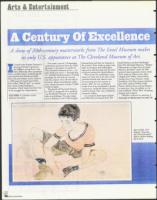
Egon Schiele's 1915
tempura "Cowering
Boy (Paul Erdmann?)''
depicts a forlorn-looking
lad in shorts.
7/30
1999
74 Detroit Jewish News