

ELEGANCE from page 67
it from Marsha and Jeffrey Miro of Bloomfield Hills.
Carlo's youngest son, Rembrandt, a gifted animal
Special to the Jewish News
sculptor, drew his inspiration from the zoos of Paris
and Antwerp, where he would spend days and weeks
rnate furnishings. Lifelike animal sculp-
at a time in close observation of the animals' habits
tures. Sleek automobiles. An unlikely mar-
and behavior. The Jardin des Plantes, near where
riage of art for three generations of a cele-
Rembrandt lived in Paris, was a living laboratory for
brated family — the Bugattis.
the artist's study of every breed of wild animal.
It began with Carlo Bugatti (1856-1940), patri-
Rembrandt Bugatti "befriended" the caged ani-
arch of an artistic dynasty that included sons Ettore
mals, thereby encouraging their posturing upon
and Rembrandt and grandson Jean. What separates
which his sculptures are built. His intimacy with the
the Bugattis from most other multigenerational artis-
subject of his sculptures
tic families is that each
extended to living with -
had a different medium
two antelopes for several
for expression.
months before sculpting
Carlo Bugatti began
them.
designing furniture in
World War I saw the
his own workshop in
destruction of all of
Milan in 1885. In a
Rembrandt's beloved ani-
radical departure from
mals at the Antwerp zoo,
traditional furniture
which
was converted to a
making, Carlo revolu-
military
hospital during
tionized the decorative
W410k40-
the
war.
This led to a
arts with his assymetri-
depression from which
cal designs, exquisitely
Rembrandt never recov-
detailed marquetry and
ered; in 1916, he commit-
strong emphasis on
This year's Concours d' Elegance salutes ted suicide.
Japanese and Islamic
the Bugatti and the Packard. Pictured is
Ettore Bugatti was a
motifs. The ambidex-
Ralph Lauren's Bugatti Type 57C. man of many talents,
trous innovator consid-
including that of an artist
ered himself more artist
whose flashy car designs bear the imprimateur of the
than craftsman; small wonder that his creations
Bugatti name. Recognizing that it was his younger
emphasized aesthetics over function.
brother, Rembrandt, who had the greater artistic tal-
Bugatti's "Cobra," or G.-Shaped, chairs are consid-
ent, Ettore turned his particular genius — that of
ered the most inventive of his designs. The can-
aeronautical engine designer and inventor — to auto-
tilevered seat, supported only by front legs, and total-
motive design. His first car was a mechanized tricycle.
ly detached from the back of the chair, anticipates
Car racing had its genesis in 1895, and a Bugatti
later 20th-century design. The G-shaped chair motif
car took second place in the 1911 Grand. Prix of
influenced the design of a simply shaped rocker
France, catapulting Ettore to fame. Following World
owned by the Detroit Institute of Arts. The piece cur-
War I, and for the next 20 years, Bugatti became the
rently is on loan to The Cleveland Museum of Art,
undisputed master builder of high performance luxu-
where the exhibit "Bugatti" runs through Sept.19.
ry
and race cars. Ettore and his son Jean's prize-win-
Carlo also made abundant use of parchment with
ning
models were duplicated into fast sports vehicles
painted decoration on many of his furniture pieces,
for
anyone
who could afford to buy them.
including a side chair on loan to the Cleveland exhib-
FRAN HELLER
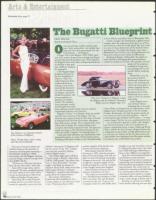
Top: Fashion is an important element
of the Concours dElegance2
Above: Vintage classic, sports, racing
and 50s cars are featured.
This year's Concours salutes two
vehicles chosen as the pinnacle of
American and European motoring —
the Packard, marking its 100th
anniversary, and the Bugatti, showing
unusual designs realized through fewer
than 8,000 vehicles.
"We have car collectors coming in
from all over the world," Moss says.
Some 250 vintage classic, sports,
racing and '50s cars, considered among
the most valued in the world, will be
set out on the lush green hills of the
1,400-acre Meadow Brook estate.
More than 60 invited Packards
include the first ever built and one
owned by legendary movie star Jean
7/30
1999
70 Detroit Jewish News
Harlow. Among the 25 Bugattis will
be the winner of the 1937 LeMans
race and one owned by fashion
maven Ralph Lauren.
"Our Friday night party will be at
Clutch Cargo in Pontiac, where there
will be 1,500 people," says Moss, who
lives in West Bloomfield. "Saturday
night is the black-tie banquet at
Meadow Brook Hall, where more than
900 people will hear G. Richard
Wagoner Jr., president and chief oper-
ating officer of General Motors."
Also present will be Rose
Lieberman of Southfield, the first
woman chosen as vice chairman of the
event. This means that in 2001,
another member of the Jewish com-
munity will become chairman.
Moss became involved with the
Concours in 1995, when he was presi-
dent of the local Morgan Club and was
asked to assist with getting outstanding
Morgans to the event. Not only did he
arrange for a dramatic display of cars,
he also arranged for a visit by a member
of the Morgan family from England.
Moss has been serving on thz car
selection committee ever since.
"My interest in cars started when I
was a kid delivering newspapers in Oak •
Park," says Moss, who also developed
an interest in slot cars. 'A guy on my
newspaper route was a hot rodder, and I
thought it was neat to see him work on
it. During that same route, I saw other
cars I liked and began subscribing to
three or four different car magazines."
Moss' love of the mechanical side of
cars led him to enter Lawrence
Technological University in mechanical
engineering, but he quickly changed to
business school and majored in account-
ing and finance. For a short time, he
worked in accounting at the Ford Motor
Co., but he spent every lunch hour
checking the stock market at a nearby
investment office and soon decided to
make a career change to Roney and Co.
Keeping car activities as a hobby,
Moss started collecting and was espe-