
accatil Lure ass
LONNY GOLDSMITH
Stqff Writer
Participation in youth games
rising nationwide,
but Detroit athletes dwindle.
7/30
1999
10 Detroit Jewish News
year after 400 Jewish local teenagers competed in Detroit in
the annual national JCC Maccabi Games, local organizers
say they can't mount full teams for almost half the events in
which they are scheduled to compete this year.
With only 166 signed up this year, organizers say the waning
interest is partially a function of cost — the athletes would have to
travel to the games that begin next week — and partially a function
of schedule — the Maccabi event conflicts with their summer camps
and with regular practice times for high school sports here.
But organizers also attribute the falloff in the number of Detroit
competitors to a failure in capitalizing on last year's enthusiasm by
maintaining an involving program of sports and other activities.
Such programs have been successful in keeping young people active
in Maccabi in Houston and other cities.
"We didn't get as good a response as we intended," said Harold
Friedman, one of the Detroit delegation heads chaperoning teams
competing in Houston, Tex., Columbus, Ohio, and Cherry Hill,
N.J., in sports that include baseball, softball, volleyball and soccer.
"We were so busy working on the games, we didn't have time to
plan effective follow-up last year," said Michelle Tarrance, sports and
recreation director for the Jewish
Community Center of
Room in the field: Last year
Metropolitan Detroit.
Detroit's Maccabi Games drew
The JCC Maccabi Games, which
400 local competitors and
began in 1982 in Memphis, is a
thousands of athletes and
Jewish event that brings 13-to-16-
spectators attended the closing
year-olds together through athletics.
ceremonies (facing page).
The teens live with families in the
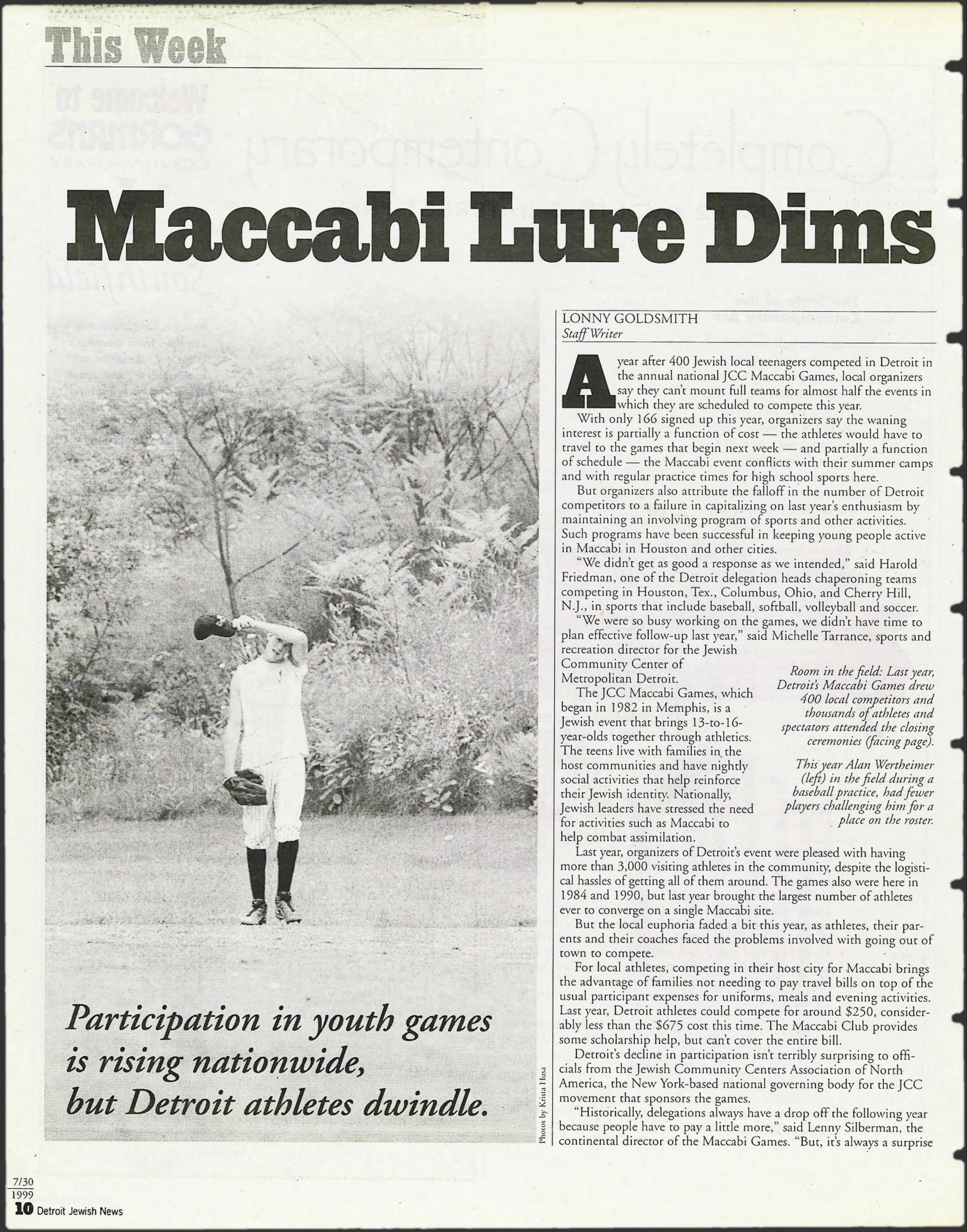
This year Alan Wertheimer
host communities and have nightly
(left) in the field during a
social activities that help reinforce
baseball practice, had fewer
their Jewish identity. Nationally,
players challenging him for a
Jewish leaders have stressed the need
place on the roster
for activities such as Maccabi to
help combat assimilation.
Last year, organizers of Detroit's event were pleased with having
more than 3,000 visiting athletes in the community, despite the logisti-
cal hassles of getting all of them around. The games also were here in
1984 and 1990, but last year brought the largest number of athletes
ever to converge on a single Maccabi site.
But the local euphoria faded a bit this year, as athletes, their par-
ents and their coaches faced the problems involved with going out of
town to compete.
For local athletes, competing in their host city for .Maccabi brings
the advantage of families not needing to pay travel bills on top of the
usual participant expenses for uniforms, meals and evening activities.
Last year, Detroit athletes could compete for around $250, consider-
ably less than the $675 cost this time. The Maccabi Club provides
some scholarship help, but can't cover the entire bill.
Detroit's decline in participation isn't terribly surprising to offi-
cials from the Jewish Community Centers Association of North
America, the New York-based national governing body for the JCC
movement that sponsors the games.
"Historically, delegations always have a drop off the following year
because people have to pay a little more," said Lenny Silberman, the
continental director of the Maccabi Games. "But, it's always a surprise