

■
MUSIC MAICII I' from page 73
What makes Rabson's skill even
more astonishing is her do-it-yourself
approach to musical training. "I don't
read music. I totally play by ear," she
confesses. "I haven't even taken lessons
... I don't seem to take direction well."
But when it comes to pursuing a
career in music, Rabson displays no
lack of direction. While raising a
daughter, she teamed up with her gui-
tar student, Gaye Adegbalola, and they
began to perform together.
Rabson began playing music full
time on the day her daughter gradu-
ated from college. Soon after, she
and Adegbalola formed Saffire, pool-
ing their resources to record a demo
tape that resulted in their being
signed to established blues label
Alligator Records.
Saffire's 1990 debut became one of
the label's best-selling releases. The fol-
lowing years witnessed the addition of
multi-instrumentalist Andra Faye
McIntosh, and the group's growing
popularity. Saffire has continually
recorded and toured, playing to a
diverse and devoted fan base.
But they soon found that not all of
their fans were familiar with the blues.
"There are a lot of people who are dis-
enfranchised by the blues who really
enjoy Saffire," Rabson remarks. "I
think a lot of times women are not
comfortable going to a blues concert.
You won't see as many of them at a
regular blues concert as you will at a
Saffire concert. And I don't know why
necessarily.
According to Rabson, the group
strives to appeal to a wide range of
people, and she is never more
pleased than when her audience rep-
resents "a cross-section of age, race
and ethnicity."
Audiences have been able to hear a
lot more of Ann Rabson since-- in
addition to performing with Saffire
— she resumed her solo career in
1997. "In a lot of ways, it was musi-
cally liberating 'cause I could call all
the shots," she explains. For instance,
Rabson carefully selects covers by
such blues greats as Cow Cow
Davenport, Bessie Smith, Roosevelt
Sykes and Ray Charles.
While she loves putting her person-
al mark on songs penned by legendary
blues artists, Rabson also put her mark
on Music Makin' Mama with songs of
her very own.
"Unfortunately," Rabson admits,
"it's not something I ever developed a
discipline about. It just sort of hap-
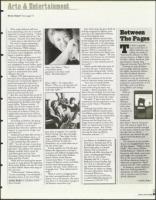
Above: Ann Rabson: "There's
a tremendous Jewish
population in the blues world.
Players. Wonderful players."
Below: Saffire - The Uppity Blues
Women: "There are a lot of people who
are disenfranchised by the blues who
really enjoy Saffire."
The Pages
T
he field of popular
music is the focus of
Jeffrey Melnick's com-
pelling new study of
"black-Jewish relations" in 20th-
century America, A Right to Sing
the Blues: African Americans, Jews
and American Popular Song-
(Harvard University Press; $27.95)
Drawing on cultural theory
and sociology, Melnick explores
the highly complicated relation-
ship that developed between
American Jews and African
Americans in the age of jazz and
ragtime, especially as expressed by
songwriters and performers of Tin
Pan Alley, such as Al Jolson,
Irving Berlin, and George
Gershwin.
With an
informed,
scholarly
approach,
Melnick
closely eval-
uates what
he calls the
'narrative of
kinship'' —
the sugges
tion that
blacks and
Jews share a history of oppres-
sion. He traces in depth how
that perceived kinship emerged
in the music industry and exam-
ines the ways in which
Jewishness was defined by and
against both blackness and
whiteness.
This narrative of race and kin-
A.(4,2,0 P....i(14 ,
,'
"
Audrey Becker is a freelance writer-
from Ferndale.
And, what's more, she gets a thrill out
of being recognized by klezmer musi-
cians not as the Uppity Blues Woman,
but as Mimi Rabson's sister.
Although Rabson's parents had a
Jewish background, being Jewish did-
n't play a large role in her upbringing.
"I like to say that my parents are athe-
ist and I rebelled and became an
agnostic. Which is essentially true,"
she says. Nevertheless, her family was
influenced by their religion. "We were
outsiders. Not because we were Jewish
so much as because we were not
Christian in a very Christian part of
the world."
Rabson speaks with some sense of
loss when she says, "I know almost
nothing about being Jewish. I think
I've been to two seders, and one was
),
as an adult.
But her awareness of the Jewish
roots in American music is growing.
Now that I've heard klezmer
music, I can hear the influence in
some of the swing era music very
strongly — Benny Goodman, Artie
Shaw, that sort of thing. I've even been
known to throw a little joking klezmer
hint in some of my minor key songs."
She adds, "I know that there's a
tremendous Jewish population in the
blues world. Players. Wonderful
players.
Although she and her sister ven-
tured down different musical paths,
Ann Rabson points out that klezmer
music and the blues are connected by
similar melodic impulses. "Both
[klezmer and the blues] have very
happy, bouncy aspects to them, but
there's an undercurrent of sorrow in
both types of music. Ray Charles
once said that the only people who
can sing the blues are African
Americans and Jews." 7
pens when it happens. I've tried the
skill of writing every day and yadda
yadda yadda .... Then when I'm dri-
ving or something, suddenly a song
comes and I have to pull over.
Sometimes I try to write them out at
the side of the road."
Putting together her CD also gave
Rabson the opportunity to bring in
musicians with different backgrounds,
including her sister Mimi Rabson,
famed violinist of the Klezmer
Conservatory Band. "I was totally
unaware of klezmer music until Mimi
and her band started putting out
records," she says. "And I think a lot
of people were. They rediscovered it,
really.
When it comes to bragging about
her sister's accomplishments, Ann
Rabson isn't at all reluctant. She notes
that there is "a tremendous resurgence
[of klezmer] everywhere I go.
Ann Rabson is scheduled to per-
form 8 p.m. Saturday, July 24, at
the Belleville Music Festival. The
festival takes place in Lakeside
Horizon Park in downtown
Belleville and offers three days of
music, including gospel (Friday,
July 23, 6-11 p.m.), blues
(Saturday, July 24, 1-11p.m.),
R&B and country (Sunday, July
25, 2 8 p.m.). Admission, park-
ing, and entertainment are free.
Showtimes are subject to change.
For more information, check out
the festival Web site at
vvww.belleville.mi.us/1999.htm,
or call the Belleville Chamber of
Commerce, (734) 697-7151.
ship is not straightforward. From
ter,:,"Yiddle
on Your
lack_
i ..........,
:,
M.
ews is
-
J
'7...` &it
on African Akig.
what were redt*.y*
.,
musical styles fdratr
In doing so, asser t,
they w ere making
nt
statements on their a
role in America and on their
Jewish. identities.
— Audrey Becker
h?,?:, 4STRMSW:Maga's:AMMOSWAMAMACSSIM
199
7/)
Detroit Jewish News
82