
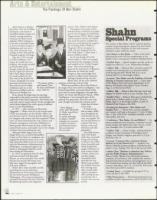

The Paintings Of Ben Shahn
Apprenticed to a lithogra-
pher from 1913-1916, Shahn
developed a style based on
simplified realistic images and
showed a strong interest in
working with letters of the
alphabet. While holding on
to his job, he attended classes
at the Art Students League in
Manhattan and went on to
New York University, City
College of New York and the
National Academy of Design.
After his 1922 marriage
to Tillie Goldstein, with
whom he would have two
children, the couple traveled
to North Africa and
Europe, where he also stud-
ied art. Upon his return to
New York, Shahn showed
his work publicly for the
first time at the Jewish Art
Center. Gradually, his work
garnered increasing atten-
"The Passion of Sacco
and Vanzetti, "from
tion and was more widely
the Sacco and Vanzetti
exhibited, early on at the
Downtown Gallery and the series, 1931-32.
Museum of Modern Art.
From almost the beginning, his paintings
responded to the social, economic and political
upheavals of the Great Depression. His realistic fig-
ural style used to narrate themes of class struggle and
social reform aligned him with a group of painters
known as the Social Realists.
In 1931 — after creating an illustrated
Haggadah — Shahn went on to do several series.
There were gouaches on the Dreyfus Affair, the
anti-Semitic trial of a French Jewish military offi-
cer charged with treason and later acquitted. There
were 23 works illustrating the trial of Sacco and
Vanzetti, immigrants convicted of killing two
bank guards; these became his first critical and
commercial success, particularly due to the charges
of ethnic bias surrounding the case.
Although Shahn began work with
Diego Rivera on a mural for Rockefeller
Center in New York, its completion was
stopped for political reasons, and it was
later destroyed. Shahn went on to work
with the Resettlement Administration in
Washington, traveling throughout the
South to photograph desperate condi-
tions during the Depression.
In 1935, he separated from his first
wife and traveled with Bernarda
Bryson, an artist-journalist who would
become his second wife many years
after they began living together and
had three children.
Shahn did a series of public murals,
including the one for the Jersey
Homesteads in New Jersey, and panels
for the Social Security Building in
Washington. His commercial projects
included illustrations for the Columbia
Broadcasting System and magazines
7/23
1999
7R r'
1
-
;
ch
such as Time, Harper 's and Esquire.
Throughout his career, which
included time as director of graphic
arts for the Congress for Industrial
Organizations (CIO), Shahn taught
and lectured at various art schools
and made his talents available for
politicians and agendas he support-
ed, including Henry Wallace's
Progressive Party campaign in
1948. He also designed sets for
New York Export — Opus Jazz, a
Jero me Robbins ballet.
In the last decade of his life,
which ended in 1969, he accepted
commissions for synagogue murals
and worked on his "Lucky Dragon"
series. That series of paintings
depicted the experiences of Japanese
fisherman on board the Lucky
Dragon as they unwittingly were
exposed to fallout from American
hydrogen bomb testing near the
Bikini atoll. All the crew suffered
radiation poisoning, and one died.
"What's extraordinary about Ben Shahn is
the range of his work and his intelligence," says
Howard Greenfeld, a personal friend of the
artist and his recent biographer through Ben
Shahn: An Artist's Lift (Random House, 1998).
"Intelligence is not necessarily part of the
makeup of a great artist. He was a man who
read, thought and had wide interests, and I
think that all shows
in his work.
"Third Allegory"
"I think he was
1955. After World War
able
to make a differ-
II, Shahn moved from
ence
through his art-
the realism of
work because he was
his earlier paintings
very, very popular. He
to allegory. Another
was
not just known as
language was necessary
a
painter.
He was a
to express the horror
lecturer, writer and
and shattered dreams
television and radio
that .accompanied
personality."
the war years.
Greenfeld became
close with Shahn
while they were both
living and working
in Paris in the 1960s,
when Greenfeld pub-
lished English-lan-
guage translations of
such writers as Italo
Calvino, Primo Levi
and Jean Piaget.
Greenfeld's book
describes the way
Shahn long avoided
the children from his
first marriage and
often missed child
support payments
after starting his sec-
ond family with a
woman who was not
Jewish.
ahn
Special Programs
N
The artistry of Ben Shahn will be explored during a
number of special programs planned by the Detroit
Institute . of Arts. Programs are free with museum
admission unless otherwise noted.
• Ben Shahn on Ben Shahn -- Video of the artist
discussing his work will run continuously in the
Modern and Contemporary Galleries Reading Room.
• Guided Tours — Special insights into the works on
display are offered at 1 p.m. Wednesdays-Sundays.
• Gallery Talk -- Rebecca Hart, assistant curator of
modern and contemporary art, discusses Shahn's
work during and after World War II at 2 p.m.
Sunday, July 25, in the Knight Gallery
• Lecture: "Ben Shahn and the Problem of Jewish
Identity in Postwar American Art" — Dora Apel
of the Wayne State University department of art
history will discuss this subject 2 p.m. Sunday,
Aug. 1, in the Lecture Hall.
• Gallery Talk — Rebecca Hart discusses myth and
allegory in Shahn's work at 2 p.m. Sunday, Aug. 29.
• Insider's View — Rebecca Hart gives a behind-the--
scenes look at Shahn's work at 6 and 7:30 p.m.
Friday, Sept. 3, in the Knight Gallery, as part of
Hudson's First Fridays at the DIA.
• Evening for Educators: "Ben Shahn and
Graphic Arts" --- Nancy Barr, assistant graphic
arts curator, will lead a discussion 5-7 p.m. Friday,
Oct. 1. Fee of $151$12 members includes a mate-
rials packet and tour.
• Conference: "Ben Shahn: Art and Politics" — Art
history professors Laura Katzman, Anthony Lee and
Diana Linden will explore this topic 10 a.m.-12:30
p.m. Saturday, Oct. 9, in the Lecture Hall.
• Gallery Talk --- Diana Linden, visiting assistant
professor at the University of Michigan, gives
insight into Shahn's religious practices at 3 p.m.
Saturday, Oct. 9.
• Lecture: "Common Men, Common Visions:
Radical Art in the Postwar Era" — Anthony Lee,
Mount Holyoke assistant professor, will discuss this
subject 2 p.m. Sunday, Oct. 10, in the Lecture Hall.
• Adult Class: "Realism in America: Art, Politics
and the Works Progress Administration" —
Nancy Locke, Wayne State University assistant
professor of art history, will examine the relation-
ship between liberal politics and progressive art in
the United States during the first half of the 20th
century. Saturdays, Oct. 16, 23 and 30. $30 mem-
bers/ $24 seniors/$12 students.
• Guided Tours --- Available for groups of 15 or
more; call (313) 833-7891.
• Slide Presentations — Illustrated presentations are
available to adult organizations; call (313) 833-1510.
N