
The OPen Boo
<
is the mother of two married chil-
dren "and grandmother to three
wonderful grandchildren, Brittany
Emily and Bradley." A retired office
manager, she now spends her
days, 'happily basking in the sun-
shine of my precious grandchildren
and reading to them every chance
get. Since I was 5, I have been an
avid reader and already have intro-
duced my grandchildren to the joy
of reading by going to the library
and book stores and story times.
Life doesn't get much better than
this!'
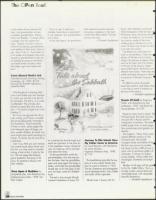
This is a cute, if rather pre-
dictable, book about a grandmoth-
er, her husband, their grandchildren
and a bear.
As the tale begins, the grandmoth-
dish expression quickly become
annoying; a glossary at the back
would have been better). The illus-
trations are so-so.
— Elizabeth Applebaum
Come Aboard Noah's Ark
illustrated by Julie Downing. Dorling
Kindersley, Ltd. 1999. S7.95.
Reviewed by Elizabeth Applebaum,
AppleTree Editor
If the thought of a rhyming Hall-
mark card makes your skin positive-
ly crawl, you may be a bit put off
by this book. The text is, in a word,
insufferable ("The animals clam-
bered on board [the ark], two by
two — It's hard to forget such a hul-
labaloo.").
But if you can get past the oh-so-
cute writing, you'll have no trouble
becoming pleasurably immersed in
the illustrations. They're beautiful.
Printed on thick, sturdy pages that
will withstand years of happy use
from smaller children, the book con-
tains bright and colorful paintings of
Noah, his family, the ark and all its
inhabitants.
Even if you think you can't endure
yet another book about Noah and
the Ark, you may want to consider
taking a look at this, if only for the
art. The last page also features
good questions, focusing on the
story, for parents to discuss with
their children.
Once Upon A Shabbos by
Jacqueline Jules, with illustrations by
Katherine Janus Kahn. 1998. Kar-
Ben Copies.
7/23
1999
116 Detroit Jewish News
family. After Yehuda's much-loved
father disappears vvhile serving with
the Russian army, the family decid e s
to leave for America. It is an ardu-
ous journey, made all the more
challenging by Yehuda's hurt arm,
which he fears may hinder his abili-
ty to enter the country.
The details are what make this
book so extraordinary. There are
photos of Yehuda and his family,
along with pictures of relevant sites
such as the New York City harbor
at the turn of the century, inspec-
tions at Ellis Island, the family's can-
dlesticks from Russia. There also are
smells and tastes that give a distinc-
tive picture of Yehuda's long jour-
ney.
It's difficult to think of another
book that could so well relate what
it was like to come to America at
the turn of the century.
— Elizabeth Applebaum
Streets Of Gold by Rosemary
Wells, with illustrations by Dan
Andreasen. 1999. Dial Books for
Young Readers. $15.99.
rin'''75'44*tehei *440 l'-':i•':e.Y4Akt(
er is making her favorite kugel and
sends her grandson to the store for
a last ingredient: honey. Along the
way, he meets up with a lost bear
who takes the honey.
So the grandmother sends the
granddaughter, who also encoun-
ters the bear; then the grandfather
goes and once again the honey is
stolen, and finally the grandmother
herself sets out for the store. In the
end, the bear comes for Shabbat
lunch.
The text is nice enough (though
constant translations of every Yid-
Journey To Ellis Island: How
My Father Came to America
by Carol Bierman, with illustrations
by Laurie McGaw.
Hyperion/Madison Press. 1998.
$17.95.
This breathtaking book tells the true
story of a boy namec Yehuda and
how he came to America in 1922.
The text, illustrations and photograph
are all absolutely terrific; both children
and adults will be captivated.
Yehuda lives in Russia with his
Based on Mary Antin's classic The
Promised Land, this book recounts
one girl's life in Russia and her
immigration to America. The author
briefly quotes Antin on each page,
then paraphrases (and greatly con-
denses).
She explains, "Mary Antin wrote
several different versions of The
Promised Land. She herself
changed names and details of her
life from one account to another.
Her book can be a difficult one to
read, with an enormous gallery of
characters. To bring it to today's
young readers, I have culled and
rearranged, shortened and simpli-
fied."
Readers of all ages will be grate<
ful for Ms. Wells' efforts. This is a
lovingly written, easy-to-read and
memorable book, with absolutely
beautiful illustrations.
Elizabeth Applebaum ❑
Scanned image of the page. Keyboard directions: use + to zoom in, - to zoom out, arrow keys to pan inside the viewer.
July 23, 1999 - Image 116
- Resource type:
- Text
- Publication:
- The Detroit Jewish News, 1999-07-23
Disclaimer: Computer generated plain text may have errors. Read more about this.