

I
t
PHILIP BERK
Special to the Jewish News
N
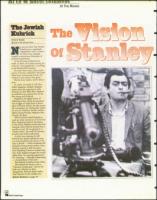
one can deny that Stanley
Kubrick was a supremely
independent artist, a vision-
ary who never repeated
.
himself, a meticulous filmmaker of
profound aspirations.
In the 40 years he labored, he
made 13 films, all of them among the
century's "most significant," according
to the British Film Institute.
He made films about space explo-
ration, Vietnam, militarism. He made
films from controversial novels. He
worked in just about every genre.
But he never made a movie about
Jews.
In a June 14 article in The New
Yorker magazine, Frederic. Raphael
writes about his experiences with
Kubrick on Eyes Wide Shut. Raphael
is credited as co-screenwriter on the
film along with Kubrick.
Raphael is the gifted writer of
Glittering Prizes, which documented
the struggle of Anglo Jews to find a
place in British society. He also wrote
the screenplays for Darling (for which
he won an Academy Award) and the
Albert Finney/Audrey Hepburn film
Two for the Road.
When Kubrick asked Raphael to
work on what turned out to be his last
film, Raphael jumped at the chance.
In the article, Raphael recalls their first
meeting, when Kubrick handed him a
novella to read. He recognized it as
"Dream Story," the work of Viennese
Jewish writer Arthur Schnitzler.
At their next meeting, he told
Kubrick how deeply infused the story
was with Jewishness (the doctor in the
story is Jewish — which emphasizes his
alienation during certain scenes). Since
Kubrick wanted to shift the action
from Hapsburg Vienna to modern-day
New York, Raphael thought this would
afford them "an amusing opportunity
for "retaining — although modernizing
— the Jewishness of the story"
But Kubrick would have none of that.
He wanted the doctor to be a
"Harrison Fordish goy," and he for-
bade any reference to Jews.
(Apparently, Kubrick didn't realize
that Harrison Ford's mother was
JEWISH KUBRICK on page 95
_.o
7/16
1999
78 Detroit Jewish News
1 1131,
At The Movies