

E
hud Barak's efforts to restart a
peace process in the Mideast
get a .warm vote of approval from
Jews in the Detroit-area and
around the country.
In interviews Sunday at the
Jewish Community Center in
West Bloomfield, locals said the
new Israeli prime minister could
be trusted to respect Israel's need
for a guarantee of security and to
negotiate with its Arab neighbors.
And they said they hoped he
would be able to maneuver more
successfully than his predecessor,
Binyamin Netanyahu.
"I do think it's the right move
because the alternative is more
fighting, more wars, more terror-
ist attacks," said Thelma Elson,
70, of Farmington Hills. "I'm not
sure it will be successful, but it's
certainly the right move.
She added, however, that she
was hesitant about having to give
up land that Israel took in the
1967 war because "we're such a
small country."
Giving up land is not so terri-
ble a price, said David Jaffa, 52,
of Bloomfield Hills.
"A first step can lead to a long
peace for both Israel and its neigh-
bors," he said. The trade of land
for peace "is going to help Israel
and its neighbors," he added.
In any event, Barak deserves the
benefit of the doubt, many said.
"I hate to see all these jihads and
attacks," said Selma Ladenheim of
Farmington Hills, "and I really don't
want to see land being given away,
but he knows better than I do."
And, she added, "what was going
on with the previous administra-
tion, Netanyahu, was a total disas-
ter. I think people should be able to
live in peace and maybe Barak is on
the right track. Yes, maybe now
they may be on the right track."
The contrast between Barak
and Netanyahu was underlined
by a poll of 606 American Jews
for the Israel Policy Forum in
New York, which has generally
supported the peace process.
7
/16
999
22 Detroit Jewish News
Realign
MATTHEW DORF
Jewish Telegraphic Agency
"I have no 'illusions,
and the chairman has
no illusions •••
Washin on
CC
Ehud Barak
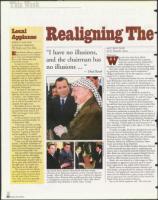
Top: Israeli Prime Minister Ehud Barak and Yasser Arafat,
chairman of the Palestinian Authority, at Erez Crossing Point last
Sunday. Above left: Barak speaks at a press conference as Egyptian
President Hosni Mubarak looks on following their July 9 meeting
in the Egyptian coastal town of Alexandria. Above right: Barak
and Jordan's King Abdullah at Akaba Palace Titesday.
Pho to by AP/Yo uscf Allen
JOSHUA CANE AND
JONATHAN FRIENDLY
Web Producer and News Editor
Photo by AP/Israeli Governmen t Press O ffice
Dam'
■
hen the dust settles From official
Washington's euphoria that is greeting
Israel's new prime minister, fundamental
policy disagreements are likely to test
President Clinton and Israeli Prime Minister Ehud Barak.
How they handle the challenge of reconciling differ-
ing positions on key issues such as settlements,
refugees and borders will set the stage for a crucial
period in U.S.-Israeli relations.
The potential distance between the two was under-
lined Wednesday when Barak, in an interview with the
New York Times, said he wanted the United States to
scale back its hands-on role as a guarantor of last year's
Wye River accord. America, he said, should stop acting
as "arbitrator, policeman and judge.
"I don't think the C.I.A. should be involved in
counting the number of policemen in the Gaza Strip
to check up on the Palestinians," he told the Times. "I
think the American role should be more special."
Frequently in recent months the State Department
has said that Israel was failing to carry out its side of the
Wye agreement while the Palestinian Authority was in
compliance. However, the Times quoted a State
Department spokesman as saying that it would like to
drop the extensive involvement that became necessary as
mistrust grew between the Palestinians and the adminis-
tration of former Prime Minister Binjamin Netahyahu.
Following meetings with Barak on Thursday and
next Monday, Clinton plans to send Secretary of
State Madeleine Albright to the region to help move
the process forward.
Virtually overnight, Barak has changed the tone and
tenor of a host of relationships with the Arab states,
the Palestinians and the United States. He came to
Washington following a Middle East tour that brought
him face-to-face with Egyptian President Hosni
Mubarak, Palestinian Authority Chairman Yasser
Arafat and Jordan's King Abdullah.
He also met with Turkish President Suleyman Demirel,
another potentially key player both in moderating area
tensions and in assuring that Israel has militarily dominant
allies. Barak was said to want to reassure Demirel that his
approach to Syria, which has been hostile to Turkey,
would not affect Jerusalem's strong ties with Ankara.
Barak, who was elected by a wide margin in May,
has pledged an aggressive and quick push to renew
peace negotiations that stalled under Netanyahu.
Barak's moves to rekindle personal relations with
Arab leaders, and specifically his embrace of Arafat as a
partner," has heightened expectations for a final settle-
ment with the Palestinians, a peace treaty with Syria
and an agreement that would result in the removal of
Israeli troops from southern Lebanon.
But as one Barak supporter said, He won't just
((