

From "Ernest Hemingway
A Life Story" by Carlos Baker ...
1919, about a party at the 1?amsdells' summer cot-
tage in Bay View
"Irene was Ernest's date, a handsome girl exactly
his age who was home on vacation. They built a fire
in the fireplace and spent a raucous evening [with
others], sampling cider and talking. Ernest hiked up
his pants leg to show Irene his scars and discoursed
at length on the wines of Italy and the Guinea Red
he said he had drunk at the Venice Café ..."
1920 in Oak Park, Ill.
"On the sixth of January, he and his friend
Jenkins made a double date with Irene
Goldstein and her college roommate, Marian
Holbrook, taking the girls to a basement
speakeasy on Wabash Avenue."
1920 in Petoskey, summer
"He went to Petoskey to play tennis with Irene
Goldstein. He always made a special point of win-
ning, and when her aunt and uncle, the
Rosenthals, asked him to dinner, he insisted on
lugging over an enormous fish which he had
bought at the market while managing to leave the
impression that he had caught it himself".
Early 1920s
"[Hemingway] told Fever Jenkins that the
Kansas City Star job was crying for a Hemingstein
to fill it ... His name was Ernest, but they called
him Ernie, Henny, Hemingstein, Stein."
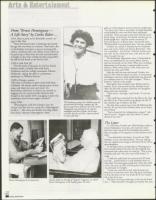
The handsome, young Irene Goldstein was the
quintessentialfim-loving, outdoors gal She
loved to play tennis daily and ski in the winter.
Hemingway was attracted to not only her
intelligence and love of books, but he later
wrote her that she was like a 'great racehorse
or a fine, fast boat."
pulls up another pleasant memory from her quilted past.
"You know what I like to remember? Grandpa Rosenthal
would peddle his items way back when and people
would say, 'Won't you open a store here? You have such
lovely things.' And he'd say, 'I'm Jewish and there are no
Jewish people here.' And the women would say, 'If
they're all like you, we'll love them.' And he did come.
The Rosenthals were prominent here," she says, proudly.
Gordon was raised in Petoskey by her maternal
aunt and uncle, Alick and Minnie Rosenthal. "She
was a newborn," says Levine, "and her mother was
not well. So her uncle and aunt, who had no chil-
dren, brought her up."
The Rosenthals' department store, S. Rosenthal &
Sons, was established by her uncle's father, Samuel,
and was eventually run by Alick. What was a multiple-
department store became a women's-ready-to-wear
business. When Alick died in 1939, Irene took over
and ran the store until 1962.
After she sold the store and retired, Gordon win-
tered in New York for almost 25 years. A consummate
theatergoer and lover of the performing arts, she lived
in a women's hotel on 57th and Lexington. "What a
location," Gloria Levine recalls.
Years before that, Gordon's Aunt Minnie and her
mother, Zinna, had moved into her Petoskey home.
After she divorced, Gordon raised her two daughters
alone and never remarried.
"Hers wasn't a marriage," says Levine. "It was two
worlds.
"She could have remarried, but she likes to do what
she likes to do. If she wanted to go skiing, she did. If
she wanted to go to Mexico, she did."
Not that there weren't men in her life following the
divorce. It's just that Irene Gordon chose not to marry
any of them.
"You've heard of the independent woman?" asks
Gloria Levine. "Eugene says she's about 75 years
ahead of her time."
The Letter
Ernest Hemingway at his typewriter.
7/9
1999
86 Detroit Jewish News
Gordon holds an old copy of "Esquire" magazine, on which
Ernest Hemingway, in his heyday, graces the cover:
In 1949, Irene Gordon sent 50th birthday wishes to
•Ernest Hemingway. In return, she received a letter
from him that crossed all the friendship boundaries
that two people of the opposite sex have between each
other.
"I was shocked by that letter. It was for my 50th
birthday. It was a devotional letter," she says, adding
that the original letter hangs in the home of one of her
granddaughters.
In the typewritten correspondence, Hemingway at
first covered surface-level news, but then delved into
emotional areas where only he could go. "This is your
birthday card and I love you very much always," it
reads.
"I wish you could send me a picture and I'll send
you one ... and I'd look at it and remember how we
were then. Everything goes good here. Mary (his wife)
is fine. She puts up with everything that is bad about
me and keeps me straight.
"I wish you could know each other because you
both have so damned much class, like great racehorses
or fine, fast boats or the way ducks fly It was wonder-
ful to hear from you.
The letter continues (referring to the time he kissed
her) ... "How beautiful I thought you looked. But then