

Full Steam Ellin!,
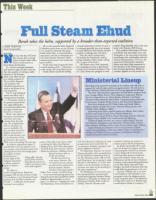
Barak takes the helm, supported by a broader-than-expected coalition.
LARRY DERFNER
Israel Correspondent
He cut the powerful Shas (Sephardi
Orthodox) party down to size, forcing
it to accept his demands that party
leader Aryeh Deri, a convicted felon,
step down, and that it relinquish con-
trol of the Interior Ministry, which
exercises great power over secular-reli-
gious matters.
At the same time, he gave the most
coveted ministry of all — Education —
to the secular, left-wing Meretz party.
Finally, Barak rejected the leading
of since the days of David
Ben-Gurion has an Israeli
prime minister taken office
with as much power as
Ehud Barak did Tuesday.
In a country thought hopelessly
split between right and left, with nei-
ther side capable of crafting a stable
majority in the Knesset,
Barak took office backed
by a ruling coalition of
75 out of the Knesset's
120 members. His
Likud-led opposition is
weak to the point of vir-
tual impotence.
The 57-year-old Barak
comes into office with a
strong personal mandate
— a 12 percent victory in
the prime ministerial elec-
tion, again defying the
conventional wisdom that
the right and left were
locked in a virtual tie.
Barak, vvho takes over
the prime ministership
only four years after
\- retiring from the
tary, has wrapped him-
self in a mystique of
near-invincibility. He
has exceeded everyone's
highest expectations —
first in the election, now
in the formation of his
government, the nation's
party of the right-wing, Likud, while
28th since its founding 50 years ago.
co-opting the right-wing National
As coalition negotiations began, it
Religious Party and Natan Sharansky's
seemed there were two options: a nar-
Yisrael B'Aliya Parry into the coalition.
row, secular, center-left government with
Barak the politician, a lifelong warrior,
ideological focus but not enough popu-
showed he knows how to
lar support to make
divide and conquer.
bold moves or a
Taking office Tuesd ay,
He did not prevail in
broad, right-to-left,
Israeli Prime Minis ter
every
point, however. His
religious-and-secular
Ehud Barak renewe d his
own
party's
central commit-
coalition unable to
call for apermanen t peace tee rejected his nominee for
agree on decisive
with Arab neighbor' s.
Knesset speaker, Shalom
action.
Simchon, choosing instead a
Yet, after six
Labor Party veteran, Avraham Burg.
weeks of negotiations, Barak has
In an emotional opening speech out-
emerged with the best of both worlds.
lining
the government guidelines, Barak
The coalition is very broad and homo-
called on regional leaders to pursue
geneous, but its heart is secular, cen-
peace "on all fronts." Forging peace with
ter-left — a reflection of the prime
the Palestinians, Syria and Lebanon are
minister's own politics.
of equal importance to Israel, he said, in
a statement generally seen as an attempt
to quell Palestinian fears that he will give
priority to making peace with Syria.
Twice he used a construction
favored by the Palestinians and by
Syrian President Hafez Assad, calling
),
for "a peace of the brave.
The former army chief reiterated
his campaign promise to pull Israeli
troops out of southern Lebanon with-
in a year. Barak also pledged to work
z
‘.01
0
O
Jordan's King Abdullah and, in the next
week, with President Bill Clinton.
One problem Palestinians will have
with Barak that they didn't have with
Netanyahu is the new prime minister's
exceedingly close relationship with the
Clinton administration. The U.S. dis-
approved of Netanyahu's hard-line
stance and often tilted somewhat in
the direction of the Palestinian posi-
tion during negotiations. Barak, by
contrast, appears to truly accept the
Ministerial Lineup
Ehud Barak has named 18 ministers to his cabinet and will seek to
expand the body by eight additional appointments. He will serve as
Prime Minister, Defense Minister and Acting Agricultural Minister.
The other One Israel Party appointees are Yossi Beilin, Justice; David
Levy, Foreign Affairs; Shimon Peres, Regional Cooperation; Shlomo
Ben-Arni, Internal Security; Haim Ramon, Minister in the Prime
Minister's Office; Binyamin Ben-Eliezer, Communications; Dalia Itzik,
Environment; Avraham Shohat Finance; and Yossi Sarid, Education.
Shas Party ministers are Eli Yishai, Labor and Social Affairs;
Shlomo Benizri, Health; Eli Suissa, National Infrastructure; and
Yitzhak Cohen, Religious Affairs.
Appointees from other political parties are: Meretz, Ran Cohen,
Industry and Trade; Center Party, Yitzhak Mordechai,
Transportation; Yisrael B'Aliya, Natan Sharansky, Interior; National
Religious Party, Yitzhak Levy, Construction and Housing
Additional deputy ministers are: Amnon Lipkin-Shahak, Tourisrn;
Yuli Edelstein, Immigration and Absorption; Nissim Dahan, Interior;
Shaul Yahalom, Educatkin; Haim Oron, Finance; Efraim Sneh, Defense.
Lipkin-Shahak and Edelstein will become ministers if Barak
expands the government. If" he does, Matan Vilna) would become a
minister for Culture, Science and Sports and iVlichael ivIelchior
would be Minister without Portfolio.
with the Palestinian Authority to reach
an agreement that would allow for
"co-existence, freedom, prosperity and
good neighborly relations."
The Palestinian response was muted.
Marwan Kanafani, who was spokesman
for the Palestinian negotiating team at
the Wye Plantation peace talks last fall,
said Palestinians "are not going to judge
[Barak] on the election, or on his state-
ments, or on his formation of the gov-
ernment, but rather on his handling of
the peace negotiations."
On Wednesday, the new prime min-
ister plunged ahead, announcing he
would meet Egyptian President Hosni
Mubarak in Alexandria on Friday and
Palestinian President Yasser Arafat on
Sunday. Then he will meet with
nece s sity of giving up territory to
achieve peace with the Palestinians.
Yet despite the breadth of his coali-
tion, his strong U.S. support, and the
wide perception of him as an uncanny
winner, Barak will not have it easy
achieving either peace or secular-reli-
gious reconciliation. Peace with the
Palestinians and the Syrians will almost
certainly involve dismantling settlements
in the West Bank, Gaza and Golan
Heights, the kind of traumatic jolts that
could shake his government to its core.
Likewise, if Barak tries to cut into
state benefits to the Orthodox, as he
promised to do, the religious parties
could bring him down. The departure
of Shas alone with its 17 Knesset seats
would deprive Barak of a majority. ❑
7/9
1999
Detroit Jewish News
23