
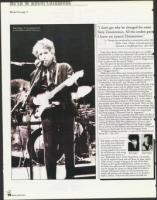

DYLAN from page 71
Bob Dvian ill an appearance
earlier this yeaK
at the
"I don't get why he changed his name
from Zimmerman. All the coolest guys
I know are named Zimmerman."
— Teenage boy overheard in a conversaiton about Bob
Dylan. From "Gesher: A Jewish Journal of
Outreach to Unaffiliated Jews," fall 1995.
Dylan (born Robert Allen Zimmerman) grew up a middle-
class Jewish kid in small-town Minnesota. He trained for his ba" -„
mitzvah and summered at Camp Herzl, and then, upon moving
to Greenwich Village to seek his fortune, tried, by design or for
a lark, to pass as an Okie named "Dylan."
But what gives the Jewish perspective on Dylan resonance is
the recurrence — over his 43 albums and 35 years of public
performances — of questions concerning "man and God and
law" ("Maggie's Fare).
While his earliest efforts were strummed from the headlines,
Dylan's classic protest songs all have a shot of something more
— be it God and Jesus in "The Masters of War" and "God on
Our Side" or the more indirect sense of apocalyptic mystery in
"A Hard Rain's Gonna Fall" and "Blowin' in the Wind."
The Highway 61 Revisited album, produced at the peak of his
mid-'60s success, opens with the biblical image: "God said to
Abraham, kill me a son / Abe said, Man you must be putting
me on." This image becomes more powerful knowing that
Dylan's father's name was Abraham Zimmerman. (Dylan's full
Hebrew name is Shabtai Zisel ben Avraham v' Rachel Rivka.)
Retreating to his home in Woodstock, N.Y., in the wake of
his famous motorcycle accident in 1966, Dylan kept a large,
permanently open Bible on a stand in his house. Sixty-one bib-
lical references were counted on his next album to emerge, John
Wesley Harding. "All Along the Watchtower" transformed Isaiah's
images into a blistering rock hit. But what was a nice Jewish
boy doing singing "I Dreamed I Saw St. Augustine?"
So even his brother was surprised when Bob Dylan was able to
recite the Kaddish when he returned to Hibbing for their father's
funeral. Soon afterward, Dylan celebrated his 30th birthday by
visiting the Western Wall. He confided plans to buy an apart-
ment in Israel and investigated kibbutz living. Rumors pegged
him as a donor to Meir Kahane and characterized his 1974 come-
back tour as a fund-raiser for the Israel Emergency Fund.
If Dylan's Judaism was private — a part of his always-private
family life — his 1979
Bob Dylan and Paul Simon,
two of the most influential
and prolific songwriters of
the last half-century, are
touring together this summer
for the first time, with a stop Bob Dylan
Paul Simon
planned for Pine Knob at 7
p.m. Wednesday, July 7. Each will perform a set backed
up by his respective band, and will share the stage togeth-
er for at least a couple of songs at the end of the show.
Tickets are $75 pavilion/$29.50 lawn and are on sale at
the Palace box office and all Ticketmaster locations. They
may be charged by phone by calling (248) 645-6666 or
through Ticketmaster online at www.ticketmaster.com .
Dylan will perform solo Tuesday, July 6, at St. Andrew's
Hall in Detroit. Tickets for that concert are sold out.
7/2
1999
74 Detroit Jewish News