

•
COrntrialinitY
C eri ar
Detroit Pionee
Keidans among Jewish
economic trailblazers
spotlighted in new exhibit.
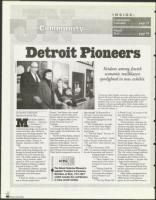
Visiting the Abba Keidan interactive video exhibit at the
Detroit Historical Museum are some o Keidan's descendants.
They are grandson Fred H Keidan of
o Birmingham; grand-
daughter Judy Levin Cantor of Bloomfield Hills; Fred's
daughter and great-granddaughter Mimi Keidan Seltzer of
West Bloomfield, and one of her children, great-great-grand-
son Harrison Seltzer, 3.
SUZANNE CHESSLER
Special to the Jewish News
M
imi Keidan Seltzer's
children — Harrison,
3, and Samuel, 1 —
are too young to
understand genealogy, but should the
interest arise later, they will have a
strong source for doing research. The
Detroit Historical Museum has
included Seltzer's forbears in a new,
permanent exhibit, Frontiers to
Factories: Detroiters at Work, 1701-
1901.
The Keidans, who had a dry
goods and general clothing store, are
among the several Jewish families
recalled as the city's economic pio-
neers. The exhibit updates an earlier
version, Furs to Factories, which
opened in 1992 as an outgrowth of
From Outposts to Industry, a display
that had its debut in 1987.
The enhanced collection, coming
to life with technology and addition-
al materials, cost the museum
$500,000.
"I think the exhibit is a wonderful
way to educate people about
7/2
1999
40 Detroit Jewish News
Detroit," said Seltzer, who viewed
the displays with her father, Fred
Keidan, and her aunt, Judith Levin
Cantor, a longtime officer in the
Jewish Historical Society of
Michigan.
"It shows how the city became
vital through the efforts of very dif-
ferent people who all did their work
with pride."
The life of Abba Keidan, Seltzer's
great-grandfather, is captured on a
video that makes up one of the 10
segments of the display, "City of
Industry." It features actors portray-
ing actual 19th-century business peo-
ple of various ethnic backgrounds.
Other Jewish entrepreneurs come to
light through "In Business for a
Century" a section that showcases
the area's enduring firms.
The remaining segments of the
exhibit include:
• The "Introduction," an explo-
ration of the Great Lakes Region
with an interactive map to show
travel routes.
• "The First People," the story of
Native Americans.
• "Furs, Forts and Fire," a look
back at French settlers between
1701 and 1825, when Detroit was
a village.
• "City of Commerce, 1825-
1865," an interactive display tracing
the role of steamships and trains in
bringing people of various
:r-
cultures
to the area.
':0 gENa al sr
• "Heavy Industry," an
li
t
examination of the nation-
al impact of various enter-
a a 0 a In
prises.
The Detroit Historical Museum's
• "Making Goods for
Detroiters," a retrospective
updated "Frontiers to Factories:
of commercial mainstays,
Detroiters at Work, 1701-1901"
such as Hudson's and
exhibit includes the contributions
Kresge's.
of many Jewish families.
• "The City Where Life
-.,
Is Worth Living," an interactive dis-
play of landmarks.
• "Ready to Be the Motor City," a
tribute to the automobile.
"Detroit became a premiere city
because of the ideas, work and con-
tributions of people representing
diverse backgrounds," says curator
Michael Smith, archivist at the
Walter P. Reuther Labor Library at
Wayne State University.
He continued, "Even before
Detroit got its start in 1701 with
French and Italian influences, it
already had diverse people through
various groups of Indians —
Ottawa, Chippewa and Wyandotte.
The 19th century brought addition-
al European settlers, including
immigrants from Poland, Greece,
Sweden and Russia — the last with
a large Jewish population."
Through a journal kept by her
mother, Cantor learned family facts,
and that information has been used
for the exhibit.
"Abba Keidan immigrated alone
from Poland to Michigan in the
1880s because of the pogroms
against the Jews and their threat to