

COMMUNITY VIEWS
My American Hero
ADAM GREENBAUM
Special to the Jewish News
elf-trust is the essence of hero-
ism." Ralph Waldo Emerson's
quote exemplifies my Papa,
Simon Schwarzenberg.
Papa was born on April 3, 1916, in
Ostrowicz, Poland. He lived in a mod-
est home with his parents, brothers
and two sisters. As a-child, Papa went
to cheder for his (Jewish) schooling.
As an adult, he worked in his father's
lime factory At 24, Papa entered the
Polish army.
From 1939 to 1942, Papa was in
hiding as the Germans invaded
Poland. In 1942, his world came to an
astonishing halt. There was a knock at
his home and Papa was taken by the
Nazis to a marketplace in the center of
town, where he was selected to go to
labor camps in Bavaria. At this point,
he was separated from his family,
never to see them again.
Papa was eventually brought to
serve as a laborer in Auschwitz. He
was branded with the number A-
18959. He worked hard and long, had
Adam Greenbaum, 14, is a ninth-
grader at Akiva Hebrew Day School in
Lathrup Village. He is the son of Marla
and Michael Greenbaum of Southfield.
This essay was one of the top 10 winners
in the statewide America er - Me Essay
Contest, sponsored by Farm Bureau
Insurance for Michigan school children.
Nearly 5,000 essays were submitted.
little to eat and suffered greatly, both
emotionally and physically. Through
all of this torture, Papa believed in
himself and God; he prayed to sur-
vive. His will to live remained strong.
Papa witnessed immense horror. He
watched as his friends were taken to
the gas chambers. He witnessed tor-
ture and suffered his own beatings. To
this very day, Papa is afraid of dogs; he
envisions guard dogs chasing him dur-
ing the time of Auschwitz.
In April 1945, Papa was given a
taste of freedom. American troops
freed the prisoners from Auschwitz.
Papa took a train back to Poland to
look for his family, but to no avail.
He ended up in Munich, Germany,
where he lived and married his high
school sweetheart. They established a
new life of their own. In 1949, they,
along with their 2 1 /2-year-old daugh-
ter, traveled by ship across the Atlantic
to New York to begin their future in
America.
Papa's belief in himself brought him
to Detroit, where he learned to speak
a new language and learned a trade so
he could provide a sound life for his
daughter. During this time, Papa
endured an emotional divorce and was
left to raise his daughter on his own.
He worked as a Fuller Brush Man to
continue his education at night.
Papa remarried in 1955 and opened a
dry-cleaning business. He went on to
have another daughter and two sons.
His courage and trust in himself to
succeed in life is beyond comprehen-
sion. I cannot imagine
starting my life all over in a
foreign land with no lan-
guage skills, no money and
no family for support.
Papa's business went on to
be quite successful as he
sent all four of his children
to college and raised them
in a traditional Jewish
home. How Papa kept his
faith in God is remarkable.
In later years, Papa's
strength was tested a few
more times. Papa remained
strong as his wife suffered
through a five-year battle
with cancer. Always by her
side, he was a source of
strength for my Bubbie.
After Bubbie's death, Papa
never became dependent on
his children. He learned
quickly to cook for himself.
Again his trust in himself
was quite evident.
Papa now is almost 82
years old. Unfortunately,
his health is failing.
Though things aren't as
easy as they used to be,
Papa's strength still shines
through. Papa has gone
through so much in his life,
yet even in times of need,
he still has trust in himself.
For this, Papa is my Ameri-
can hero. He has taught me
the meaning of life. fl
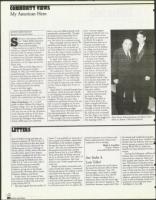
Papa Simon Schwarzenberg and Adam Green-
baum at Adam's 1998 bar mitzvah.
LETTERS
dom of Judah during and after the
Assyrian conquest of 734-721 B.C.E.
There is also evidence that they head-
ed to the Phoenician colonies of the
Mediterranean (such as Carthage in
North Africa). Finally; those who were
actually taken captive into Assyria
eventually amalgamated into the wave
of Judeans who came to the same
region during the Babylonian exile
(586 B.C.E.) and even earlier. All of
these Israelite groups eventually
became one with their Judean
brethren, giving rise to the Jewish
communities of North Africa, Judeo-
Palestine, Babylon and Persia.
In any event, the mystery of the
lost tribes of Israel ceases to be much
of a mystery at all by the end of the
sixth-century B.C.E.
My essay argued that the author of
7/2
1999
34 Detroit Jewish News
Psalm 77 was probably an aristocrat or
even a priest in Jerusalem, whose fam-
ily had fled to the southern kingdom
during the Assyrian conquest of the
north. This was not uncommon (even
the prophet Jeremiah had a similar
family history) but it is very different
from saying that the Psalm was writ-
ten by a member of the "lost tribes" of
Israel. In my estimation, they were
always a part of their people and never
truly lost.
Despite my fairly conservative atti-
tude towards this subject, I commend
Simcha Jacobovici for making a movie
that deals with this issue. I do not
agree with some of the conclusions
offered by the film, but I believe its
merit lies in the questions it will leave
in the mind of the viewer. Hopefully,
it will move some of us to explore the
pivotal moments in our history, and
better understand the richness and
complexity of our heritage.
Mark A. Leuchter
Toronto, Ontario
orsonwelles I @ho tmail. con
Are Serbs A
Lost Tribe?
I read with interest the article about
the search for the lost tribes of Israel
("An Ancient Mystery," June 18).
Interestingly, I have heard it taught
that the Serbians are a lost tribe of
Israel. I always considered this a
ridiculous claim until the recent hap-
penings in the former Yugoslavia. The
similarities between unprovoked Mus-
lim hatred and worldwide prejudice
between Serbs and Jews, coupled with
the fact that the Serbians were one of
the few groups to protect their Jews (-\
during World War II, makes me
rethink my hasty dismissal of such a
notion.
During the Holocaust, millions of
Serbians also were killed and put in
concentration camps by Nazis and
their puppet state nation, the Croat-
ians. The Serbian Orthodox priests,
although not practicing Judaism by
any stretch of the imagination, copy
many of the practices seen in Judaism
such as observations of certain days,
separation of men and women during
religious ceremonies, cleansing prac-
tices, as well as keeping certain cere-
monies for mourning and other
LETTERS ON PAGE 36