

AIATC lionors Ford
Car company chairman lauded for social and environmental commitment.
4. *0
HARRY KIRSBAU1v1
Staff Writer
T
he great-grandson of Henry
Ford received a human rela-
tions award from a national
Jewish organization last
week, in a ceremony marked by a
touch of irony.
William Clay Ford Jr., chairman of
Ford Motor Company, received the
American Jewish Committee's
National Human Relations Award in
front of 500 mainly non-Jewish, auto-
industry professionals June 23 at
Henry Ford Museum in Dearborn.
Henry Ford was blatantly anti-Semitic
in his writings, but his grandchildren
and great-grandchildren, such as
Henry Ford II and the AJC honoree,
have followed a different path.
"Keeping in the tradition of honor-
ing industry leaders who. understand
the meaning of an enlightened part-
nership between society and business,
he is very much an inspiration to
those who know him," said Eugene
Driker, AJC co-chairman, of the hon-
oree. "Bill is richly deserving of the
award precisely because of his very
personal and powerful commitment to
diversity; to ethical business practices;
and for his search for the cohesive sen-
timent that is the foundation for our
democracy. "
William McDonough, dean of the
University of Virginia School of
Architecture, gave the environmentally
themed keynote address. He called for
a new industrial revolution designed
around a new protocol" that does not
harm the environment for future gen-
erations.
Mirroring that thought, Ford said
he believed the role of corporations is
to address environmental and societal
issues as well as create economic value.
He cited building schools in Mexico,
assisting flood victims in Poland, start-
ing a charter school in Dearborn's
Greenfield Village and planning to
introduce a zero-emission vehicle for
sale by 2004 as his company's form of
corporate citizenship."
"My personal and professional
vision is to have all the organizations
that I'm involved with to achieve simi-
lar positive results for future genera-
"
7/2
1999
10 Detroit Jewish News
t.
%-•;
.:
sm,
.
;%
1:::*:k` a •
wAlli
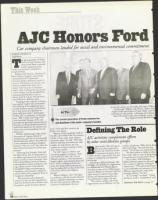
The current generation of Fords eschews the
anti-Semitism of the motor company's founder.
tions," Ford told the crowd at the
$250-a-seat dinner.
"Because of the wonderful work of
the AJC, the world of the 21st century
will be a closer, safer, more tolerant
and better place," he said. "This won-
derful award that you honor me with
tonight not only honors me, but
inspires me to keep working to make
that vision a reality."
The AJC began in 1906 to save
Jews from pogroms in Russia. Now,
said Frederick Frank, AJC Detroit
Chapter president, "we're focused on
human rights, international issues and
U.N. issues, working with the con-
sular core along with protecting not
just the rights of Jews, but those of all
minorities, ethnic and religious
groups.
Sharona Shapiro, AJC's Michigan
area director, said the award's selection
process includes submission of names
by the AJC board and collecting
resumes of individuals who are
At the AJC dinner are, from left, Jack Lapin, William
McDonough, William Clay Ford Jr., Robert Kraft,
Eugene Driker and Frederick Frank. Kraft, master of
ceremonies for the evening, is chairman of the Boston-
based The Kraft Group, whose holdings include the
New England Patriots football teanr
Defining The Role
AJC activities complement efforts
by other civil-liberties groups.
egun nearly 100 years ago to
save Jews from pogroms in
Russia, the American Jewish
Committee has grown into a
75,000-member organization that spe-
cializes in combating anti-Semitism
and racism.
According to Sharona Shapiro, AJC
Michigan area director, the organization
is a defense and civil liberties agency
that deals in areas such as lobbying gov-
ernment officials on education and civil
rights issues. It is distinct from other
Jewish civil liberties groups like the
Anti-Defamation League, she said.
"The culture and the style of the
organizations are so different. On the
B
surface, people say, 'Well, they're doing
the same thing,"' she said, but they
aren't. "We all have our constituencies.
"We don't market as visibly as others,"
she noted, and our ways of doing things
are not the same as some of the others."
Don Cohen, ADL/Michigan
Region director, agreed on the need
for a variety of agencies working in
related areas. The institutional histo-
ry, lay leadership and resources of the
different organizations make their
messages distinct," he said.
"Is it overlap?" he asked. "I think
the better word is 'complement' each
DEFINING THE ROLE on page 12
K