

the pure joy of killing.
As an SS officer in the novel points
•
out: "In China in 1850 or something
*
like that there was a little war and 25 •
million people died. How many of us
•
remember that? And this ... who will
•
•
remember it? I know I will — it's a
•
sadist's dream"
•
Macmillan's prose is spare, serving
•
as a frame for the focus of his novel — • •
the inner workings of the characters.
•
•
Readers are given an opportunity to
•
examine the psyches of perpetrators of •
•
unadulterated evil.
We meet, among others, Schneck, a • •
•
high ranking SS officer and former
medical student who discovers that his • •
real talent is for killing rather than
•
•
mending people; Anatoly Yovenko, a
•
Ukrainian guard who, though not over- •
•
whelmed with pity for his victims,
•
nonetheless becomes "empty and dead" •
for having been surrounded by so much •
•
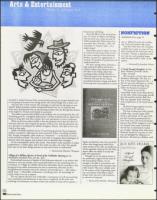
ilustration hy
il tschk,
mocked in school because of his controversial paternity, he accepts himself with-
in the group of eccentric but loving adults who acknowledge him as their own.
And just who is this woman who manages to captivate her devotees so corn-
pletely? Judith possesses neither exceptional beauty nor wit. It could be that
what most distinguishes her are the piercing screams that rip through her dreams
every night for 10 years until Zayde is conceived.
The reader surmises that Judith's soul-curdling cries are prompted by her still-
throbbing grief for a daughter abducted by a former husband and an infant born
dead not long after that first trauma. But such speculation is never confirmed.
What we do know about Judith is that she possesses more than her share of
charisma. She not only inspires the passion of three men and the adoration of a
son, she also is worshipped by Moshe's daughter, Naomi, who falls in love with
Judith at first sight.
Judith eventually performs an act of unstinting generosity that precipitates
Zayde's conception, reflecting the sweet mysteries of fate. According to Shalev,
fate, though inescapable, often sends out "emissaries" — in the form of crows,
cows and other animals. The catch is to be able to recognize these harbingers of
destiny when they appear, and to know how to decipher their messages.
As the contemplative Jacob tells Zayde, "Fate doesn't make surprises. It makes
preparations, it makes signs, and it also sends out spies, but only a few people
have eyes to see these things and ears to hear and a brain to understand."
— Reviewed by Marlena Thompson
Village of a Million Spirits: A Novel of the Treblinka Uprising by Ian
MacMillan (Steerforth Press; 257 pp.; $24)
Fictionalized accounts of aspects of the Holocaust abound, so an author who
chooses to write yet another must necessarily believe he has something new to
contribute. In Village of a Million Spirits Ian Macmillan doesn't introduce a new
perspective but rather accentuates one that is sometimes obscured. In this
straightforward narration about the ultimate of contradictions — life within a
death camp — Macmillan underscores a terrifying truth, the knowledge of
which many of us try to repress.
The war against the Jews was irrefutably a consequence of well-nurtured big-
otry, intolerance and fanaticism. It also was an outgrowth of the most soul-
numbing of inclinations to endure within the natures of many of our species —
6/25
1999
Detroit Jewish News
death; and Joachim Voss, the cynical SS
officer who brings booty stolen from
camp inmates to his wife, an intellectual
whose supposed contempt for the Nazis
doesn't affect her ability to accept the
gifts with equanimity.
Though we are not given access to
the nethermost regions of the souls of
the fictionalized villains, we see
enough to be able to reconstruct con-
vincing facsimiles of the monsters that
really existed. The story unfolds with-
in the context of the impending upris-
ing, and despite Macmillan's dispas-
sionate style, the story still maintains
an element of suspense.
— Reviewed by Marlena Thompson
•
•
•
•
•
•
•
•
•
•
•
•
•
•
•
•
•
•
•
•
•
•
•
•
•
•
•
•
•
•
•
•
•
•
•
•
•
•
•
•
•
•
•
•
•
•
•
•
•
•
•
•
•
•
•
•
•
•
•
NONFICTION
CONTINUED
from page 74
not, as Jablonski writes, for combin-
ing "rock and southern folk music."
And the 1962 show Mr. President
couldn't have come at a time of "stu-
dent protests of the American role in
Vietnam." Neither a significant mili-
tary role nor such protests began
until the latter half of 1964, at the
earliest.
— Reviewed by Jonathan Groner
A Good Enough Daughter by Alix
Kates Shulman (Schocken Books;
272pp.; $23.00)
She was given a boy's name and a
firstborn's birthright. The first is a
fact of Alix Kates Shulman's life — a
fact she says she celebrates as a lucky
"bestowal of male privilege long
before the feminist movement."
The second is one of the
immutable truths of the Kates family.
As the older child, chronology should
have favored her brother Bob. But
Bob was adopted, both a blessing
,–/
and complication in the Kates house-
hold.
Shulman brings together two dis-
tinct stories in her memoir.
The first is about her solid, Jewish,
middle-class, mostly happy child-
hood in Cleveland. At the age of 20,
she left Cleveland permanently for
New York City. Like Saul Steinberg's
famous New Yorker magazine cover of
the United States map, Cleveland
and all that it represented receded
out of sight. During those early years,
Shulman found her vocation in writ-
ing, and pledged her allegiance to
feminism. She had two children, and
ALIX (A TES SH IM AN
Mcm oi rs of v i Ex- P(g ;T:. Ozi n.f?
„of
c itrie feyz
....:Arelje
c
r
c.7