

Arts Entertainment
Books To Get Away With
Pink Slip by Rita Ciresi (Delacorte
Press; 353 pp. ; $22.95)
Messiah by Andrei Codrescu (Simon c Schuster; 366 pp.; $25.00)
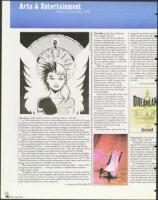
As 1999 winds down to the turn of the millennium, we meet Felicity Le Jeune,
an aimless twentysomething with a private investigator's license and a lot of body
piercing who has spent every day of her life in New Orleans. Meanwhile, halfway
around the world, Andrea, a teenaged Sarajevan refugee, stumbles into a Jerusalem
convent and captivates the visitors there with her beauty and spiritual aura.
Felicity is compulsively honest; Andrea lies as naturally as breathing. Felicity's
life is all too orderly; Andrea creates chaos wherever she goes. Is one of these two
women — or both together — the Messiah? Or, how about Vanna White?
Andrei Codrescu, best known for his NPR essays and the documentary Road
Scholar (he's also published some 20 books during the past quarter-century), has
written a satisfying, layered novel, a smorgasbord of the sacred and profane.
It's rollicking good fun — with enough skin, sex, bright colors and descrip-
tions of food for entertainment on the sensory level --- but with sufficient discus-
sion of comparative religion and world's end to provide food for thought.
Some of Codrescu's targets are obvious — the villain is a television evangelist
— but most of the time his vision is not only imaginative but also wholly origi-
nal. In the world Codrescu envisions a mere few months from now, the TV show
Wheel of Fortune has a wildly popular counterpart in every nation, and every lan-
guage, and is presented as a metaphor for- humankind's fate.
Meanwhile, heaven has become a democracy, with the angels — who are also
the great minds of history — voting on whether to inhabit human bodies or
remain points of light.
Throughout the novel, damp, fetid, chaotic New Orleans is spread out before
the reader as America's most repellent and seductive city, a sweaty old hooker of a
town that still has warmth in its embrace. It presents the apocalypse and it pre-
sents hope springing eternal, and so does Andrei Codrescu's story, leaving us per-
haps a little wiser but not without optimism.
• •
•
•
•
•
•
•
•
•
•
•
•
•
•
•
•
•
•
•
•
•
•
•
•
•
•
•
•
•
•
•
•
• •
•
•
•
• •
— Reviewed by Ellen Jaffe-Gill •
6/25
1999
78 Detroit Jewish News
It is 1985, and 25-year-old Lisa
Diodetto, after paying her dues in a
low-level publishing job and a rat-
infested apartment, has landed a rela-
tively cushy job editing press releases
and brochures for a giant pharmaceu-
tical company. Now she's working and
living in the 'burbs, making decent
money and looking for Mr. Right.
Her boss, Eben Strauss, nice-looking
but very tightly wrapped, couldn't be
"the guy' — could he?
Pink Slip takes us through the ups
and downs of the romance between
Lisa and Strauss, a classic mismatch,
if ever there was one. Lisa is the
feisty product of New Haven's Italian
ghetto, her working-class instincts
tempered by a Sarah Lawrence edu-
cation and the influence of her
sophisticated gay cousin, Dodie.
Strauss is the son of a Treblinka sur-
vivor, sweet in his way, but fearful
and controlling.
Ciresi's first novel, Blue Italian, also
was about a young Italian woman
who falls in love with and marries a
Jewish man. Pink. Slip is a much bet-
ter book, if only because it takes an
interest in characters other than the
protagonist.
I wasn't convinced by the central
relationship of the story; no matter
how much Lisa wants to settle down,
Strauss is much too stodgy to keep her
interested for the long haul. But the
friendship between Lisa and her cousin,
who is her real soul mate, rings
absolutely true.
Ciresi also does a great job of cap-
turing the particular kind of to
AIDS created in the mid-'8
there were no therapies and we
know enough about the disease
confident in any sort of intima
tact, even the non-sexual kind.
Ciresi evades the issue of in i
child rearing in Blue Italian an
Slip, and it could have been an
in each novel, since both prota
feel an ongoing attachment toe
Catholicism and seek some
of solace from the Church.
But Pink Slip isn't a novel
tackle thorny societal problem
beach book, pure and simple -
Rainer Dart, author of Beaches
been Italian, she would have v ■
it
designed for readers whe
to laugh a little, cry a little
the end.
—
an
— Reviewed by Ellen
Dreamland by Kevin Baker
Collins; 519pp.; $2600) -
Immigrants arriving in tur
century New York scanned th
harbor anticipating the ful
their hopes and dreams. Not
them would have imagined t
fantastic lights emanating fro
shore's Coney Island carnival
the garish, cutthroat new wor
they were about to enter.
In Dreamland, Kevin Bakei
novel, our guide into the lou
impoverished streets of the c
and Coney Island is Trick the
an entertainer with the carni
sometimes dresses as a young
mask the deformity that bran
unacceptable in the outside w
Here in the midst of the (real;