

The Ten Lost Tribes
The Tribes
REtTVEN
LEAH
SnwmoN
Iksiimuut
JUDAH
ZEVITLUN
Brumu
ZIT PAH
RACHEL
I
I
I
1
I
1
i
1
NAPHTALI
ASHER
DAN
JOSEPH BENJAMIN Gan
I
I
BIENASHE
EPHRAIM
g rET-
54,23T@
GAIL ZIMMERMAN
Arts es Entertainment Editor
Among. Semitic peoples, tribes were
definite social units, consisting of
clans, which in turn were made up
of families, held together by kin-
ship or blood brotherhood and
loyal to a patriarch. In ancient
times, conventional and organiza-
tional patterns built around groups
of 12 tribes are found from Asia
Minor to Greece to Italy.
In the development of Israel,
tribes played both a historical and
psychological role. The nation of
Israel is thought to have consisted of
12 tribes, originally corresponding
to the 12 sons of Jacob (Israel):
Reuven, Simeon, Levi, Judah,
Issachar, Zevulun, Joseph,
Benjamin, Dan, Naphtali, Gad and
Asher.
According to the Bible, Jacob and
his family went into Egypt number-
ing 70 and grew to a nation of more
than half a million by the time of
the Exodus. Moses conferred the
priestly office on the tribe of Levi,
and to maintain the number of
tribes due to receive territory in the
Promised Land at 12, divided the
tribe of Joseph into Ephraim and
Menashe (Joseph's sons).
The classification of the sons of
Jacob by his wives Leah and Rachel
and handmaidens Zilpah and Bilhah
divides the tribes into the following
groups:
*Leah Tribes: Reuven, Simeon,
Levi, Judah, Issachar, Zevulun
*Rachel Tribes: Joseph (Ephraim
and Menashe), Benjamin
*Zilpah Tribes: Gad, Asher
*Bilhah Tribes: Dan, Naphtali.
Under Joshua, say some scholars,
the united force of 12 tribes was
powerful enough to conquer the land
of Canaan, and the territory was
divided among them. Other scholars
assert that Canaan was not conquered
by an alliance at any one time but
through individual incursions into
6/18
1999
82 Detroit Jewish News
g
the land at widely separated periods.
In fact, some modern scholarship
does not accept the biblical notion
that the 12 tribes are divisions of a
larger unit descended from Jacob at
all. Rather, some assert, the 12 tribes
grew from an independent organiza-
tion of independent tribes or groups of
tribes forced together for historical rea-
sons.
Taking their names from ancient
sites in Canaan, six original tribes
(the Leah tribes) may have existed
as a confederation at an earlier date
and been joined only later by tribes
that penetrated the area the first
group occupied. (The attribution
of four tribes to handmaidens
Bilhah and Zilpah may indicate a
lower status or late entry into the
confederation.)
At the beginning the tribes shared
a religious confederation, based
upon the belief in the one "God of
Israel" with whom the tribes had
made a covenant and whom they
worshiped at a common sacral cen-
ter as the "people of the Lord."
Each tribe enjoyed a great deal of
autonomy. There were central
shrines and meetings of tribal elders
and leaders during the period of set-
tlement and under the judges. It is
possible that various shrines served
different tribes simultaneously,
while the sanctuary, which held the
ark, was revered as central to all.
There are indications of intertribal
quarrels and disputes, and there is not
one war detailed during the period of
the judges in which all tribes acted in
concert against external enemies.
It was only toward the end of the
period of the judges when the
Philistine pressure on the Israelite
tribes increased in the west and the
aggression of the Transjordanian
peoples mounted in the east, that
the religious-national tribal confed-
eration assumed political and mili-
tary dimensions.
TWELVE TRIBES
on opposite page
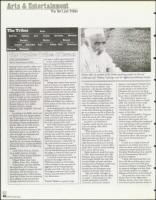
Pathan elder (a member of the Pashto-speaking people) in front of
2,300-year-old "Hebrew" carvings near the Afghanistan/Pakistan border.
"I feel that I've achieved more or
less what I tried to achieve," says
Jacobovici, who became Orthodox
after his trek. "Whenever I make a
movie, I try to take people on the
journey that I've been on. If I go
somewhere intellectually, psychologi-
cally, emotionally and physically, I
want the audience to experience that
while they're watching the movie.
"Most people who watch my movie
on the tribes of Israel are not going to
get on an airplane and fly to [those dis-
tant places]. I want them to feel at the
end of the movie, after 100 minutes,
what it took me four years to feel."
Jacobovici, an Israeli-born
Canadian, eased into his quest as a
result of making a film about
Ethiopian Jews.
"What attracted me to that issue
was that I didn't want to sit passively
by as Jews were being murdered,
raped and sold into slavery," says the
filmmaker about his first project. "I
really became involved as an activist
for the Jewish people. I wasn't a film-
maker then; I was an activist looking
for a way to tell my story.
Before Jacobovici made his movie,
in 1981, there were fewer than 200
Ethiopian Jews in Israel. The airlifts
later brought 60,000, but only after
the chief rabbis of Israel ruled that
the black Jews of Ethiopia could enter
as children of Israel. The rabbis
decreed that the Ethiopians were
members of the lost tribe of Dan.
"After the airlifts, I thought to
myself, 'Is it possible that the rabbis
are right?'" recalls Jacobovici, who
studied philosophy at McGill
University and earned a master's'
degree in international relations from
the University of Toronto. "Are we
actually seeing in the airlift of the
Ethiopian Jews not just a far-flung
Jewish community coming back home
but, in fact, a veritable lost tribe?"
The filmmaker's interest was
fueled by an article about an Israeli
rabbi who claimed to have made
contact with the lost tribe of
Menashe. A visit with the rabbi con-
vinced Jacobovici that there was sub-
stance to the claim.
The people in question, living on
the Burmese-Indian border, call
themselves Menmasseh and have
ancient songs recalling the crossing of
a sea with parting water and follow-
ing a pillar of fire at night and a
cloud by day, similar to the biblical
account of the Exodus from Egypt.
The Menmasseh converted to
Christianity about 100 years ago, but
now, several thousand practice
Judaism.
"It took me a couple of years of
research to see if there were more
tribes out there, and I wrote it out in
a proposal and got backing from the
Canadian Broadcasting Corp. and the
Arts & Entertainment Network,"
Jacobovici explains.
"I think what motivated them was
that it felt like an Indiana Jones story,
an attempt to solve one of the great
mysteries of Western civilization. With
my personal mishegas and their fund-
ing, I found myself on an airplane
looking to find the lost tribes of Israel."
The production crew went to the
Khyber Pass on the Afghanistan-
Pakistan border, where they claim to -
have found speech patterns similar to